

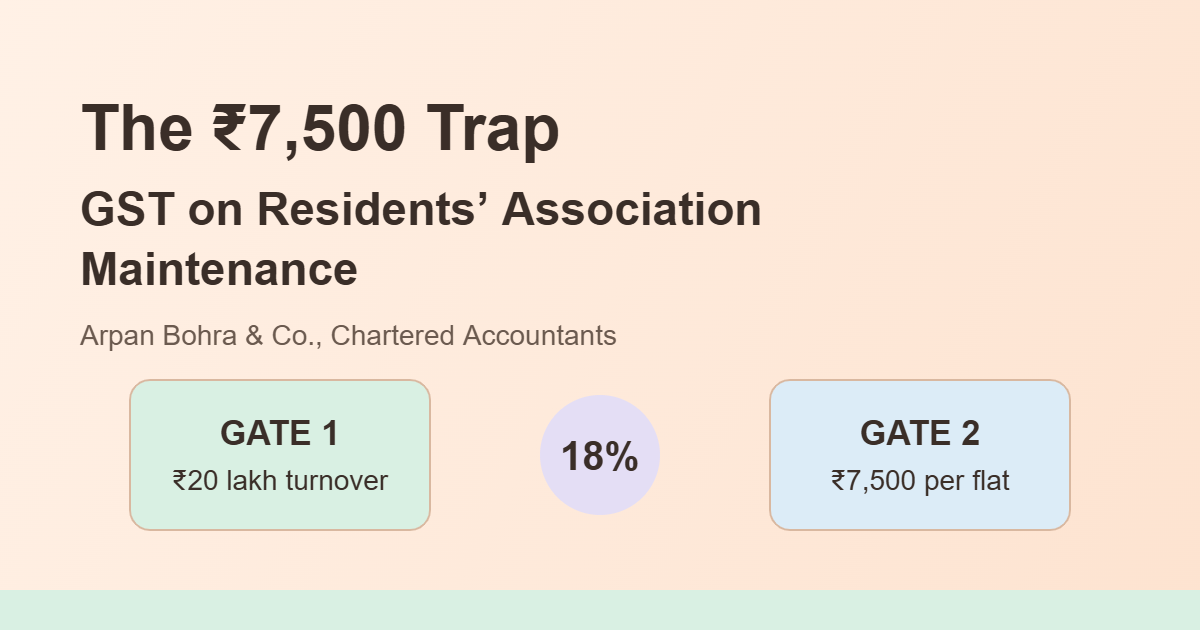
Arpan Bohra & Co., Chartered Accountants · Author: Priya N · Law as on 24 November 2026
Promise: after this guide you can tell, in 30 seconds, whether a society’s maintenance bill carries GST, and explain why.
The story: Mr. Iyer’s ₹9,000 bill
Panel 1. Sunrise Residency has 100 flats. Secretary Mr. Iyer proudly announces: “Our maintenance is ₹9,000 a month. Anything above ₹7,500 is taxed only on the extra ₹1,500. That’s what a friend told me.”
Panel 2. Young accountant Kavya frowns at the register. “Sir, the Board circular says something different.”
Panel 3. A GST officer, Mr. Rao, visits for a routine check. Polite, fair. “Your yearly collection is ₹1.08 crore. Where is the registration?”
Panel 4. Mr. Iyer goes pale. “But we are a non-profit society!”
Panel 5. CA Sir arrives with a notebook. “Two gates, Mr. Iyer. Gate one: yearly turnover above ₹20 lakh. Gate two: any flat paying above ₹7,500 a month. Both open, GST applies.”
Panel 6. “And on how much?” asks Kavya. CA Sir: “The Board says on the whole bill. A High Court said only on the excess, but that view is not settled. Collect on the whole bill, or follow a documented advice.”
Panel 7. Society registers, collects 18%, and claims credit on generator repairs and security services.
Moral: Count the flats, count the rupees, and never trust “a friend told me”.
Simple words: the story is simplified; the law is exact in the sections below.
In one minute
- GST on a society’s maintenance bill depends on two gates, both must be crossed.
- Gate 1: the society’s yearly turnover is more than ₹20 lakh.
- Gate 2: a member pays more than ₹7,500 a month (tested per flat, not per person).
- If both gates are crossed, the rate is 18%. CBIC says on the whole bill.
- Registered societies can claim input tax credit on repairs, goods and services.
Memory tip: “20 · 75 · 18”
Say it like a phone number: 20 lakh, 7500, 18 per cent. Add two slogans:
- “Two gates, one rate.” Both gates open before 18% applies.
- “Per flat, not per person.” A man with two flats is tested twice.
What is the rule, in plain words?
A Residents’ Welfare Association (RWA) collects money from flat owners to buy common services: security, lifts, housekeeping, diesel for the generator, repairs. GST law treats this in a special way. The service the RWA gives its own members, by passing on the cost of third-party goods and services for common use, is exempt up to ₹7,500 per member per month. Above that limit, and above a yearly turnover of ₹20 lakh, GST at 18% applies.
The law in a box
| Provision | In simple words | Why it matters |
|---|---|---|
| Notification 12/2017-Central Tax (Rate), dated 28.06.2017, Entry 77(c) | Services by an unincorporated body or a registered non-profit entity to its own members, by way of reimbursement of charges or share of contribution, for goods or services bought from a third party for common use, are exempt up to ₹7,500 per member per month | This is the exemption itself |
| Notification 2/2018-Central Tax (Rate), dated 25.01.2018 | Raised the limit from ₹5,000 to ₹7,500 per month per member, from 25.01.2018 | Old bills before this date use ₹5,000 |
| Section 22 CGST Act | Registration is needed when turnover crosses the threshold (₹20 lakh is the figure used in the Circular) | Gate 1 |
| Section 23(1) CGST Act | A person making only exempt supplies need not register | Why small or low-bill societies stay out |
| Circular 109/28/2019-GST, dated 22.07.2019 | Official clarification: five issues answered, including whole-bill taxability, per-flat testing and ITC | The department’s working rule |
| Section 7(1)(aa) CGST Act | Deems transactions between an association and its members to be a supply (effective 01.01.2022, retrospective from 01.07.2017) | Read with the Kerala High Court ruling in the case section |
Simple words: Entry 77(c) gives the relief. Circular 109 explains how the department applies it.
Who is affected?
| Person | Affected? | Why |
|---|---|---|
| RWA or society, turnover ₹20 lakh or less | No GST, no registration for the maintenance | Gate 1 stays shut |
| RWA, turnover above ₹20 lakh, every flat at ₹7,500 or less | No GST on these bills | Gate 2 stays shut; registration is not needed if only exempt supplies are made |
| RWA, turnover above ₹20 lakh, some flats above ₹7,500 | Yes, GST at 18% on those flats | Both gates are open |
| Flat owner with two flats | Tested flat by flat | Circular 109: the limit applies to each apartment |
| Non-members using the clubhouse or hall | Likely taxable | The exemption covers members only (Position to be checked case by case) |
| Developer-run or commercial maintenance agency | Taxable | Entry 77(c) is for a society and its members, not for a third-party agency |
Warning: the exemption is for reimbursement of third-party costs for common use. Charges that are not for common use, or services given to outsiders, are not safe under this entry.
The limits, gate by gate
| Yearly turnover of RWA | Monthly charge per flat | GST on maintenance? |
|---|---|---|
| Above ₹20 lakh | Above ₹7,500 | Yes (18%) |
| Above ₹20 lakh | ₹7,500 or less | No |
| ₹20 lakh or less | Above ₹7,500 | No |
| ₹20 lakh or less | ₹7,500 or less | No |
This table follows Circular 109/28/2019-GST. Only the first row attracts GST.
Warning: “Up to ₹7,500” means ₹7,500 itself is exempt. ₹7,501 opens Gate 2.
What goes into the ₹7,500 count?
The Circular answers the main question: the ceiling applies per apartment. If one person owns two flats and pays ₹5,000 for each, both are exempt, even though the person pays ₹10,000 in total.
For individual charges, the GST Council’s flyer on housing societies (an older educational note, not a notification) gives this working view:
| Charge | Position in the flyer | Counts toward ₹7,500? |
|---|---|---|
| Property tax and water tax collected for the municipal body | Not leviable to GST | Excluded |
| Electricity charges collected under other laws | Not leviable to GST | Excluded |
| Sinking fund, repairs fund | Taxable | Flyer is silent |
| Car parking charges | Taxable | Flyer is silent |
| Non-occupancy charges | Taxable | Flyer is silent |
| Penal interest on late payment | Taxable | Flyer is silent |
| Rent of common hall, transfer fee | Not covered | Not covered |
Position not certain / requires verification: whether sinking fund, parking and similar charges count toward the ₹7,500 ceiling is not settled in the sources checked. Take a written view for each society before billing.
On which amount is GST charged?
- CBIC view (Circular 109): if the charge is above ₹7,500, GST is on the entire amount. Example in the Circular: for ₹9,000, GST at 18% is on ₹9,000, not on ₹1,500.
- Madras High Court view (Greenwood Owners Association, 01.07.2021): the words “up to” in the entry mean only the amount above ₹7,500 is taxable. The Court quashed the Circular on this point.
Matter is litigative / unsettled. See the case section for the risk view.
Input tax credit (ITC)
- Circular 109 says RWAs can take ITC on GST paid on capital goods (such as generators and water pumps), goods (such as taps and pipes) and input services (such as repair and maintenance), and use it to pay GST on maintenance charges above the limit.
- An RWA that makes only exempt supplies cannot use ITC, because credit follows taxable supplies (section 17(2) CGST Act).
- Practice tip: keep vendor invoices in the RWA’s GSTIN. Credit is lost if the invoice is in the secretary’s or the builder’s name.
Filing, in one line
A registered RWA files outward-supply and tax returns (GSTR-1 and GSTR-3B) and issues GST invoices on maintenance bills. Due dates change by notification and by monthly or quarterly option; check the GST portal calendar for the year.
Worked examples (illustrative figures)
All examples assume a society that bills only for common-use third-party services. Numbers are invented to show the method; they are not real client data.
Example 1: Both gates closed (easy)
Facts: 40 flats, ₹3,000 a month each. Yearly collection: 40 × 3,000 × 12 = ₹14,40,000. Law applied: Turnover is ₹20 lakh or less; each flat is below ₹7,500. Answer: No GST. No registration needed. Lesson: Small society, small bill: nothing to do.
Example 2: Big society, small bills (medium)
Facts: 120 flats, ₹6,000 a month each. Yearly collection: 120 × 6,000 × 12 = ₹86,40,000. Law applied: Gate 1 is open (above ₹20 lakh) but Gate 2 is shut (₹6,000 is below ₹7,500). Answer: No GST on the maintenance bills. Registration is not needed if the society makes only exempt supplies (section 23(1)). Lesson: A large turnover alone does not create GST.
Example 3: Premium society (medium)
Facts: 100 flats, ₹9,000 a month each. Yearly collection: 100 × 9,000 × 12 = ₹1.08 crore. Law applied: Both gates are open.
| View | Taxable value per flat | GST at 18% | Bill per flat |
|---|---|---|---|
| CBIC Circular 109 (whole bill) | ₹9,000 | ₹1,620 | ₹10,620 |
| Madras High Court, Greenwood (excess only) | ₹1,500 | ₹270 | ₹9,270 |
Answer: The department will expect the first treatment. The second is a litigation position, binding in the Madras High Court’s territory at most, and reported as stayed on appeal (see case section). Lesson: The word “whole” costs ₹1,350 per flat per month here. Decide it with a written view.
Example 4: Small society, high bills (tricky)
Facts: 15 flats, ₹9,000 a month each. Yearly collection: 15 × 9,000 × 12 = ₹16,20,000. Law applied: Gate 2 is open but Gate 1 is shut (turnover is ₹20 lakh or less). Answer: No registration and no GST, as per Circular 109. Lesson: High bills alone do not trigger GST. If more flats join and turnover crosses ₹20 lakh, the position flips.
Example 5: One owner, two flats (tricky)
Facts: Mr. Shah owns two flats, each billed ₹5,000 a month. Total paid: ₹10,000. Law applied: The limit applies separately to each apartment. Answer: Each flat is within ₹7,500, so both are exempt. Lesson: Never add up flats.
Example 6: ITC offsets the tax (practice)
Facts: The society in Example 3 collects GST of 100 × ₹1,620 = ₹1,62,000 a month. It pays ₹40,000 of GST a month on security services, lift maintenance and generator repairs, with valid invoices in its own GSTIN. Law applied: ITC is available to an RWA charging GST (Circular 109), subject to the usual conditions of the Act. Answer: Net GST payable in cash for the month: ₹1,62,000 − ₹40,000 = ₹1,22,000. Lesson: The residents bear 18% on their bill, but the society’s own input GST reduces what it pays the government.
Circulars, notifications and cases
| Document | Date | What to remember |
|---|---|---|
| Notification 12/2017-Central Tax (Rate), Entry 77(c) | 28.06.2017 | The exemption: up to ₹7,500 per member per month |
| Notification 2/2018-Central Tax (Rate) | 25.01.2018 | Limit raised from ₹5,000 to ₹7,500 |
| Circular 109/28/2019-GST | 22.07.2019 | Registration only if turnover is above ₹20 lakh; whole bill taxable if above ₹7,500; limit per apartment; ITC allowed |
| Greenwood Owners Association v. Union of India (Madras High Court, W.P. Nos. 5518 and 1555 of 2020 and others) | 01.07.2021 | Only the amount above ₹7,500 is taxable; Circular and the Tamil Nadu AAR ruling quashed |
| Indian Medical Association v. Union of India (Kerala High Court, Division Bench) | 11.04.2025 | Sections 7(1)(aa) and 2(17)(e) struck down as unconstitutional |
| Union of India v. Indian Medical Association, SLP(C) 18349-18350/2025 (Supreme Court) | notice issued 25.07.2025 | No recovery steps against IMA until further orders |
What each document means for an RWA
Circular 109 is the department’s operating rule. An officer will test every society against it.
Greenwood says the circular reads more into Entry 77(c) than the words allow, because “up to” a limit is a ceiling for the exemption, not a cliff. The court relied on the rule that an exemption is read strictly but within its words. A report on the case notes that the Division Bench stayed the single judge’s order on the department’s appeal. The final outcome of that appeal is not verified here: requires verification before you rely on Greenwood. Also, a High Court judgment binds as a precedent only within its own territory.
Kerala High Court (IMA) concerns the mutuality principle, that an association cannot supply to itself, and held the deeming provision in section 7(1)(aa) unconstitutional. The Union has challenged it in the Supreme Court. The RWA entry sits inside this larger debate. Matter is litigative / unsettled.
Department’s view vs taxpayer’s view
| Issue | Department | Taxpayer | Risk |
|---|---|---|---|
| GST on whole bill or excess over ₹7,500 | Whole bill (Circular 109) | Excess only (Greenwood) | High for whole-bill non-collection outside Madras territory |
| Registration when only high-bill flats exist but turnover is ₹20 lakh or less | Not required (Circular 109) | Same | Low |
| Two flats of one owner | Each flat tested separately | Same | Low |
| Parking, sinking fund, penal interest within ₹7,500 count | Often taxed separately; not settled | Treated as part of contribution | Moderate |
| Mutuality (section 7(1)(aa)) | Supply between association and members | Not a supply (Kerala HC) | Moderate while the Supreme Court appeal is pending |
Primary position and recommendation
- Primary position (recommended): follow Circular 109. Register once both gates are crossed, charge 18% on the whole bill, and claim ITC.
- Alternative position: charge GST only on the excess over ₹7,500, relying on Greenwood. Use it only with a written legal opinion, a reserved liability and a society resolution.
- Risk level: Low for the primary position; High for the alternative outside Madras High Court territory.
- Practical recommendation: do not leave members guessing. Send one notice explaining the method used, and keep a copy of the resolution.
Common mistakes and how notices arise
| Mistake | Consequence | Fix |
|---|---|---|
| Adding all flats of one owner together | Wrong test; tax charged or missed | Test each flat alone |
| Looking only at the ₹7,500 and ignoring the ₹20 lakh gate | Unneeded GST charged, or registration missed | Check both gates every year |
| Charging GST on the excess only, with no written view | Short collection; interest and penalty exposure if the department’s view holds | Follow Circular 109, or hold a documented opinion |
| Treating a non-profit status as a GST exemption | Registration and tax missed | The exemption is under Entry 77(c), with limits |
| Vendor invoices in the secretary’s name | ITC lost | Use the society’s GSTIN on every invoice |
| Taking ITC when only exempt bills are raised | Credit reversal | Credit follows taxable supplies only |
| Billing non-members (clubhouse, hall, hoarding) as if members | Unbilled GST | Treat outsiders as separate taxable customers |
| Mixing rent from a telecom tower or a hall with maintenance | Turnover crosses ₹20 lakh without notice | Track every income head for Gate 1 |
| Not telling members which method is used | Disputes and AGM fights | Send a one-page explanation |
Warning: the first notice usually comes from a turnover mismatch. Bank credits and bills do not agree. Keep one monthly reconciliation of bills raised, amounts received and GST charged.
Myth vs fact
| Myth | Fact |
|---|---|
| Non-profit societies never pay GST | Entry 77(c) gives a limited exemption, not a blanket one |
| ₹7,500 is the total for the whole building | It is per member, applied per flat |
| GST applies on only the amount above ₹7,500 | CBIC says the whole bill; a High Court said the excess. Unsettled |
| Turnover above ₹20 lakh means GST on every bill | Both gates must be crossed |
| A registered society cannot claim input tax credit | It can, on goods, capital goods and input services (Circular 109) |
| Property tax collected by the society is taxed again | The flyer treats municipal property and water tax as not leviable |
| The 2019 circular is still the final word | A High Court quashed it in 2021 for one point; the appeal outcome must be checked |
How to remember: five memory tools
- The phone number: 20 · 75 · 18. ₹20 lakh, ₹7,500, 18%.
- Two gates, one rate. Both gates open, then 18%.
- Per flat, not per person. Count flats, never owners.
- “Whole or excess?” = “CBIC whole, Madras excess”. Rhyme: Board says whole, Madras says part.
- ITC is the cushion. Output tax minus input tax, never the full 18% in cash.
Use the mind map and the two-gate flow below to fix these in memory. Draw them on a whiteboard in the office: repetition is the memory.
The map has five branches: the law, the two gates, the rate with credit, and the one open question.
Read the flow left to right for every flat bill; only the top path ends in GST.
If a notice comes
- Day 1: note the section, period and date of the notice. Diarise the reply date.
- Day 1 to 3: collect the year’s bills, member list with flat-wise charges, bank statements and ledgers.
- Day 3 to 5: reconcile turnover under each income head to the returns filed (if any).
- Day 5 to 7: prepare the reply on the two gates, the Circular and any documented view. Ask for a personal hearing.
- If an order is passed: appeal to the first appellate authority under section 107 CGST Act, generally within three months of the order, with a possible one-month extension. A further appeal lies to the GST Appellate Tribunal (GSTAT) under section 112. Check the order for exact limits and pre-deposit.
Practice tip: attach the society’s general-body resolution fixing the billing method. It shows good faith and a considered position.
Checklist for the owner (society committee)
- ☐ Yearly turnover of the society calculated, including hall rent and other income
- ☐ Flat-wise monthly charge listed
- ☐ Both gates tested for the year
- ☐ Billing method (whole bill or excess) decided and minuted
- ☐ Registration taken if both gates are crossed
- ☐ GST shown on invoices; credit claimed on society-GSTIN invoices
- ☐ Members informed in writing
Checklist for the team
- ☐ Per-flat test done, not per-owner
- ☐ Non-member income billed separately
- ☐ Monthly reconciliation: bills, receipts, GST charged, returns filed
- ☐ Vendor invoices checked for GSTIN and tax split
- ☐ Position not certain items (sinking fund, parking) have a written view
- ☐ Greenwood status rechecked before relying on it
Quick Q&A
- Is a society’s maintenance always exempt from GST? No. It is exempt up to ₹7,500 per member per month, or if turnover is ₹20 lakh or less.
- What if one flat is above ₹7,500 and others below? Only the above-limit flat is outside the exemption, if the society’s turnover is above ₹20 lakh.
- Does ₹7,500 include GST? Position not certain / requires verification: the sources checked do not state this. Take a written view.
- A man owns three flats at ₹5,000 each. GST? No. Each flat is tested alone.
- Do we need registration if turnover is ₹18 lakh but bills are ₹8,000? Not under Circular 109. Watch turnover through the year.
- Can the society claim ITC? Yes if it charges GST (Circular 109). Not for exempt bills.
- Is GST on the whole bill or only the excess? CBIC says whole. Madras HC said excess, with the appeal status to be verified.
- Is property tax collected through the society taxed? The Council flyer treats municipal property and water tax as not leviable.
- Are non-members covered by the exemption? No. Entry 77(c) is for members.
- What if we charged GST wrongly? Correct through credit notes or refund as the law permits; take advice on the period and limitation.
Team quiz
- What are the two gates? Turnover above ₹20 lakh; a flat above ₹7,500 a month.
- Is ₹7,500 exactly exempt? Yes. “Up to” includes it.
- Which circular matters most? 109/28/2019-GST.
- Is the limit per person or per flat? Per flat.
- Rate of GST when applicable? 18%.
- Who said “excess only”? Madras High Court in Greenwood, 2021; appeal status to verify.
- Can a registered RWA take ITC? Yes, on eligible goods, capital goods and input services.
- Which provision exempts the society’s services? Entry 77(c) of Notification 12/2017-CT(Rate).
Glossary
- RWA: Residents’ Welfare Association, a society or association of flat owners.
- Aggregate turnover: total value of the supplies of the registered person for the year.
- ITC: input tax credit, GST paid on purchases that is set off against GST payable.
- Mutuality: the idea that a body cannot supply to its own members for tax.
- AAR: Authority for Advance Ruling.
Closing
Recommendation: run the two-gate test every April and every time a new income stream is added. Document the billing method. Keep the Greenwood point under watch.
This note is general information, not advice for a specific case.
Arpan Bohra & Co., Chartered Accountants · www.arpanbohra.co.in · gst@arpanbohra.co.in · appeals@arpanbohra.co.in · office@arpanbohra.co.in · 9010558981
Sources
This article is for general information and is not professional advice. Law and rates change; please consult us before you act.