

Arpan Bohra & Co., Chartered Accountants · Law as on 28 November 2026
Imran (an illustrative paper dealer in Hyderabad) buys “bond paper” from one mill and “maplitho” from another. Both invoices show HSN 4802. A customer then asks him for glossy art paper, and his accountant types 4802 again because “it is all paper”. A year later, a GST officer asks why a coated paper was classified like an uncoated one. This guide shows how to classify paper HSN code properly, so that your invoices, returns and tax rate stand on firm ground.
Classify paper HSN code: why it matters
- Rate. The rate notifications list goods by heading and description. A wrong heading can mean a wrong rate.
- Invoices and returns. Your invoices and your HSN summary in GSTR-1 must carry the code.
- Credit and audit. Mismatched codes between your purchase and sale documents raise questions in an audit.
- Special entries. The entry for paper used for notebooks sits under 4802 only. Our guide on GST on paper for notebooks shows how classification and use work together.
In plain English: what is an HSN code?
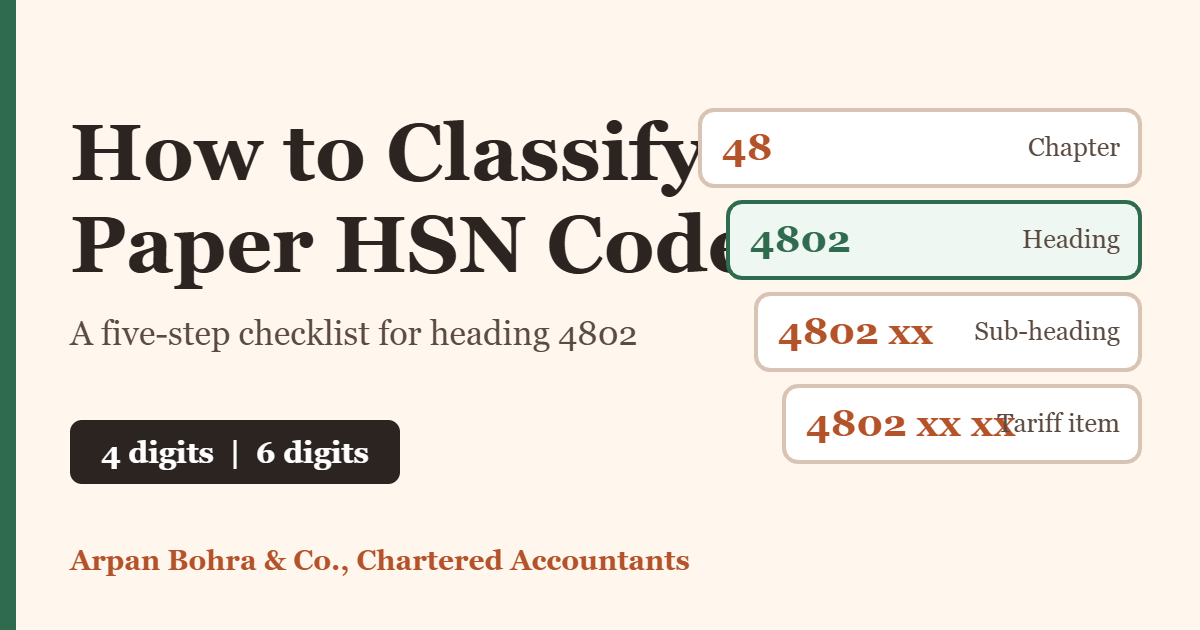
HSN stands for Harmonised System of Nomenclature, a worldwide numbering system for goods. Think of it as a postal address for a product. The first two digits are the chapter, the next two the heading, and further digits narrow it down. The rate is a separate question: first find the address, then check the delivery rule attached to it.
Five steps to a defensible code
Step 1: know the paper. Write down whether it is coated or uncoated, supplied in rolls or sheets, its GSM, the type of pulp used and what it is made for. Step 2: find the heading. Read the heading text and the section and chapter notes of Chapter 48 before looking at any HSN list on the internet. In the tariff, “paper” includes paperboard. Step 3: narrow it down. Inside heading 4802 the tariff splits paper by how much of the fibre comes from mechanical or chemi-mechanical pulp, by weight and by form. Step 4: cross-check. The mill’s invoice, test certificate and specification sheet should support the code. Step 5: write it down. Keep one page per paper type with the code, the reasons and the supporting papers.
Reading the code from left to right
Same family, different headings
“Paper” covers many headings. Use the graphic as a pointer and always read the exact heading wording.
Worked examples (illustrative)
Simple example 1: copier paper. 75 GSM white A4 sheets made from chemical pulp, uncoated, meant for printing and writing. This fits the words of heading 4802 (uncoated paper for writing, printing or other graphic purposes, in rolls or sheets). The exact 6 or 8 digit code is read from the tariff using fibre content, weight and form. The rate is 18% unless the paper is used for notebooks.
Simple example 2: art paper. Glossy paper coated on both sides with kaolin. It is not “uncoated”, so it does not belong in heading 4802. It is read under the heading for coated paper. Typing 4802 here would be wrong even though the paper looks similar to a customer.
Simple example 3: use does not change the heading. Uncoated reels sold to a notebook factory stay in heading 4802. What changes is the rate entry: nil for paper used for notebooks, 18% for other uses. A finished ruled notebook, however, is no longer paper. It sits in heading 4820 and has its own entry.
How many digits on the invoice?
Under Notification 78/2020-Central Tax (amending Notification 12/2017-CT), a taxpayer with aggregate turnover up to ₹5 crore in the preceding financial year must show at least 4 digits of HSN on B2B invoices, and a taxpayer above ₹5 crore must show at least 6 digits. These are minimum digits. Showing more is fine if you are sure of them.
When the mill’s code differs from yours
Two mills may show different codes for the same paper. Do not copy blindly in either direction. Compare the specification sheet with the heading and sub-heading text, decide, and keep a note of why. Where genuine doubt remains, you can get a written specification from the mill, take a professional opinion, or apply for an advance ruling on classification. An advance ruling binds only the applicant and the officer with jurisdiction over the applicant (section 103), so it is useful for your own certainty, not as a precedent for other dealers.
Common mistakes and how notices arise
- Copying a competitor’s code. Their paper may differ from yours.
- Mixing up code and rate. The same code can attract different rates depending on the entry.
- Using too few digits. Check your turnover against the digit rule.
- Not revisiting codes after a rate change. New entries from 22 September 2025 split 4802 by use.
- Calling finished notebooks “paper”. They sit in a different heading.
FAQs
What is the HSN code for A4 paper?
A4 paper that is uncoated and meant for writing or printing falls in heading 4802. The full 6 or 8 digit code depends on fibre content, weight and form, so read it from the tariff for your paper.
Is the HSN of notebook paper different from the HSN of A4 paper?
No. Both are in heading 4802. The rate differs, because paper used for notebooks has its own nil-rate entry.
How many HSN digits must I show?
At least 4 digits if your turnover in the preceding financial year was up to ₹5 crore, and at least 6 digits if it was above ₹5 crore.
Can I change my HSN code during the year?
Yes, if you find the earlier code was wrong, but record the reason and check whether past invoices and returns need correction.
Does an advance ruling on classification help other dealers?
No. It binds only the applicant and the officer with jurisdiction over the applicant.
Closing
Takeaway: classify from the words of the tariff and the facts of the paper, keep the mill’s specification on file, and remember that the code only leads you to the rate entry. For 4802 paper, the use then decides the rate.
This note is general information, not advice for a specific case. Facts and law change; consult a professional for your situation.
Arpan Bohra & Co., Chartered Accountants · www.arpanbohra.co.in · gst@arpanbohra.co.in
This article is for general information and is not professional advice. Law and rates change; please consult us before you act.