

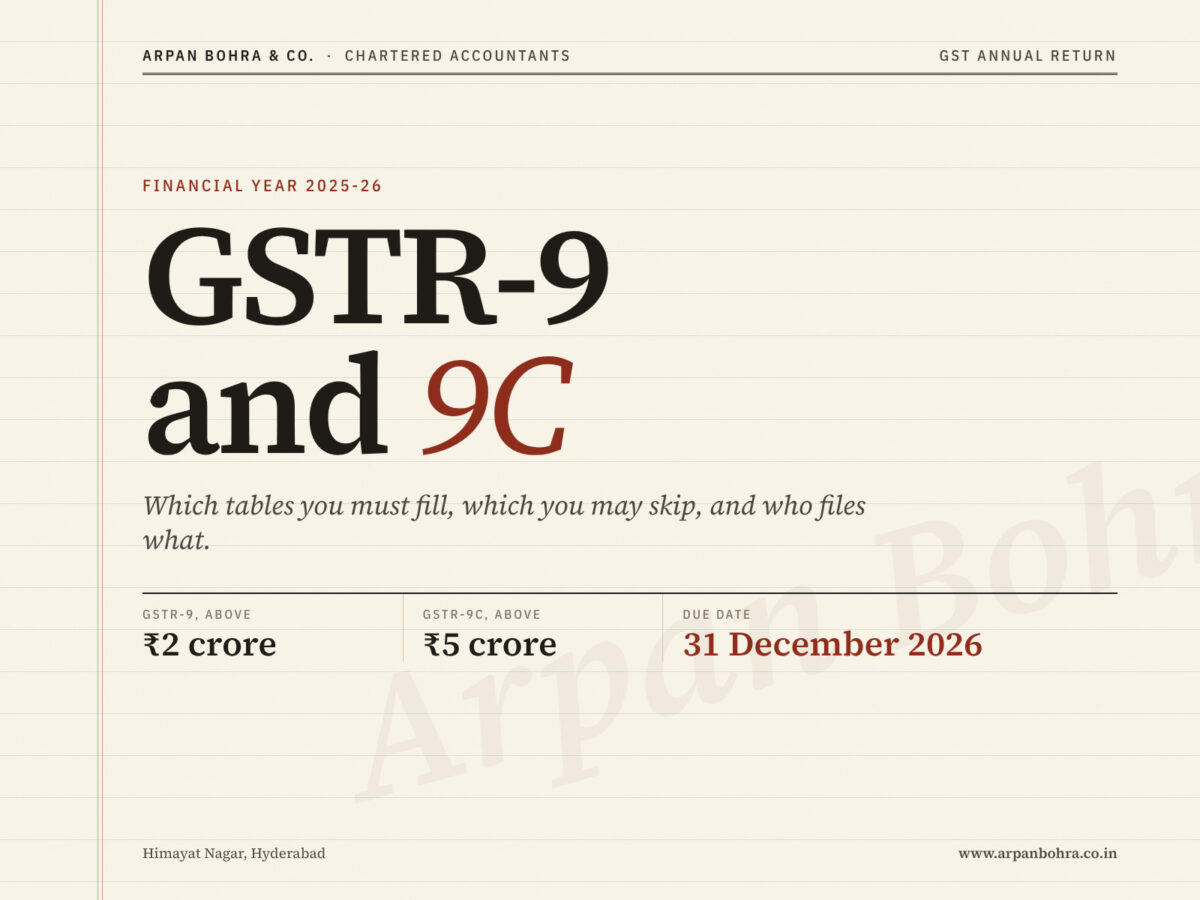
A Hyderabad manufacturer with an aggregate turnover of ₹4.6 crore asks a simple question in the last week of the year: do we file only GSTR-9, or GSTR-9C as well, and which tables can we skip? For FY 2025-26, GSTR-9 and GSTR-9C are due on 31 December 2026. GSTR-9 is needed where aggregate turnover exceeds ₹2 crore, and the self-certified GSTR-9C is needed additionally where it exceeds ₹5 crore. Notification No. 05/2026-Central Tax dated 26 October 2026 also relaxes how several tables are reported. In the example above, the answer is GSTR-9 only.
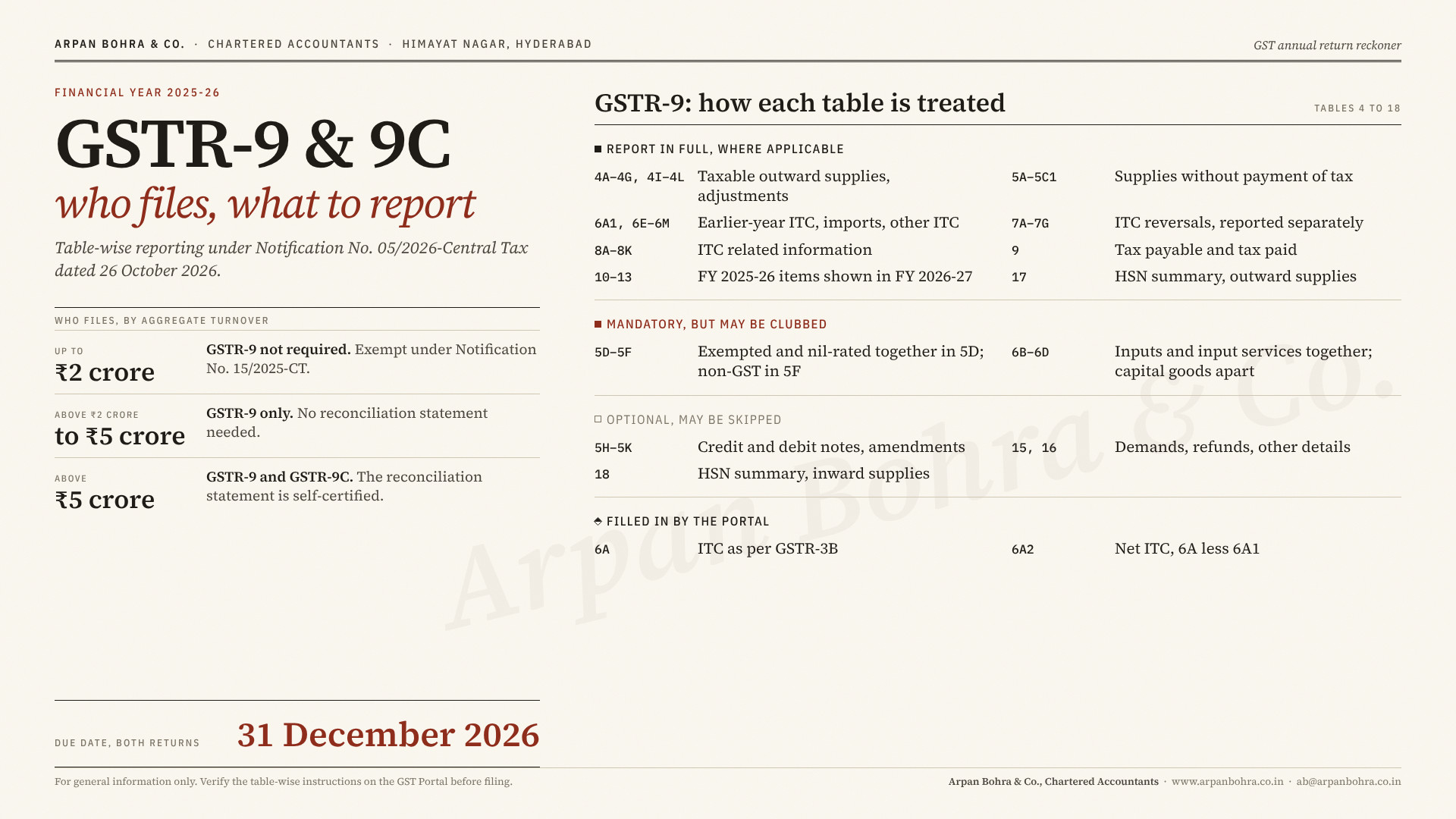
Who must file GSTR-9 and GSTR-9C for FY 2025-26?
Aggregate turnover is computed PAN-wise across India under section 2(6) of the CGST Act, 2017, and each GSTIN under the PAN files its own return.
| Aggregate turnover | GSTR-9 (annual return) | GSTR-9C (reconciliation statement) |
|---|---|---|
| Up to ₹2 crore | Exempt under Notification No. 15/2025-Central Tax | Not required |
| Above ₹2 crore, up to ₹5 crore | Mandatory | Not required |
| Above ₹5 crore | Mandatory | Mandatory, self-certified, under Rule 80(3) of the CGST Rules, 2017 |
Due date and when the forms open
The due date for GSTR-9 and GSTR-9C for FY 2025-26 is 31 December 2026. The GST Portal has enabled both forms for the year, as per the GSTN advisory dated 12 October 2026. In practice, the utility opens for filing only after the year’s GSTR-1 and GSTR-3B returns have been filed, so pending monthly or quarterly returns should be cleared first. Once filed, GSTR-9 cannot be revised, so reconcile before you submit.
GSTR-9 for FY 2025-26: which tables are mandatory, optional or auto-populated?
Notification No. 05/2026-Central Tax (G.S.R. 919(E)) dated 26 October 2026 carries the FY 2025-26 instructions for GSTR-9 and GSTR-9C. Table-wise, GSTR-9 reporting stands as follows.
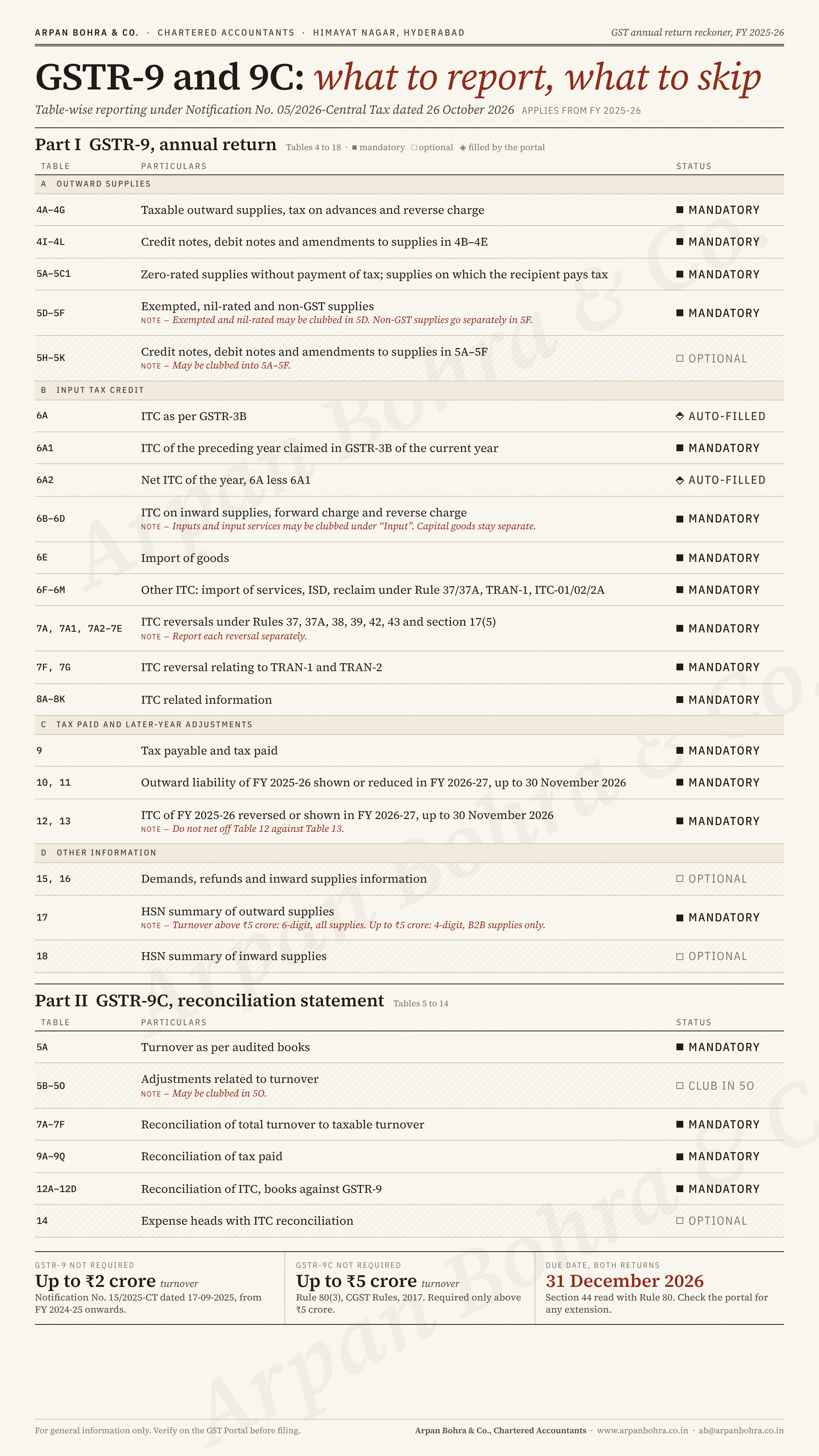
Download: GSTR-9 and 9C table-wise reckoner, FY 2025-26 (PDF, Full HD)
| Tables | What they report | Status |
|---|---|---|
| 4A–4G, 4I–4L | Taxable outward supplies and related adjustments | Mandatory, where applicable |
| 5A–5C1 | Supplies without payment of tax | Mandatory, where applicable |
| 5D–5F | Exempted, nil-rated and non-GST supplies | Exempted and nil-rated supplies may be shown together in 5D; non-GST supplies separately in 5F |
| 5H–5K | Credit notes, debit notes and amendments | Separate reporting optional; may be consolidated |
| 6A | ITC as per GSTR-3B | Auto-populated |
| 6A1 | ITC of the preceding year claimed in GSTR-3B this year | Mandatory, where applicable |
| 6A2 | Net ITC of the financial year (6A less 6A1) | Auto-calculated |
| 6B–6D | ITC on inward supplies | Inputs and input services may be combined; capital goods shown separately |
| 6E–6M | Imports and other ITC details | Mandatory, where applicable |
| 7A–7G | ITC reversals and ineligible ITC | Mandatory, where applicable |
| 8A–8K | ITC reconciliation | Mandatory, where applicable |
| 9 | Tax payable and tax paid | Mandatory |
| 10–13 | Outward liability and ITC of FY 2025-26 shown, reduced or reversed in FY 2026-27 up to 30 November 2026 | Mandatory, where applicable. Tables 12 and 13 should not be netted off |
| 15–16 | Demands, refunds and other specified details | Optional |
| 17 | HSN summary of outward supplies. Turnover above ₹5 crore: 6-digit level for all supplies. Turnover up to ₹5 crore: 4-digit level for B2B supplies only | Mandatory |
| 18 | HSN-wise summary of inward supplies | Optional |
“Optional” means the portal does not require the table to be filled. It does not mean the underlying transaction can be ignored: tax and ITC reported in your returns must still reconcile with your books.
What GSTR-9C does and who certifies it
GSTR-9C reconciles the turnover and tax in your audited financial statements with GSTR-9, and the ITC in your books with the ITC claimed. Since 1 August 2021 it is self-certified by the registered person, so a Chartered Accountant or Cost Accountant certificate is no longer required. Its table-wise reporting relaxations for FY 2025-26 follow the notification text, so check the portal utility before you start entering data.
Practical points before you file
- Reconcile first. Match GSTR-9 figures with GSTR-1, GSTR-3B and the books of account, and keep working papers for every difference.
- Split data around 22 September 2025. The GST rate changes effective that date mean rate-wise and HSN-wise data for the year should be separated into the periods before and after it.
- Check ITC timing. Review section 16(4) eligibility for credit claimed in FY 2025-26 before you declare it in Tables 6 to 8.
- Tax missed during the year. If a reconciliation reveals short-paid tax or excess ITC, it is generally paid through Form GST DRC-03, since GSTR-9 itself does not carry a payment of past liabilities.
Frequently asked questions
Is GSTR-9 mandatory if my turnover is below ₹2 crore?
No. Taxpayers with aggregate turnover up to ₹2 crore are exempt from filing GSTR-9 under Notification No. 15/2025-Central Tax.
When is GSTR-9C required?
GSTR-9C is required where aggregate turnover for the year exceeds ₹5 crore, under Rule 80(3) of the CGST Rules, 2017.
Do I need a CA certificate for GSTR-9C?
No. GSTR-9C has been self-certified since 1 August 2021, and the authorised signatory signs it.
Has the 31 December 2026 due date been extended?
Any extension must come through an official notification or order. At the time of writing, we have not seen one for FY 2025-26, so plan to file by 31 December 2026 and check the GST Portal before the date.
Can I still correct GSTR-9 after filing?
No. Once filed, GSTR-9 cannot be edited, which is why reconciliation should be completed before submission.
Key takeaway
For FY 2025-26, decide your filing category from aggregate turnover, complete pending GSTR-1 and GSTR-3B returns, reconcile, and file GSTR-9, and GSTR-9C where applicable, by 31 December 2026. Verify the current table-wise instructions on the GST Portal and the CBIC tax information site before filing. This article is for general information and is not professional advice for any specific case.
Arpan Bohra & Co., Chartered Accountants
Website: https://www.arpanbohra.co.in/
Email: ab@arpanbohra.co.in
This article is for general information and is not professional advice. Law and rates change; please consult us before you act.