

By CA Arpan Bohra (FCA, CS), Arpan Bohra & Co., Chartered Accountants, Hyderabad. Position of law as at 21 November 2026.
Money first, paperwork later is how allotments go wrong. Here is the right order.
Priya and Karthik formed a private limited company in Hyderabad with ₹1,00,000 of share capital, split equally. A seed investor now wants to put in ₹50 lakh for 20%. Before a rupee moves, the founders need to know how to issue shares in a private limited company: which route the law allows, who must approve it, what the price rests on and which forms must be filed by which date.
This guide explains each step in plain words, with the deadlines and a worked example using assumed figures.
A private company issues new shares through one of four routes: a rights issue to existing shareholders, employee stock options, a preferential allotment (private placement) to chosen persons, or bonus shares from reserves. For a new investor, the usual route is a preferential allotment under Section 62(1)(c) read with Section 42: special resolution, a registered valuer’s price, an offer in Form PAS-4, money received by banking channels, allotment within 60 days, Form PAS-3 within 15 days and share certificates within 2 months.
The four routes for issuing shares
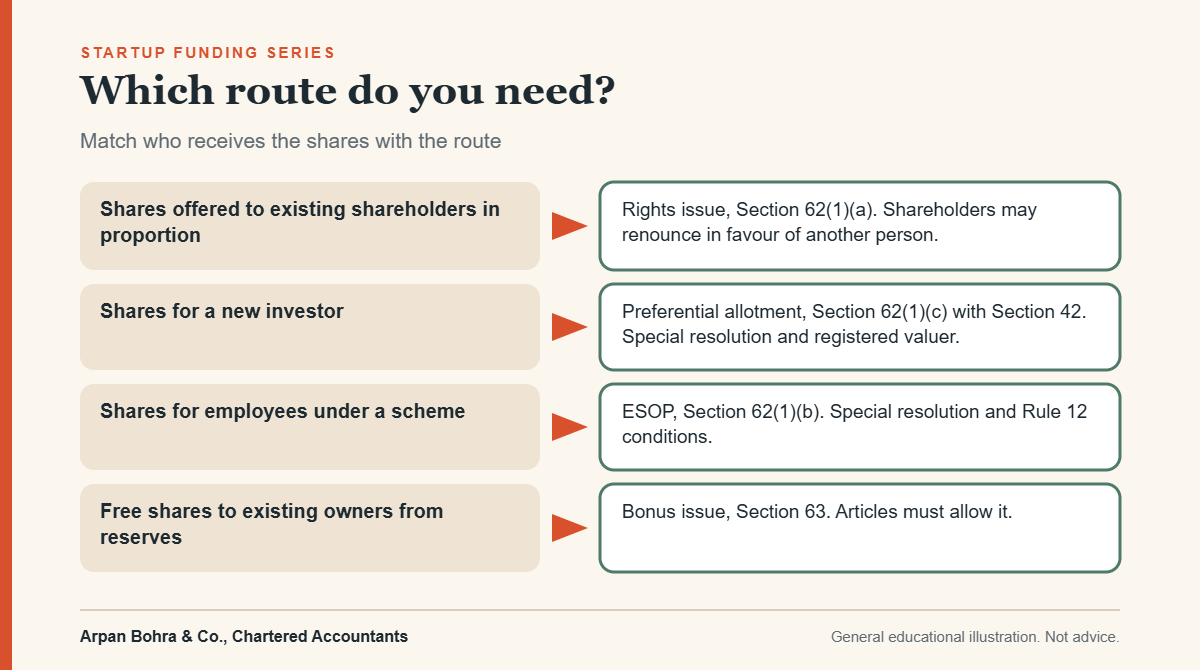
Which route applies depends on who gets the shares. Pick the route first, because the approvals and valuation follow from it.
| Route | Section | Who receives shares | Main approvals |
|---|---|---|---|
| Rights issue | 62(1)(a) | Existing equity shareholders, in proportion to their holding | Board approves the offer. Shareholders may renounce their right in favour of another person. The offer must stay open for the period fixed under Section 62 and Rule 12A. |
| Employee stock options | 62(1)(b) | Employees and directors under a scheme | Special resolution and the conditions of Rule 12 of the Share Capital Rules. |
| Preferential allotment or private placement | 62(1)(c) with Sections 42 and Rules 13, 14 | Any person, including new investors | Special resolution, registered valuer’s report for an unlisted company, offer letter in Form PAS-4. Offers go to named persons, up to 200 in a financial year (excluding employees under ESOP and qualified institutional buyers). |
| Bonus shares | 63 | Existing shareholders, from reserves | Articles must permit. No fresh money comes in. |
A rights issue offers new shares to current owners first. A preferential allotment lets the company sell shares to someone new, so the law asks for a special resolution and an independent valuation to protect existing shareholders from a cheap sale.
Before you start: three checks
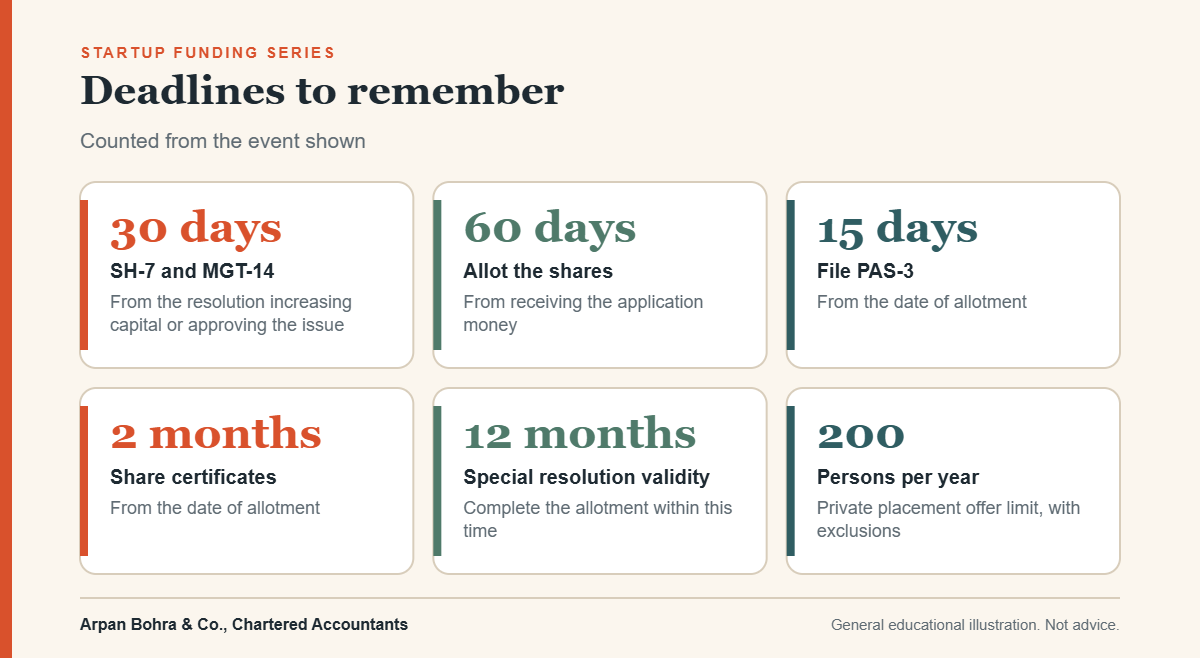
- Authorised capital. A company can allot shares only up to its authorised capital. If the new issue takes paid-up capital above it, increase authorised capital first and file Form SH-7 within 30 days of the resolution.
- Articles of Association. Confirm the articles permit the kind of issue you plan. If they do not, alter them first by special resolution and file Form MGT-14.
- Price and premium. Shares have a face value (say ₹10). Any amount paid above face value is the securities premium and goes to a separate account under Section 52.
Fixing the right price is its own exercise. See our guide on startup valuation methods for how investors and valuers arrive at it.
Step by step: issuing shares to a new investor
This is the preferential allotment route. Deadlines are the ones prescribed under the Companies Act, 2013 and the rules.
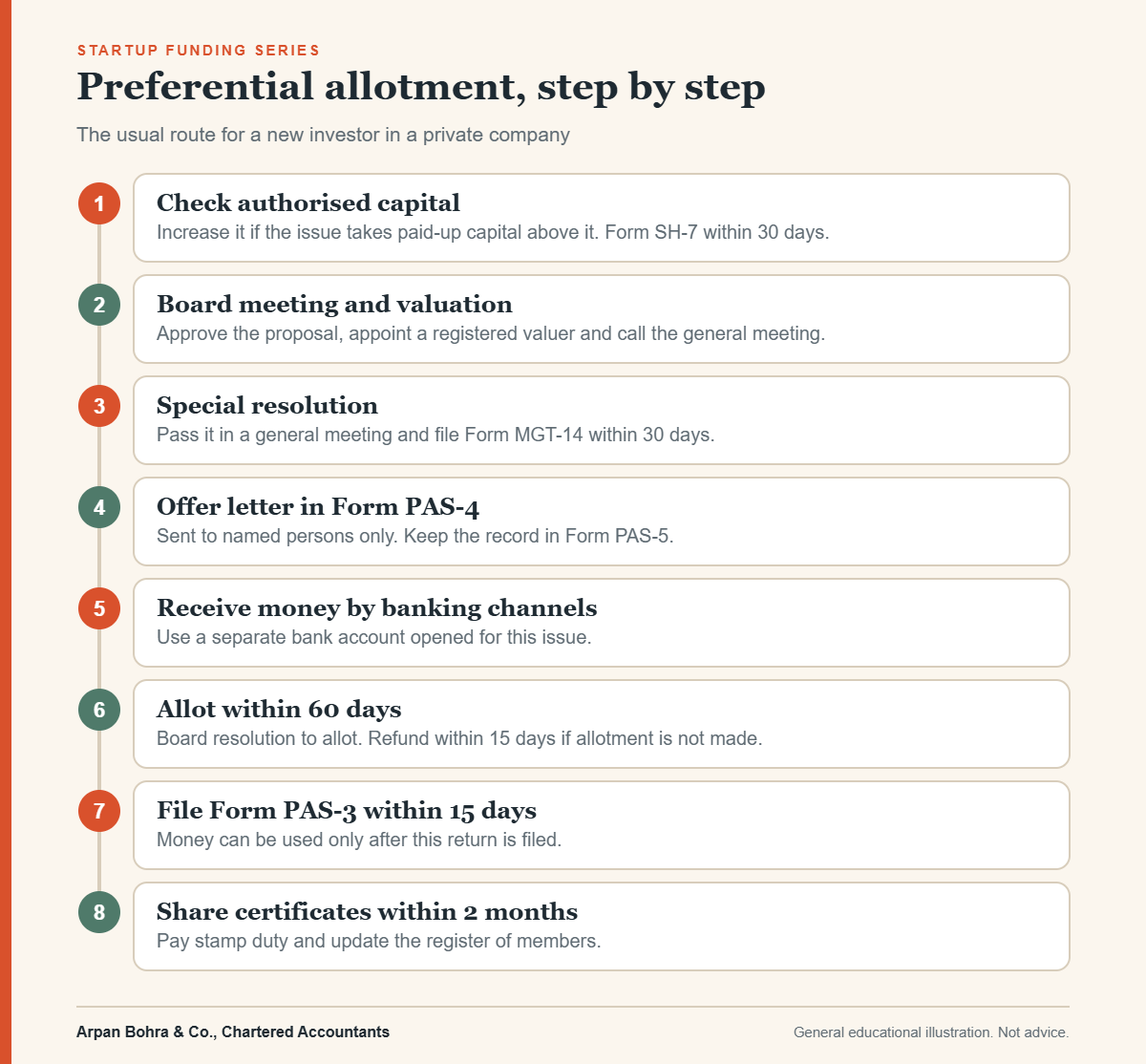
- Check authorised capital and increase it if needed (Form SH-7 within 30 days).
- Hold a board meeting to approve the proposal, appoint a registered valuer and call a general meeting.
- Get the valuation report from a registered valuer. The price must be supported by it for an unlisted company.
- Pass a special resolution in a general meeting and file Form MGT-14 within 30 days. The allotment must be completed within 12 months of the resolution.
- Send the offer letter in Form PAS-4 to the named investor and keep the record in Form PAS-5.
- Receive the money by banking channels into a separate bank account opened for the purpose.
- Allot the shares by board resolution within 60 days of receiving the money. If you cannot, the money must be refunded within 15 days, failing which interest at 12% a year is payable.
- File Form PAS-3 (return of allotment) within 15 days of allotment. The company cannot use the money until it has filed this return.
- Issue share certificates within 2 months of allotment, pay stamp duty and update the register of members.
- Foreign investor? Report on the RBI portal within 30 days. See our note on FEMA reporting for foreign investment.
Worked example: a ₹50 lakh seed investment
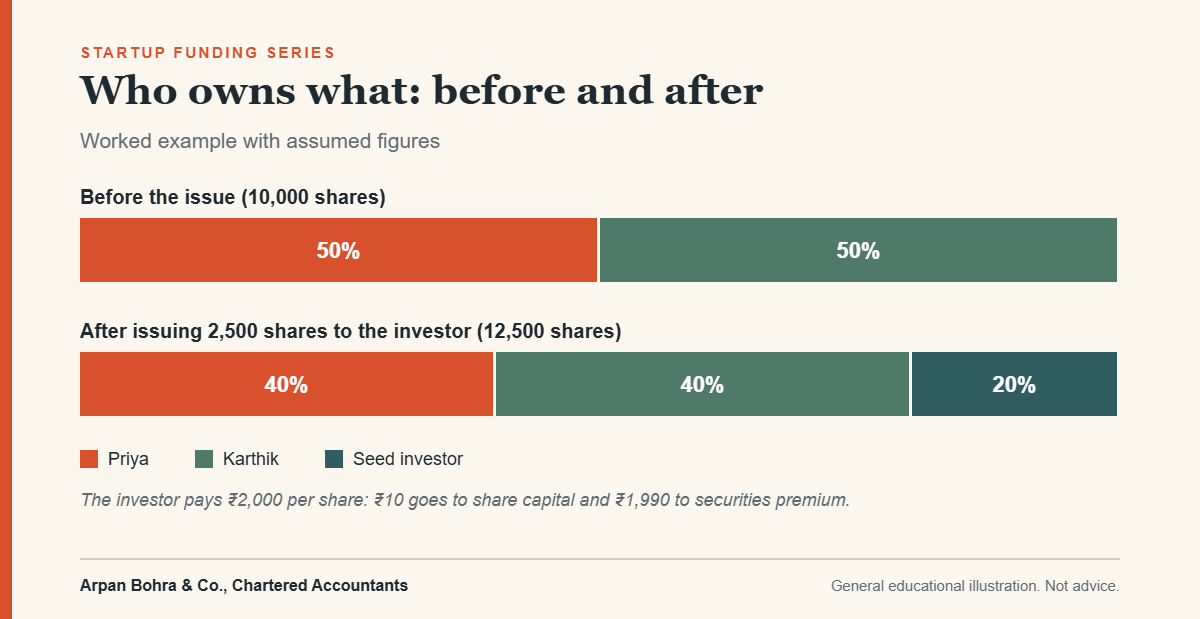
Priya and Karthik hold 5,000 shares each of face value ₹10. Authorised capital is ₹1,00,000. The investor agrees to invest ₹50,00,000 for 20% of the company after the issue.
- Shares to issue. Let the new shares be x. x ÷ (10,000 + x) = 20%, so x = 2,500 shares.
- Price per share. ₹50,00,000 ÷ 2,500 = ₹2,000 per share. Face value ₹10, so premium is ₹1,990.
- Accounting. Share capital rises by 2,500 × ₹10 = ₹25,000. Securities premium rises by 2,500 × ₹1,990 = ₹49,75,000. Total ₹50,00,000.
- Authorised capital. Paid-up capital becomes ₹1,25,000, which is more than ₹1,00,000. The company must increase authorised capital before allotment.
- Valuation check. Post-money value = 12,500 shares × ₹2,000 = ₹2.5 crore. The registered valuer’s report must support the ₹2,000 price.
Common mistakes to avoid
Receiving the investor’s money and using it before filing Form PAS-3. The law bars use of the funds until the return of allotment is filed.
- Allotting beyond authorised capital. Increase it first.
- Calling a loan conversion a rights issue. Shares issued for something other than cash, or to a new person, belong under Section 62(1)(c), with a valuation report.
- Letting the resolution lapse. If the allotment is not completed within 12 months of the special resolution, pass a fresh one.
- Forgetting the registers. Update the register of members and keep Form PAS-5 on file.
- Offering to too many people. The private placement limit is 200 persons in a financial year, excluding employees under ESOP and qualified institutional buyers.
Missed or late filings bring additional fees and scrutiny. Our notes on ROC annual compliance and common non-compliances of private companies show how these add up.
Local note for Hyderabad companies
Companies registered in Telangana file with the Registrar of Companies, Hyderabad, and every form above is filed online on the MCA portal. Stamp duty on the issue of shares is payable. The central framework collects 0.005% through the depository for shares issued in demat form, and for physical certificates the stamp law of the state applies, so confirm the rate for your case before issuing certificates.
Also read how an investor sees the deal in our article on angel investor vs venture capitalist, and the instruments available in convertible notes vs CCPS vs CCD.
Frequently asked questions
Can a private company issue shares without a valuation report?
How many people can a private company offer shares to?
What is Form PAS-3?
What if shares are not allotted within 60 days?
Can shares be issued for something other than cash?
Is stamp duty payable when shares are issued?
Arpan Bohra & Co., Chartered Accountants, Himayat Nagar, Hyderabad.
This article is shared for general professional education. Readers may write to the firm for information about its practice areas.
General educational information as at 21 November 2026. It is not legal, tax or investment advice and does not create a professional relationship. Examples use assumed figures for illustration only. Provisions, rates and thresholds change; verify the current law and notifications before acting.
This article is for general information and is not professional advice. Law and rates change; please consult us before you act.