

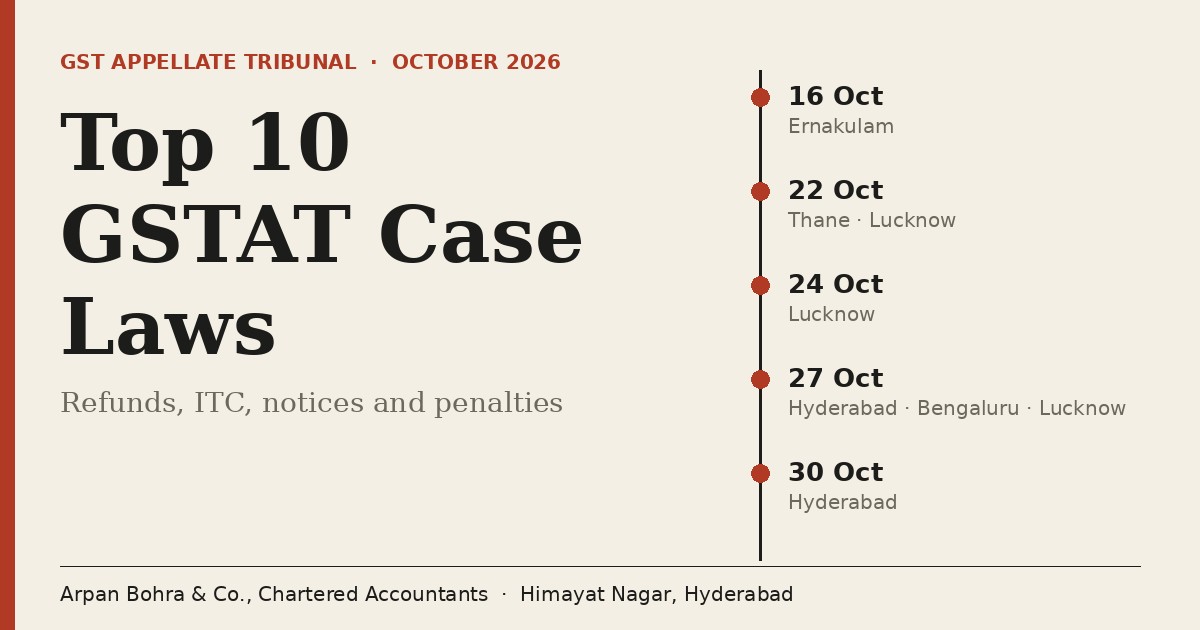
GSTAT case laws October 2026: ten orders of the GST Appellate Tribunal (GSTAT) from five State Benches, with the issue, the holding and the practical takeaway for each.
Table of Contents
A refund is rejected without the mandatory notice. A demand is upheld on a ground never mentioned in the show cause notice. A penalty is imposed on an entire consignment when only part of it is undocumented. In October 2026 the Tribunal dealt with each of these situations and, in each, set the order aside.
Short answer: the GSTAT case laws October 2026 share one theme. A GST order must follow the notice, the notice must state the allegation, and mandatory procedure cannot be skipped or cured later. Several orders also protect substantive entitlements: pre-18 July 2022 inverted-duty refunds, IGST credit booked in the wrong head, and excess output tax set off against disallowed ITC.
GSTAT orders bind the parties and are persuasive, not binding, for other benches. Check each order and any further challenge before relying on it. Disclosure: the author appeared for the appellant in Case 1 (Kedia Agro).
Download the PDF of all ten orders: bench, appeal number, paragraph references, authorities and a practice point for each.
GSTAT case laws October 2026 at a glance
| # | Case | Bench | Order date | Core point |
|---|---|---|---|---|
| 1 | Kedia Agro | Hyderabad | 27.10.2026 | Pre-18.07.2022 inverted-duty refund not defeated by later filing |
| 2 | Innominds Software | Hyderabad | 30.10.2026 | IGST credit booked as CGST/SGST is not “wrongly availed” |
| 3 | Fortinet Technologies | Bengaluru | 27.10.2026 | DRC-01 is no substitute for a notice; no new grounds on appeal |
| 4 | Trivesh Enterprises LLP | Thane | 22.10.2026 | Vague notice, unreasoned orders: open remand |
| 5 | B.L. Agro Industries | Lucknow | 22.10.2026 | Provisional ITC reversal is not admitted liability |
| 6 | Vikram Inderjit Kapur (Lavino Kapur Cottons) | Thane | 22.10.2026 | Refund rejection needs RFD-08 and hearing |
| 7 | Mani Ply | Lucknow | 27.10.2026 | Section 129 penalty only on the undocumented excess |
| 8 | Time Steels | Lucknow | 24.10.2026 | Delayed entry of genuine stock: no confiscation |
| 9 | Chennamkudiyil Timbers | Ernakulam | 16.10.2026 | Excess output tax offsets disallowed ITC |
| 10 | Sunny (Ashok Kumar Arora Oil Co.) | Lucknow | Reported October 2026 | Route deviation alone cannot sustain a penalty |
1. Kedia Agro v. Principal Commissioner, Hyderabad GST Commissionerate (Hyderabad Bench, APL/194/HYD/2026, 27.10.2026)
Issue: can refund of ITC accumulated before 18.07.2022 under an inverted duty structure (May 2020 to March 2021) be denied only because the fresh application was filed after that date?
Facts: an edible-oil manufacturer filed a refund claim on 18.06.2022 (Rs 65,04,986), withdrew it, and refiled on 25.03.2023 for Rs 61,47,671. The claim was rejected under Notification 09/2022-Central Tax (Rate) and Circular 181/13/2022-GST.
Held: ITC is a right that accrues on purchase, and an executive circular cannot curtail it retrospectively. The orders rested solely on para 2 of the Circular, which several High Courts (Andhra Pradesh, Gujarat, Rajasthan, Allahabad, Calcutta) have struck down or read down, and the Supreme Court dismissed the Revenue’s SLPs against the Andhra Pradesh ruling on 09.05.2025. The orders were set aside and the claim remitted for fresh decision, including interest.
Takeaway: entitlement turns on when the credit accumulated, not on the date of filing.
2. Innominds Software Pvt Ltd v. Commissioner of State Tax (Hyderabad Bench, APL/51/HYD/2026, 30.10.2026)
Issue: is IGST credit of Rs 68,52,254 on two SEZ-supplier invoices (30.03.2018), recorded as CGST and SGST, “wrongly availed” under Section 73?
Held: no. The burden under Section 155 was discharged through GSTR-2A reflection, bank statements and reconciliation. The supplier CA certificate in Circular 183/15/2022-GST is a verification aid, not an eligibility condition. Following the Kerala High Court in Rejimon Padickapparambil Alex (26.11.2024), the head-level error was an error of reporting, not availment of credit. The Tribunal did not rest its decision on revenue neutrality, left other contentions open, and allowed interest on the pre-deposit of Rs 6,85,226.
Takeaway: keep invoice, GSTR-2A and payment evidence ready, and plead every ground.
3. Fortinet Technologies India Pvt Ltd v. Commissioner of Commercial Taxes, Karnataka (Bengaluru Bench, APL/88/BUR/2026, 27.10.2026)
Held: Form GST DRC-01 is a summary that accompanies the Section 73(1) notice and cannot replace it. A personal hearing under Section 75(4) is mandatory, and the first appellate authority cannot sustain a demand on a basis never put to the taxpayer (here, Section 9(4) and forward charge, against an original reverse-charge allegation). On merits, outdoor catering was not notified under Section 9(3). The demand of Rs 1,09,815 each under CGST and SGST was set aside. The taxpayer lost on one point: absence of DIN or RFN did not invalidate communications for the period.
Takeaway: compare the grounds in the notice, the order and the appellate order line by line.
4. Trivesh Enterprises LLP v. Joint Commissioner of State Tax (Thane Bench, APL/52 and 53/THN/2026, 22.10.2026)
ITC of Rs 4,89,456 (FY 2020-21) and Rs 6,80,142 (FY 2021-22) was denied on purchases from suppliers whose registrations were cancelled. The notices said only “as per attachment”, the orders were ex parte, and the first appeals were dismissed for non-prosecution. The Tribunal held that dismissal of a statutory appeal for non-prosecution is unsustainable under Section 107, the notices and orders were not speaking, and natural justice was breached. It expressly expressed no opinion on the merits of ITC and ordered open, de novo adjudication.
Takeaway: this is a procedural win, not a ruling on supplier cancellation. The taxpayer must still prove genuine receipt.
5. Ajit Kumar Minz v. B.L. Agro Industries Ltd (Lucknow Bench, APL/53/LCK/2026, 22.10.2026)
B.L. Agro provisionally reversed Rs 14.35 crore of ITC in August 2018 after stock-shortage allegations, stating it did not admit liability. The Tribunal dismissed the department’s appeal and upheld the refund order, subject to compliance with Section 54, holding that a provisional reversal and a pending investigation do not by themselves establish tax liability.
Takeaway: record in writing, when reversing, that the reversal is provisional and without admission.
6. Vikram Inderjit Kapur (Lavino Kapur Cottons) v. Dy. Commissioner of State Tax (Thane Bench, APL/32/THN/2026, 22.10.2026)
For a 100% export-oriented unit, Rs 18,09,402 of an August 2020 refund of Rs 63,17,232 was rejected for “ITC mismatch” without Form GST RFD-08 or a hearing. The Tribunal held Rule 92(3) mandatory, that a post-decisional appellate hearing cannot cure the omission, and remanded all 39 connected appeals with directions for an invoice-wise RFD-08, a reply in RFD-09, a hearing and a reasoned RFD-06. The merits were not decided.
7. Ravish Kumar Singh v. Mani Ply (Lucknow Bench, APL/239/LCK/2026, 27.10.2026)
A vehicle carried 450 pieces of plywood against 418 covered by invoice and e-way bill. The penalty under Section 129(3) had been imposed on the whole consignment. The Tribunal dismissed the department’s appeal and upheld restriction of the penalty to the 32 excess pieces, finding no sufficient evidence that the documented quantity was transported in contravention.
8. Sanjeev Kumar Niranjan v. Time Steels (Lucknow Bench, APL/103/LCK/2026, 24.10.2026)
A 2018 survey found a stock-book difference, which the assessee attributed to a delay in recording genuine transactions. The Tribunal held that such delay does not by itself establish deliberate non-accountal, confiscation under Section 130 was not justified, and dismissed the department’s appeal with the demand at nil.
9. Chennamkudiyil Timbers v. Commissioner of State Tax (Ernakulam Bench, APL/20/ERN/2026, 16.10.2026)
For 2017-18 the taxpayer had paid output tax of Rs 99,449 in excess of the disputed ITC of Rs 62,626. The Tribunal held that where excess output tax exceeds disallowed ITC there is no short payment and no Section 73 demand; that unjust enrichment was not attracted on the excess (Section 54(8)(c)); that a demand cannot rest on a ground absent from the notice; and that a one-line rejection of detailed submissions is non-speaking. It followed Rejimon in treating credit as a pool across IGST, CGST and SGST.
10. Sunny (Ashok Kumar Arora Oil Company) v. Shrawan Kumar Mishra, Asst. Commissioner (Lucknow Bench, reported October 2026)
A tanker of refined glycerine bound for Ludhiana was intercepted near Kanpur Dehat and a penalty of Rs 6,76,694 imposed under Section 129(3). As reported, the Tribunal held that route deviation, without proof of a statutory contravention or intent to evade tax, cannot by itself sustain the penalty where valid invoices and an e-way bill show the declared destination. This entry is based on a published report; the order itself should be read before it is cited.
Frequently asked questions on GSTAT case laws October 2026
Are GSTAT orders binding precedents?
They bind the parties. For other benches they are persuasive. A contrary Supreme Court or High Court decision prevails.
What is the time limit to appeal to GSTAT, and what pre-deposit is required?
Under Section 112(1) of the CGST Act, 2017, an appeal lies within three months of communication of the Section 107 or 108 order (or a later date notified), and the Tribunal may condone a further three months for sufficient cause under Section 112(6). Under Section 112(8), the admitted amount must be paid in full, plus ten per cent of the remaining tax in dispute, in addition to the amount paid under Section 107(6), subject to a maximum of twenty crore rupees. Where the order imposes only a penalty, ten per cent of the penalty is payable. Check State Act and notified filing windows for the specific case.
Can an order of the Tribunal be challenged further?
Yes. Section 117 allows an appeal to the High Court within 180 days of receipt of the order, and the High Court may admit it if a substantial question of law is involved. The department may itself approach the Tribunal under Section 112(3) on the Commissioner’s direction within six months.
Does a remand mean the taxpayer has won?
No. In Trivesh Enterprises and the Lavino Kapur batch the Tribunal left the merits open and directed fresh adjudication after proper notice and hearing.
Where are Telangana appeals filed?
Before the Hyderabad State Bench, other than matters reserved for the Principal Bench. See our GSTAT guide and the GST appeal ladder.
Taken together, the GSTAT case laws October 2026 give taxpayers three working rules. First, test every notice and order against the mandatory procedure. Second, rely on the reconciliation and documents that prove entitlement. Third, read each of the GSTAT case laws October 2026 against the facts of your own matter, because several were remands and not decisions on merits.
Conclusion: what the GSTAT case laws of October 2026 teach
The GSTAT case laws October 2026 show that procedure and evidence decide GST disputes. Compare every notice with the order that follows it, keep reconciliations and documents ready, and plead every available ground.
For GST queries: gst@arpanbohra.co.in | 9010558981 | office@arpanbohra.co.in
Arpan Bohra & Co., Chartered Accountants, Himayat Nagar, Hyderabad | www.arpanbohra.co.in
Download the PDF. All ten orders in one file, with bench, appeal number, paragraph references and authorities, plus ten takeaways. If this helped, forward it to a colleague or client who has a notice, refund or appeal pending.
Sources: orders of the GST Appellate Tribunal (Hyderabad, Bengaluru, Thane, Lucknow and Ernakulam Benches); CGST Act, 2017, Sections 112 and 117 (CBIC). This article is for general information and is not professional advice.
This article is for general information and is not professional advice. Law and rates change; please consult us before you act.