

By CA Arpan Bohra (FCA, CS), Arpan Bohra & Co., Chartered Accountants, Hyderabad. Position of law as at 21 November 2026.
A valuation is an argument backed by numbers, not a fact waiting to be found.
A founder says the company is worth ₹20 crore. An investor says ₹8 crore. Both may be acting honestly, because early-stage startup valuation methods rest on assumptions about the future, not on audited facts. The aim is to reach a price both sides can defend.
This article explains the common methods in plain words with simple numbers, and then separates two things founders often mix up: the price negotiated with an investor and the valuation report the law asks for in certain cases.
No single formula gives a startup’s value. Investors combine methods: market comparables (what similar companies are worth), the venture capital method (work backwards from an expected exit), discounted cash flow (value of future cash today), and scorecard or Berkus checks for pre-revenue companies. Separately, a preferential allotment by an unlisted company needs a registered valuer’s report, and an issue to a non-resident must meet the FEMA fair value pricing rule. Angel tax no longer applies from assessment year 2025-26.
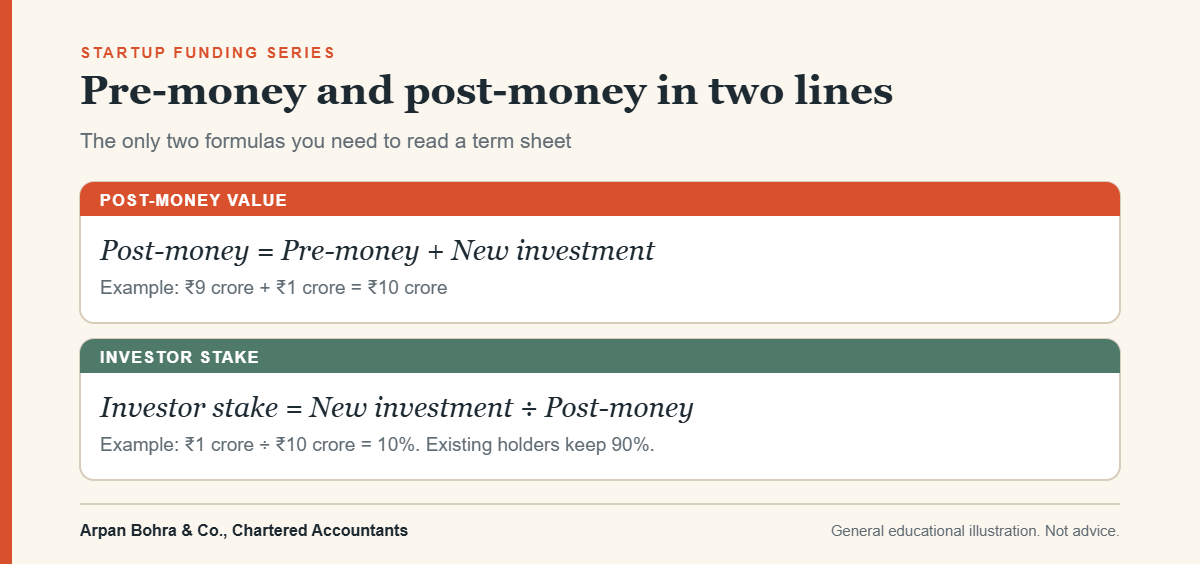
Pre-money and post-money in plain English
Pre-money valuation is what the company is worth before the new investment. Post-money valuation is pre-money plus the new money. The investor’s percentage is the new money divided by post-money.
An investor puts in ₹1 crore at a pre-money valuation of ₹9 crore.
- Post-money = ₹9 crore + ₹1 crore = ₹10 crore.
- Investor stake = ₹1 crore ÷ ₹10 crore = 10%.
The founders and earlier holders keep the remaining 90%.
The main startup valuation methods
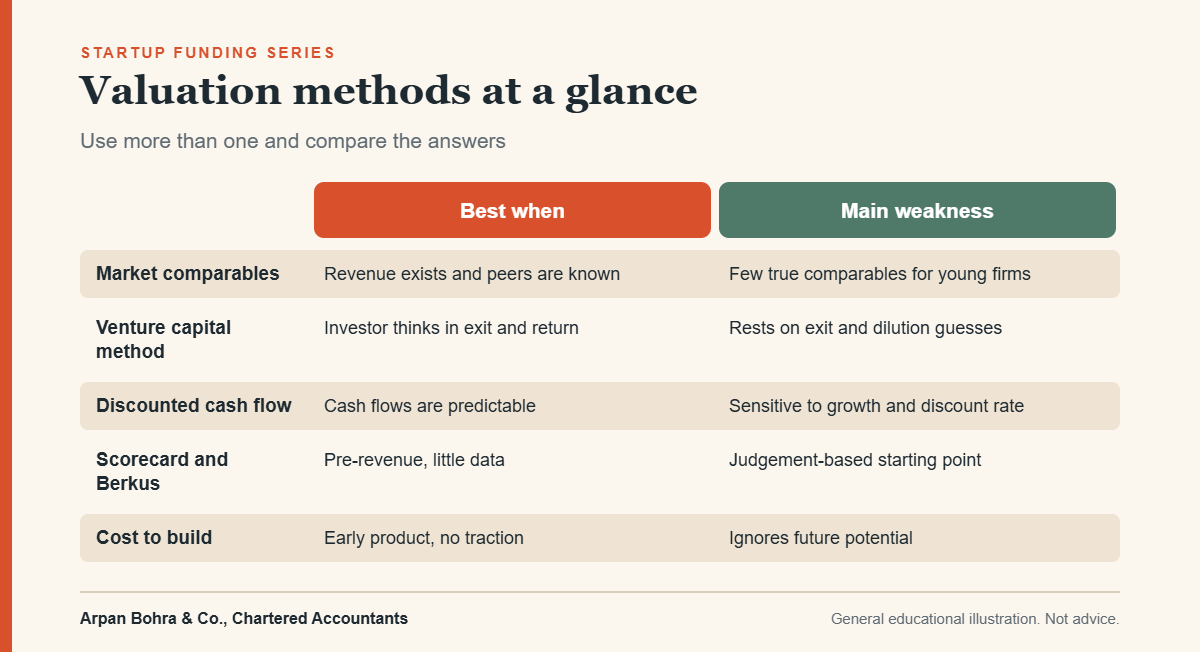
Each method answers a slightly different question. Investors rarely rely on one alone.
| Method | Best when | Main weakness |
|---|---|---|
| Market comparables | The company has revenue and similar companies have known prices or deals | Few true comparables for young companies, and public company multiples may not fit |
| Venture capital method | The investor thinks in terms of an exit and a target return | Depends heavily on the exit value and dilution assumptions |
| Discounted cash flow (DCF) | The business has predictable cash flows | Small changes in growth or discount rate move the answer a lot |
| Scorecard and Berkus | The company is pre-revenue and has little data | Largely judgement-based, so the result is a starting point only |
| Cost to build | Early product with little traction | Ignores future potential and market size |
1. Market comparables
Pick similar companies, find a multiple such as value ÷ annual revenue, and apply it to your numbers.
A software startup has an annual revenue run-rate of ₹5 crore. Similar deals were priced at about 3 times revenue.
- Indicative value = ₹5 crore × 3 = ₹15 crore.
- An investor may apply a discount of 20% for small size and difficulty of selling the shares: ₹15 crore × 80% = ₹12 crore.
2. Venture capital method
The investor starts with the expected sale value of the company in a few years, decides the return it wants, and works backwards.
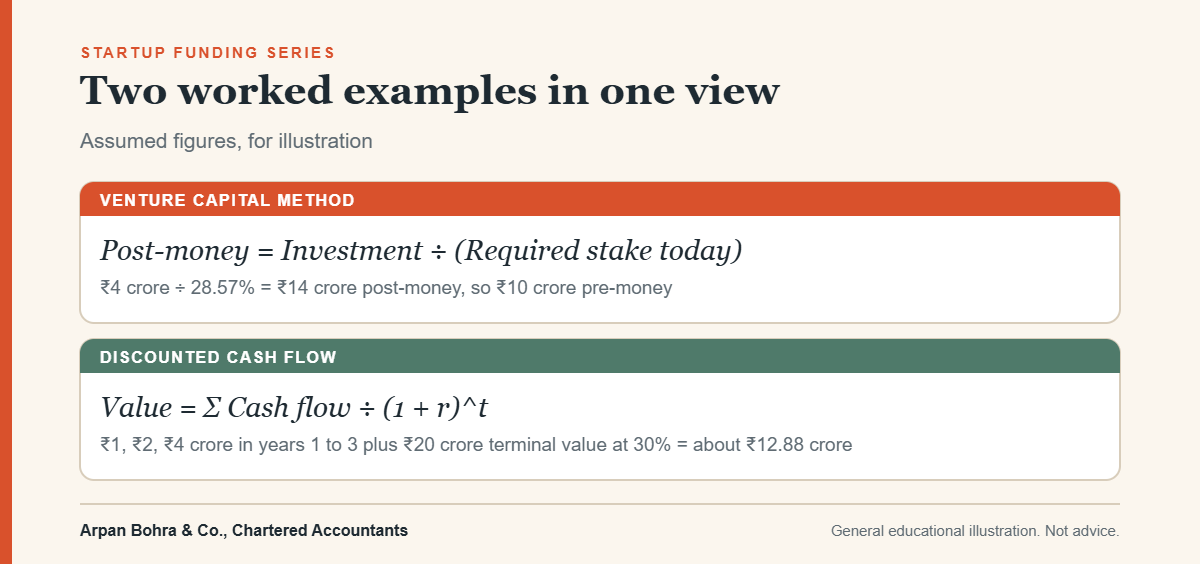
An investor puts in ₹4 crore. It expects the company to be sold for ₹200 crore in six years and wants 10 times its money back.
- Stake needed at exit = (₹4 crore × 10) ÷ ₹200 crore = 20%.
- Future rounds will dilute everyone by about 30%. Stake needed today = 20% ÷ 0.70 = 28.57%.
- Post-money today = ₹4 crore ÷ 28.57% = ₹14 crore. Pre-money = ₹14 crore − ₹4 crore = ₹10 crore.
3. Discounted cash flow
DCF adds up the cash the business is expected to produce and reduces each amount for the time and risk of waiting. A higher discount rate means a lower value.
| Year | Cash flow (₹ crore) | Discount factor at 30% | Present value (₹ crore) |
|---|---|---|---|
| 1 | 1.0 | 0.769 | 0.769 |
| 2 | 2.0 | 0.592 | 1.183 |
| 3 | 4.0 | 0.455 | 1.821 |
| Terminal value at year 3 (assumed) | 20.0 | 0.455 | 9.103 |
| Total | 12.876 (about ₹12.88 crore) |
4. Scorecard and Berkus for pre-revenue companies
The scorecard method starts with the average pre-money value of similar startups in the region and adjusts it for strengths and weaknesses. The Berkus method assigns a capped value to each of five factors: idea, prototype, management team, strategic relationships and product roll-out.
Average pre-money value of similar startups: ₹4 crore. Factor weights and how the startup compares:
- Team: 30% × 125% = 37.5%
- Market size: 25% × 100% = 25%
- Product: 15% × 90% = 13.5%
- Competition: 10% × 80% = 8%
- Sales and marketing: 10% × 100% = 10%
- Need for further funding: 10% × 100% = 10%
Total = 104%. Indicative pre-money = ₹4 crore × 104% = ₹4.16 crore.
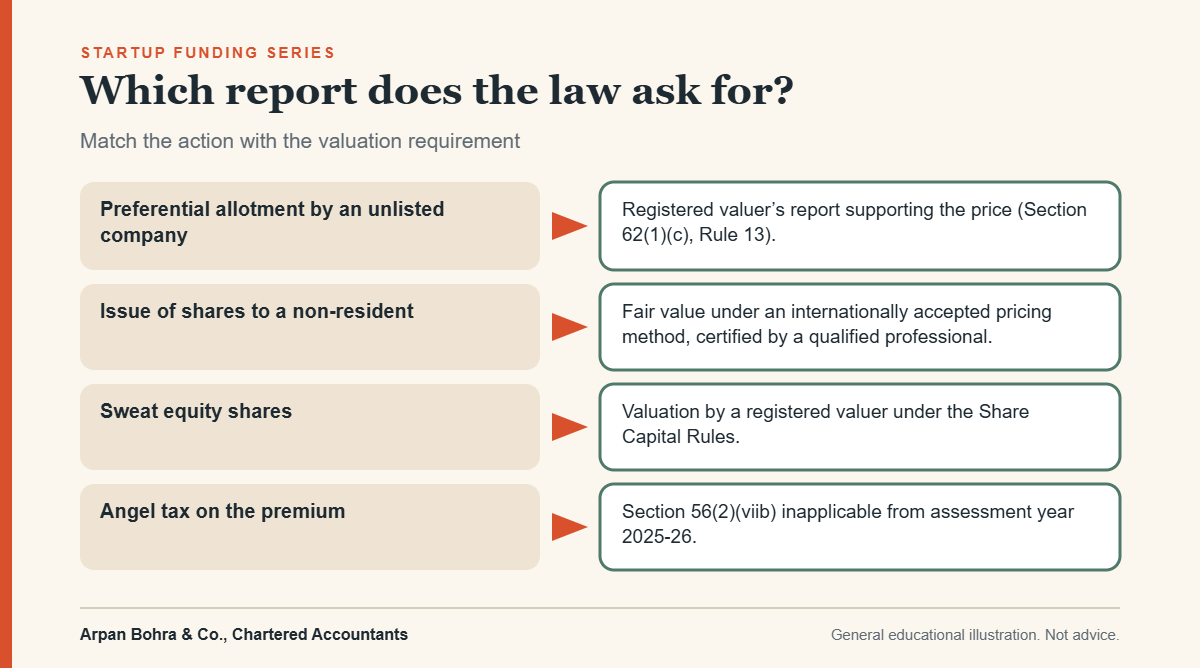
Which valuation does the law ask for?
A negotiated price is not the same as a valuation report required by law. The report depends on the action you are taking.
| Action | Valuation requirement |
|---|---|
| Preferential allotment of shares by an unlisted company | The price must be supported by a registered valuer’s report (Companies Act, Section 62(1)(c) read with Rule 13). |
| Issue of shares to a person resident outside India | The price must not be lower than fair value worked out under an internationally accepted pricing method, certified by a qualified professional such as a chartered accountant or SEBI-registered merchant banker. The certificate should be recent when shares are allotted. |
| Sweat equity shares | Valuation by a registered valuer under the Share Capital Rules. |
| Tax on shares | Angel tax under Section 56(2)(viib) is inapplicable from assessment year 2025-26. The Income-tax Rules, 2026 consolidate fair market value rules in Rule 57 for specified purposes, for example transfers of unquoted shares. |
A valuation done for one purpose is not automatically valid for another. Keep each report on file with the resolution it supports. For how the allotment itself is done, see our guide to issuing shares in a private limited company. Foreign money adds reporting under FEMA, and ESOP exercise has its own tax valuation, explained in our ESOP article.
Common mistakes in startup valuation
Mixing up pre-money and post-money. A ₹10 crore valuation can mean very different stakes depending on which one is being quoted. Always write which one you mean.
- Hockey-stick projections with no assumptions behind them.
- Copying a listed company’s multiple without adjusting for size and risk.
- Ignoring dilution from future rounds and the option pool.
- Using an old valuation report for a new allotment. Check the date against the requirement.
- No paper trail. Keep assumptions, working papers and the report with the board and shareholder resolutions.
Investors will test the same numbers during due diligence. Our due diligence checklist and the article on the financial model for investors show what they look for.
Frequently asked questions
What is the difference between pre-money and post-money valuation?
Which method is best for a startup with no revenue?
Do I need a registered valuer for a seed round?
Is angel tax still payable?
Can the valuation report and the negotiated price differ?
Why do investors ask about future dilution?
Arpan Bohra & Co., Chartered Accountants, Himayat Nagar, Hyderabad.
This article is shared for general professional education. Readers may write to the firm for information about its practice areas.
General educational information as at 21 November 2026. It is not legal, tax or investment advice and does not create a professional relationship. Examples use assumed figures for illustration only. Provisions, rates and thresholds change; verify the current law and notifications before acting.
This article is for general information and is not professional advice. Law and rates change; please consult us before you act.