

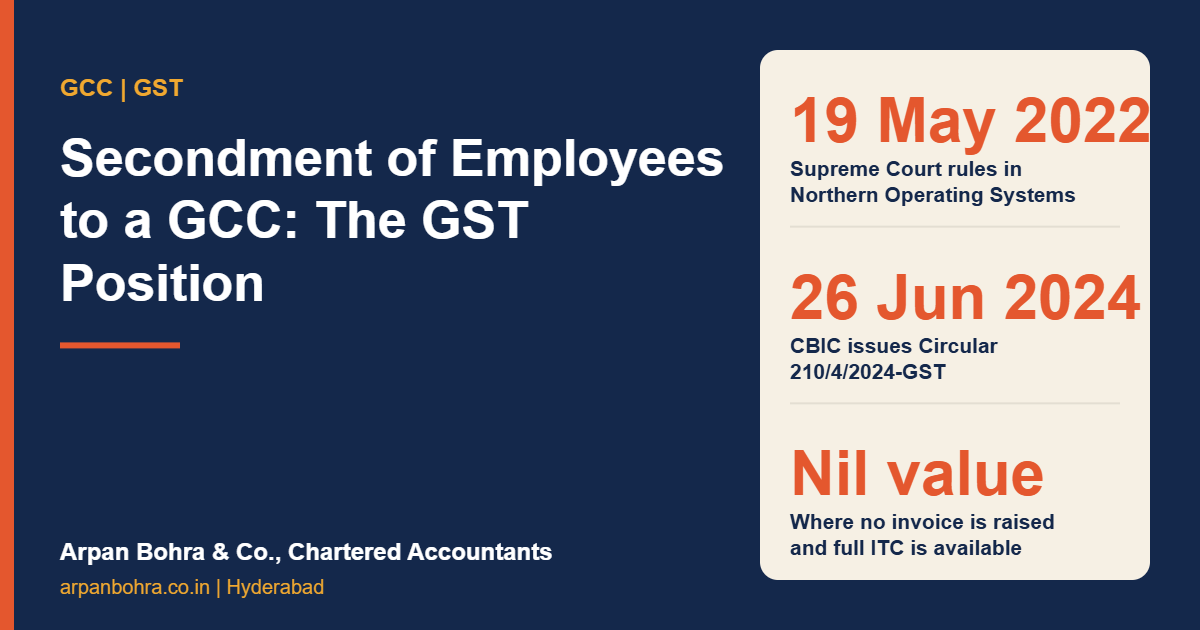
By Arpan Bohra & Co., Chartered Accountants, Hyderabad. Position of law as at 29 November 2026. General information, not advice for a specific case.
A GCC’s first head of engineering is an expatriate from the parent. She stays on the parent’s payroll, works full time in the Hyderabad office and her cost is recharged to the GCC every quarter. Is that recharge a taxable service under GST? For years the answer was disputed, and parts of it still are. Between a Supreme Court ruling, a CBIC circular and a High Court decision, the position has become clearer, but not simple.
How the law developed
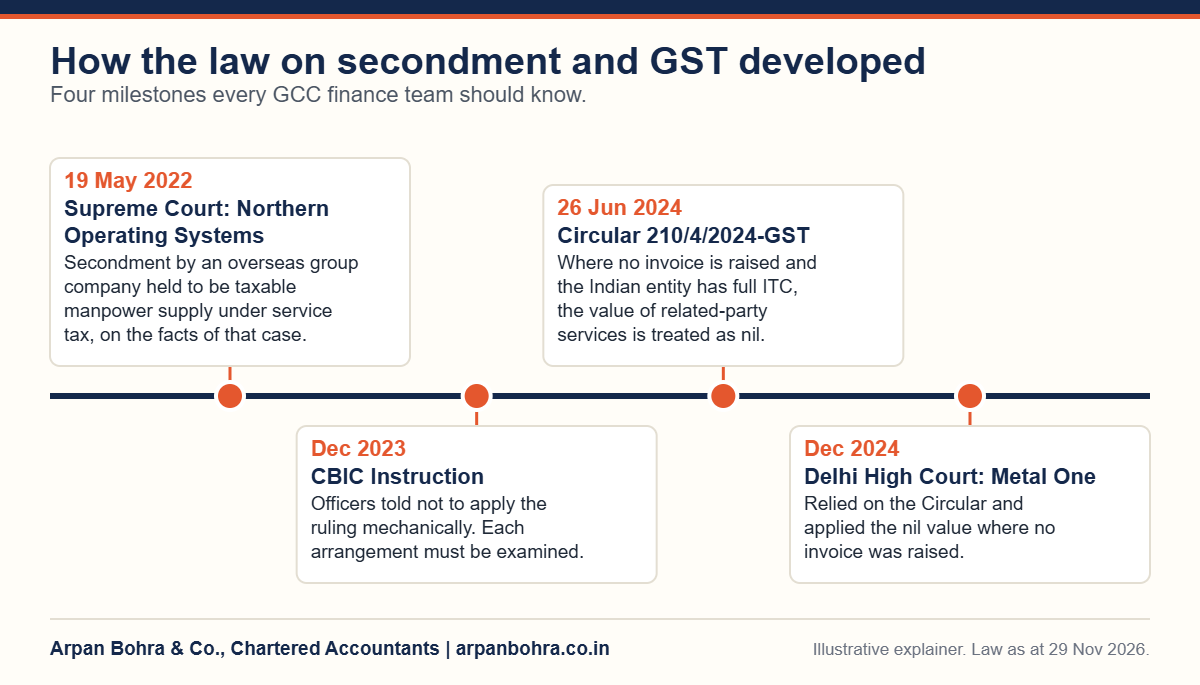
The Supreme Court looked closely at the agreements and facts in Northern Operating Systems Pvt Ltd, including who retained control and how costs were recovered. It did not lay down a rule that every secondee remains an employee of the foreign company. CBIC’s instruction in December 2023 said the same: the ruling should not be applied mechanically, and officers should examine the contract and facts of each case.
Circular 210/4/2024-GST dealt with related-party and cross-border services. Where a related domestic entity is eligible for full input tax credit and no invoice is issued, the value of the service is treated as nil. In Metal One Corporation India Pvt Ltd v. Union of India (Delhi High Court, December 2024), the Court relied on that clarification. Other courts have taken their own views, so the position outside Delhi is less uniform.
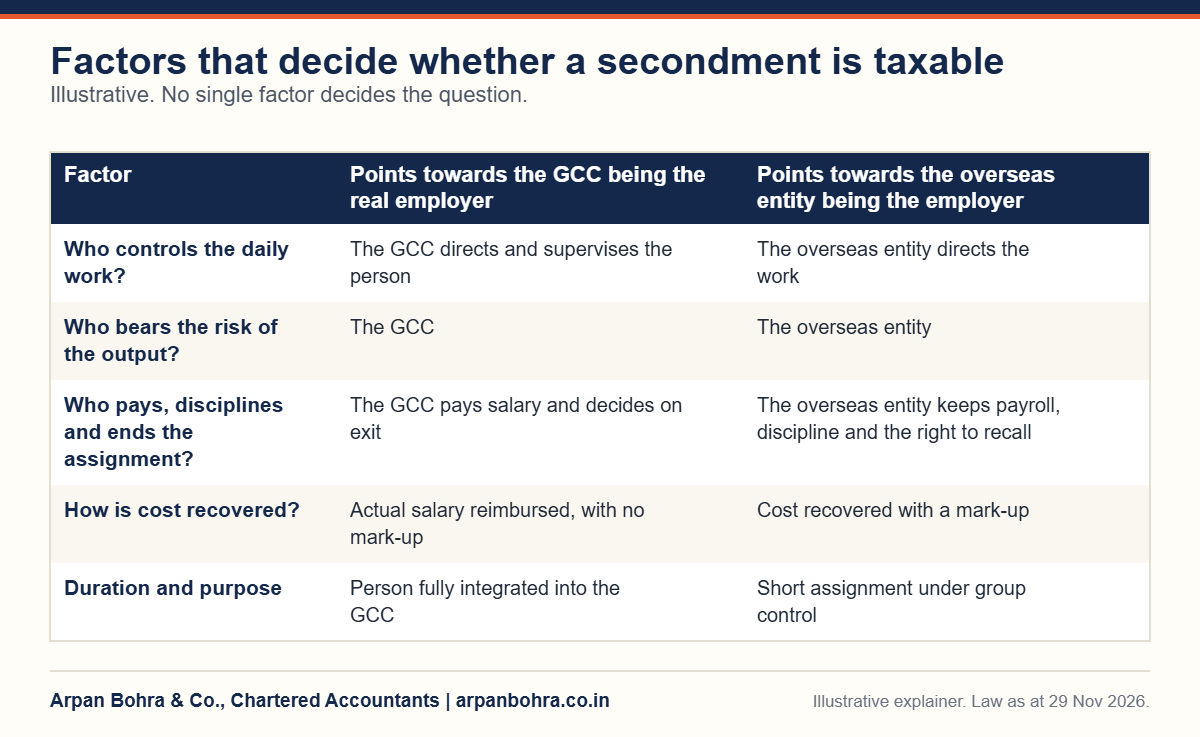
What officers look at
Where the Circular helps, and where it does not
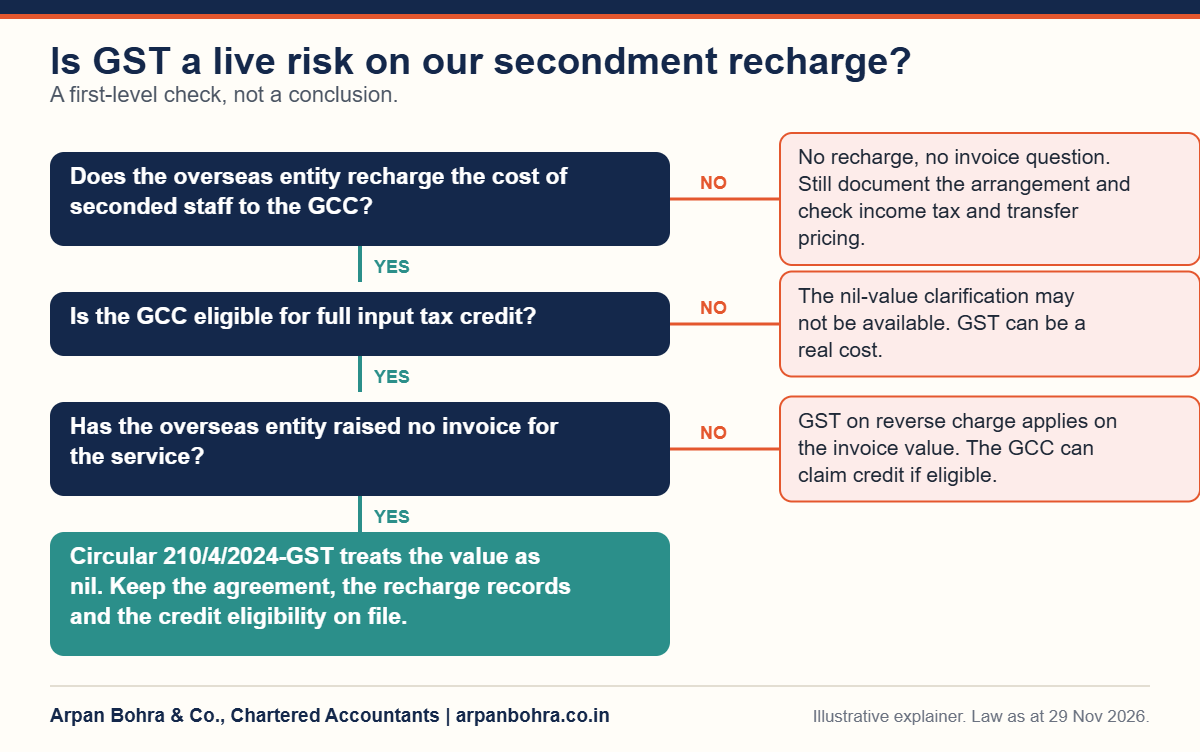
- Full credit is the key. A GCC that makes only zero-rated exports usually has full credit. A centre making exempt supplies may not, and the nil-value position may then be unavailable.
- No invoice is the other key. If the overseas entity does issue an invoice, GST is payable on reverse charge on the invoice value.
- Other taxes remain. Income tax withholding, deductibility and transfer pricing on the recharge are separate questions.
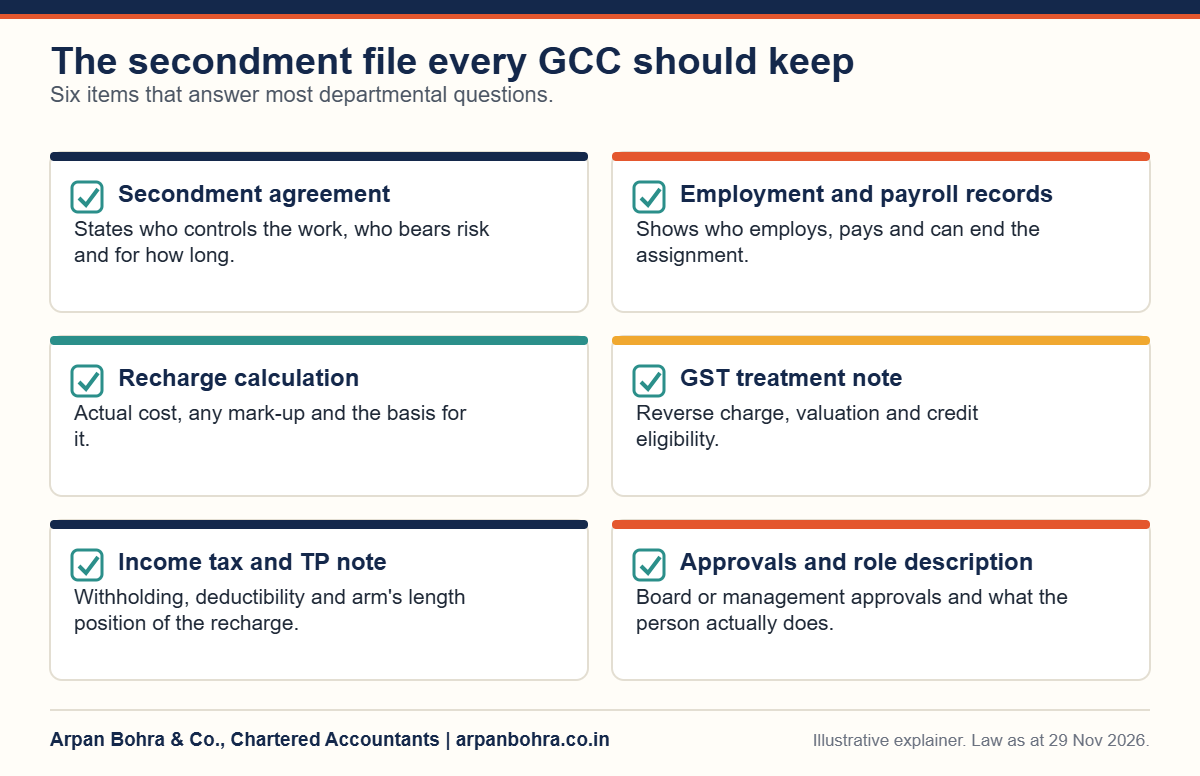
Keep a secondment file
- Treating recharge entries as internal book adjustments with no GST analysis.
- Raising an invoice with a mark-up, then not paying GST on reverse charge.
- Writing secondment agreements that do not match who actually controls the person.
- Assuming nil value applies without checking credit eligibility.
Frequently asked questions
Is secondment of employees taxable under GST?
It depends on the arrangement. The Supreme Court’s ruling treated one secondment as taxable. CBIC says each case must be examined, and a Circular provides a nil-value position in specified conditions.
What is Circular 210/4/2024-GST?
A CBIC circular dated 26 June 2024 that clarifies GST on certain cross-border related-party services, including a nil-value position where no invoice is issued and the Indian entity has full credit.
Does a GCC pay GST on reverse charge for seconded staff?
It may, if the overseas entity is treated as supplying manpower and raises an invoice. The credit is available if the GCC is eligible for it.
Is the Delhi High Court’s decision binding everywhere?
It is binding in Delhi and persuasive elsewhere. Other courts may take different views.
Does this affect income tax?
Yes, separately. Withholding, deduction and transfer pricing of the recharge need their own analysis.
Takeaway. A secondment is a legal and commercial arrangement before it is a tax one. Documentation that matches the real working relationship is the best protection under any reading of the law.
Arpan Bohra & Co., Chartered Accountants, Hyderabad. Website: https://www.arpanbohra.co.in/ | Email: ab@arpanbohra.co.in. For general information only. Tax law changes frequently and outcomes depend on facts, so consult a qualified professional before acting.
This article is for general information and is not professional advice. Law and rates change; please consult us before you act.