

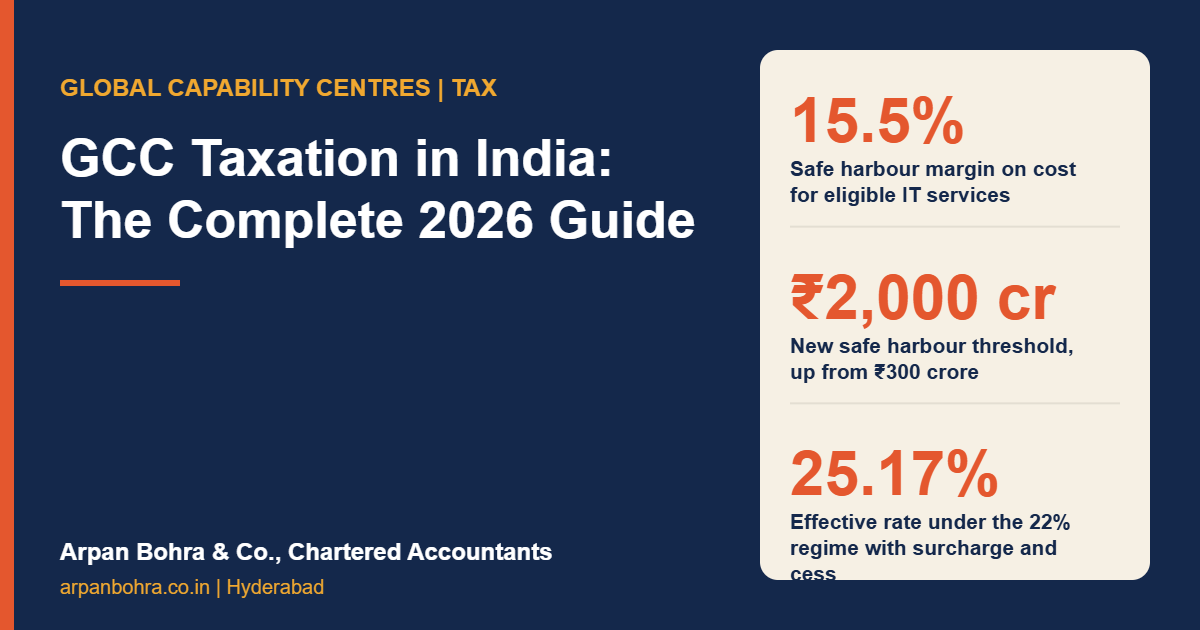
By Arpan Bohra & Co., Chartered Accountants, Hyderabad. Position of law as at 29 November 2026. General information, not advice for a specific case.
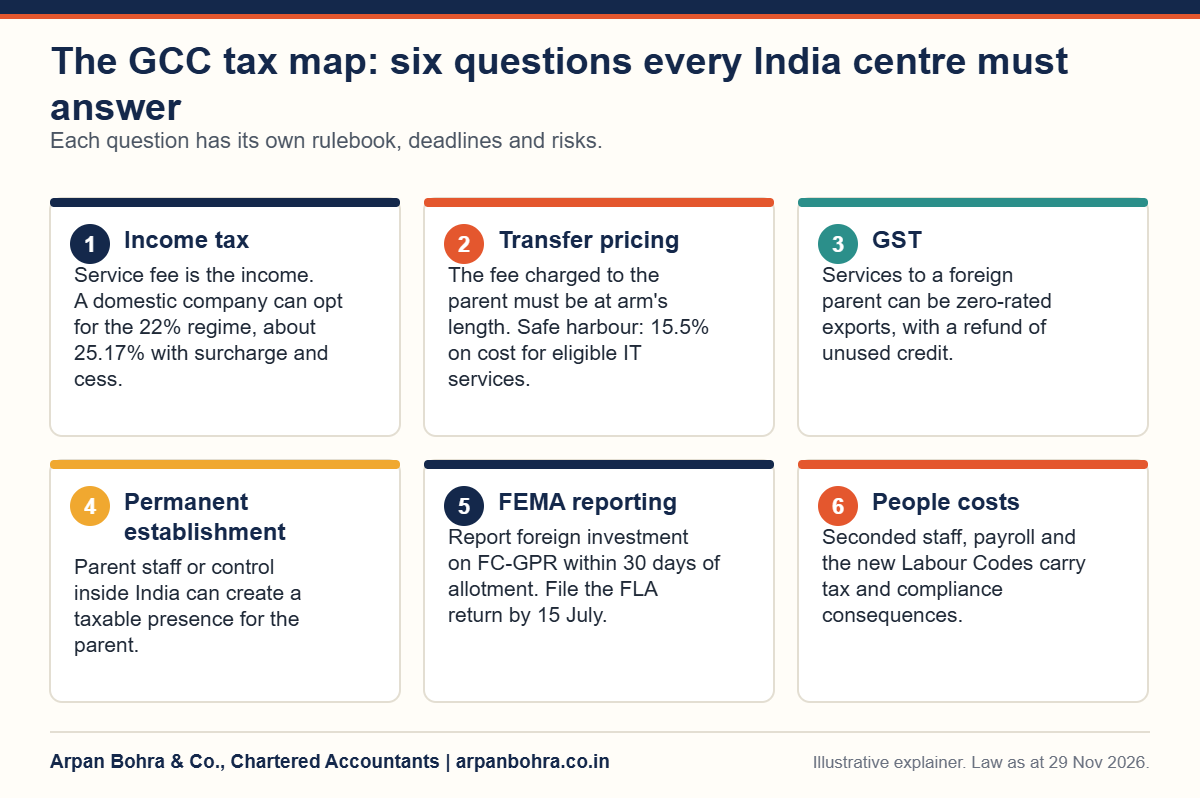
A US bank decides to open a technology centre in Hyderabad. Within a month, the India team is asking five questions. How will the centre be taxed? What margin can it charge the parent? Can it claim GST refunds? Will the parent’s executives visiting the office create tax trouble for the group? What must be reported to the RBI? Each question has its own rulebook, and the answers connect. This guide maps all of them in plain English.
1. Income tax: how the GCC’s profit is taxed
An Indian GCC company is taxed like any other domestic company. Its profit is the service fee received less its costs. A domestic company can opt for the concessional regime of 22% under section 200 of the Income-tax Act, 2025, subject to conditions, including giving up specified deductions. With the 10% surcharge and 4% cess, 22% works out to about 25.17%.
The Income-tax Act, 2025 applies to income from 1 April 2026 (tax year 2026-27). The Income-tax Act, 1961 continues to govern FY 2025-26 and earlier years, including assessments and appeals. For the change from the old law, see Income-tax Act 2025 for GCCs.
2. Transfer pricing: is the fee fair?
The parent and the GCC are related parties. Tax law therefore asks whether the fee the GCC charges is what two independent parties would have agreed. This is the arm’s length principle. Most GCCs work on a cost-plus basis: total costs plus a margin.
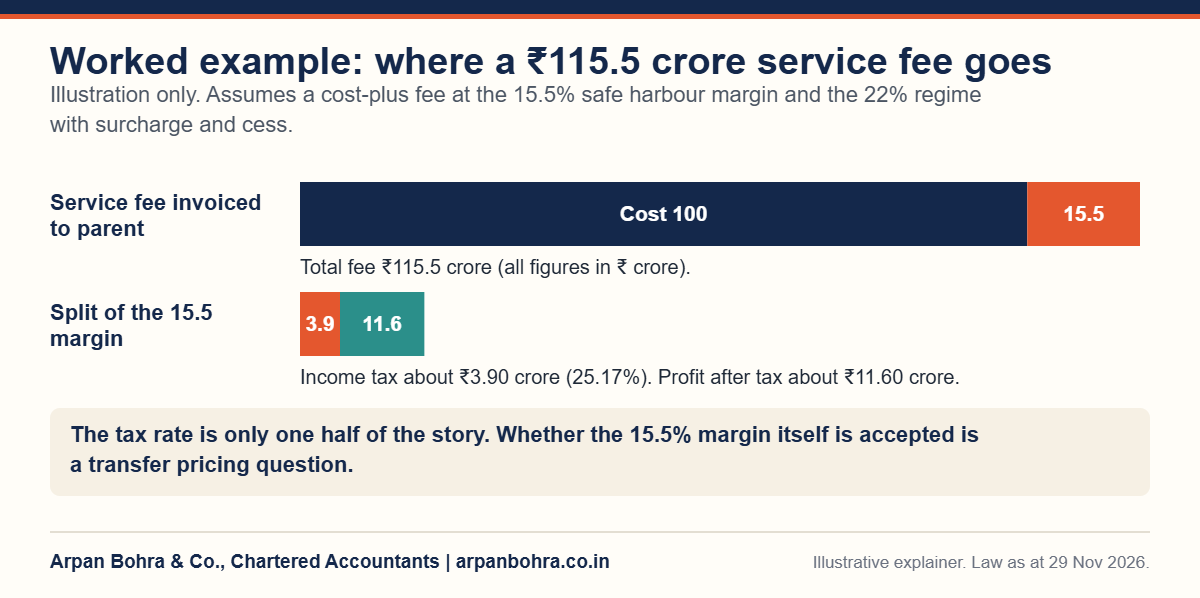
From 1 April 2026, eligible IT services (software development, IT-enabled services, knowledge process outsourcing and software-related contract R&D) can use a single safe harbour margin of 15.5% on operating cost, and the eligibility ceiling has risen from ₹300 crore to ₹2,000 crore. Safe harbour buys certainty, but it is not automatically the cheapest route. Read the full transfer pricing guide before electing.
3. GST: services to the parent as exports
Services supplied to a foreign group company can qualify as export of services, which is zero-rated under GST. The GCC can supply under a Letter of Undertaking without paying IGST and claim a refund of unused input tax credit. Five conditions must all be met, and a GCC structured as a branch of the foreign company can fail one of them. Also, the long-running intermediary dispute changed on 30 March 2026. All of this is explained in GST on GCC services.
4. Permanent establishment: the parent’s hidden risk
A GCC subsidiary is not, by itself, a permanent establishment (PE) of the parent. The risk arises if the parent’s own people or decision-making in India amount to a taxable presence. The Supreme Court’s 2025 Hyatt ruling shows that control in substance, not paperwork, decides the outcome. See PE risk for GCC parents.
5. FEMA: report the foreign investment
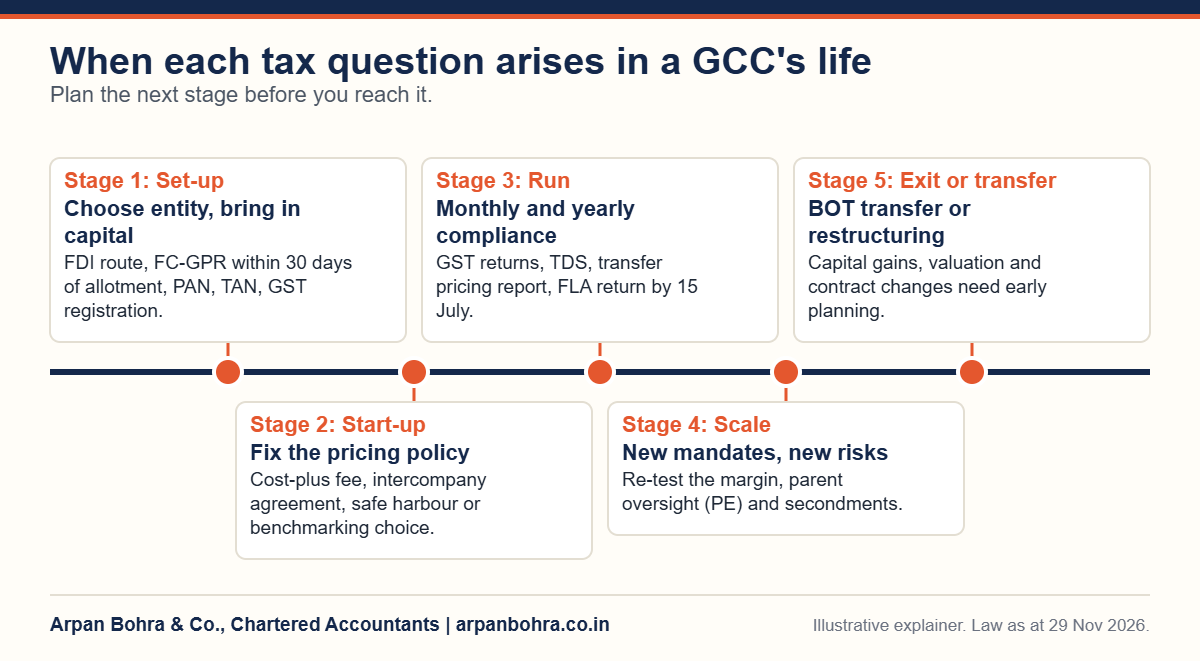
Most IT and business-process sectors allow up to 100% foreign investment under the automatic route, subject to conditions. Once shares are allotted to the foreign parent, the company must file Form FC-GPR within 30 days of allotment. Shares must be allotted within 60 days of receiving the foreign funds. Every year, the company that holds foreign investment must also file the Foreign Liabilities and Assets (FLA) return by 15 July. For the step-by-step process, see our guide to FEMA foreign investment reporting.
6. People costs: secondees, payroll and Labour Codes
Many GCCs begin with expatriate or secondee leaders. Whether the parent’s recharge of their cost attracts GST is a live area of dispute, covered in secondment and GST. Separately, the four Labour Codes took effect on 21 November 2025. Wages must generally form at least 50% of total remuneration, and fixed-term employees qualify for gratuity after one year. Central and state rules are still being finalised in parts, so payroll structures need a fresh look.
Choosing the structure first
Subsidiary, branch, LLP or build-operate-transfer: the choice changes the GST, PE and income tax outcome. It is the hardest thing to undo later. See GCC structure and tax.
- Treating recharges from the parent as a “no-tax” internal matter, when GST reverse charge and transfer pricing can both apply.
- Setting the markup once and never testing it against actual results.
- Letting parent executives work from the GCC office with no written governance protocol.
- Filing FEMA reports late because the allotment date was not tracked.
- Assuming export status under GST for a GCC set up as a branch.
Frequently asked questions
Is a GCC’s income taxable in India?
Yes. A GCC that is an Indian company is taxed on its income in India. GST zero-rating of exports is a different concept: it relates to GST, not to income tax.
What is the transfer pricing safe harbour margin for GCCs?
For eligible IT services, 15.5% on operating cost, for operating revenue up to ₹2,000 crore, effective from 1 April 2026. Eligibility depends on the nature of services and the risk profile of the GCC.
Can a GCC claim a GST refund?
If its services qualify as zero-rated exports, it can claim a refund of unutilised input tax credit, subject to the conditions and time limits in the GST law.
Does a GCC create a permanent establishment for its foreign parent?
Not automatically. The question is whether the parent’s own people, premises or control in India create a taxable presence. It depends on the facts and on the applicable tax treaty.
Which law applies to FY 2025-26 income?
The Income-tax Act, 1961. Income from 1 April 2026 falls under the Income-tax Act, 2025.
Is this guide specific to Hyderabad?
The tax rules are national. Hyderabad-based centres around Kondapur, Gachibowli and HITEC City face the same rules. For a location-led view, see our earlier article on GCCs in Hyderabad: tax, GST and transfer pricing basics.
- Transfer pricing for GCCs: the 15.5% safe harbour
- GST on GCC services: export, LUT, refund and the intermediary change
- PE risk for GCC parent companies after the Hyatt ruling
- Subsidiary, branch, LLP or BOT: the tax view
- Secondment of employees and GST
- GCC transfer pricing audit issues and dispute routes
- Income-tax Act 2025: what changes for GCCs
Takeaway. A GCC’s tax position is built in layers: structure, pricing, GST, parent oversight and reporting. A decision in one layer changes the others, so they are best planned together before operations begin.
Arpan Bohra & Co., Chartered Accountants, Hyderabad. Website: https://www.arpanbohra.co.in/ | Email: ab@arpanbohra.co.in. This article is for general information only. Tax law changes frequently and outcomes depend on facts, so consult a qualified professional before acting.
This article is for general information and is not professional advice. Law and rates change; please consult us before you act.