

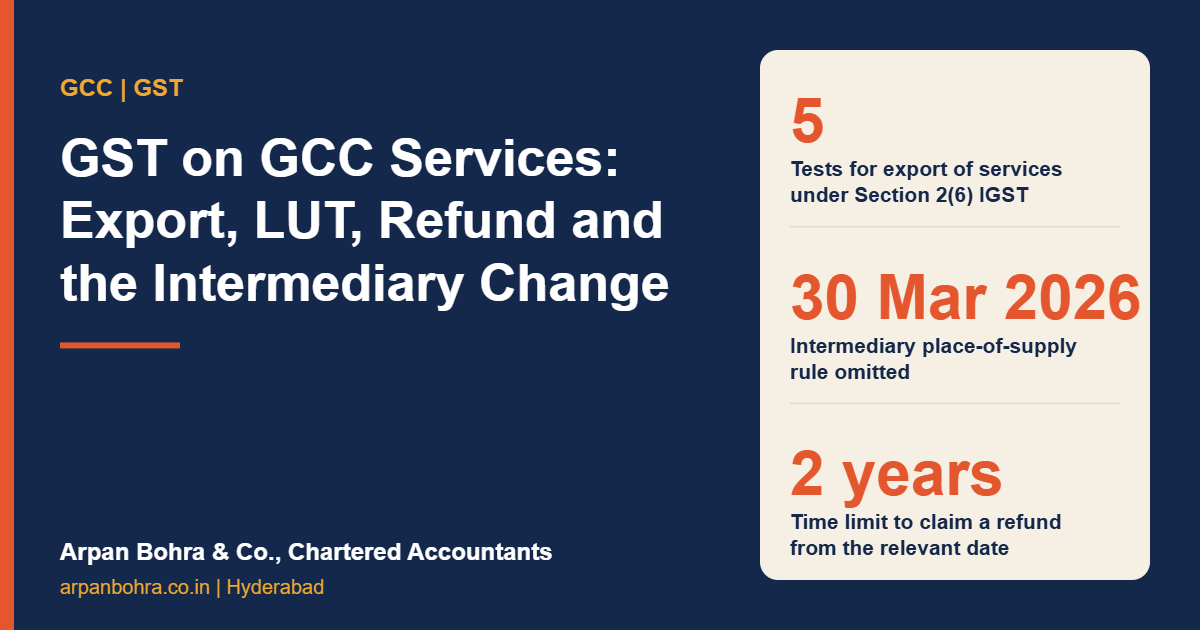
By Arpan Bohra & Co., Chartered Accountants, Hyderabad. Position of law as at 29 November 2026. General information, not advice for a specific case.
A Hyderabad GCC invoices its US parent ₹115.5 crore for the year. Should the invoice carry IGST? If it should not, can the GCC still recover the GST it paid on rent, software and professional fees? These two questions decide the GCC’s cash flow. The answers depend on whether the services qualify as an export under GST, and in 2026 the law on one disputed point changed.
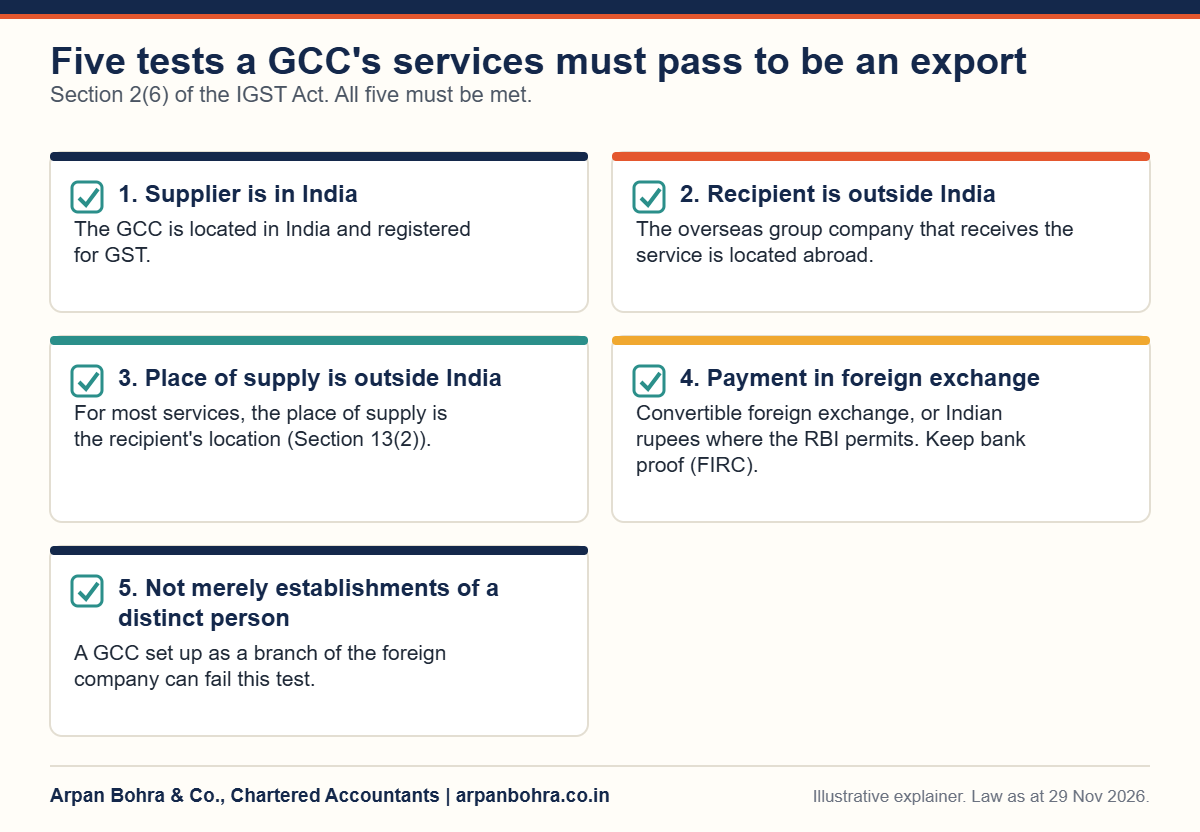
The five tests for an export of services
A service is an export of services only if all five conditions are satisfied. Miss one, and the supply is a domestic supply, taxable at the normal rate.
Why structure matters: subsidiary or branch
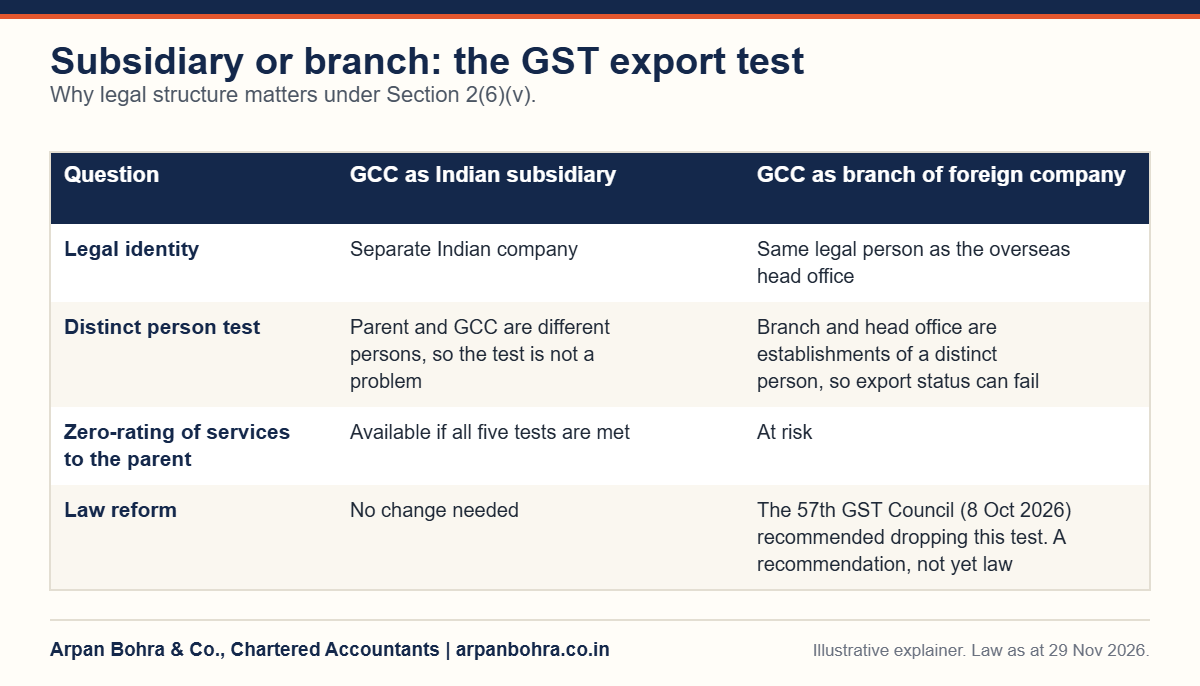
The fifth test asks whether the supplier and the recipient are “merely establishments of a distinct person”. A branch in India and its head office abroad are the same legal person and are treated under GST as establishments of a distinct person. A GCC set up as a separate subsidiary does not have this problem. This is one reason most GCCs are subsidiaries. More on the choice in GCC structure and tax.
The intermediary change from 30 March 2026
For years, Section 13(8)(b) of the IGST Act made the place of supply of “intermediary services” the location of the supplier, which meant India. An intermediary arranges or facilitates a supply between two other parties; it does not supply on its own account. Because the place of supply was India, such a service could never be an export, even if the customer was abroad.
The Finance Act 2026 (Section 157) omitted that clause. Without it, the default rule in Section 13(2) applies, and the place of supply is the recipient’s location. The Finance Act received assent on 30 March 2026, and the omission is read as effective from that date. The definition of “intermediary” itself has not changed.
Letter of Undertaking and the refund
A registered person making zero-rated supplies can supply without paying IGST by furnishing a Letter of Undertaking in Form GST RFD-11. It is furnished for a financial year, before the first export supply of that year. The alternative is to pay IGST and claim a refund of IGST. Most GCCs prefer the LUT route to protect working capital.
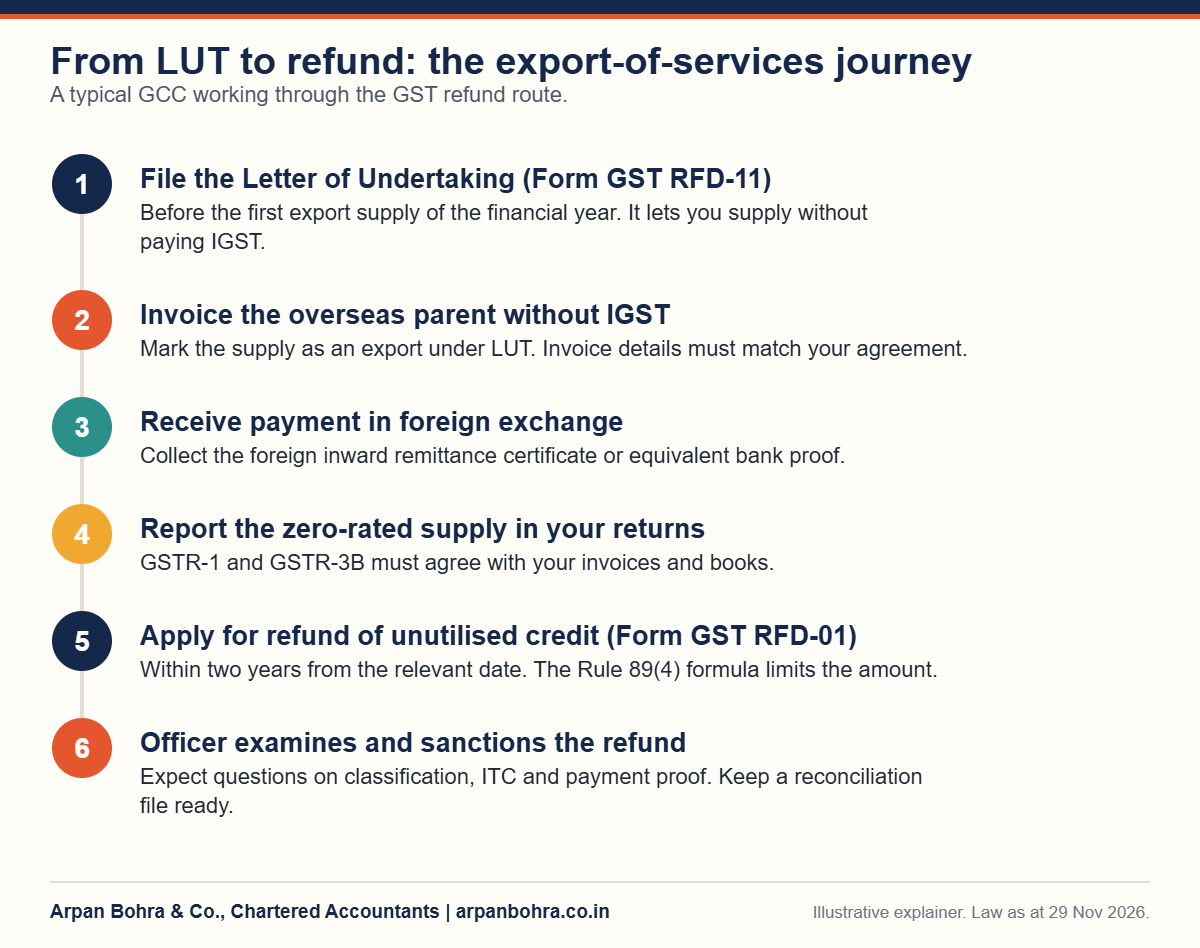
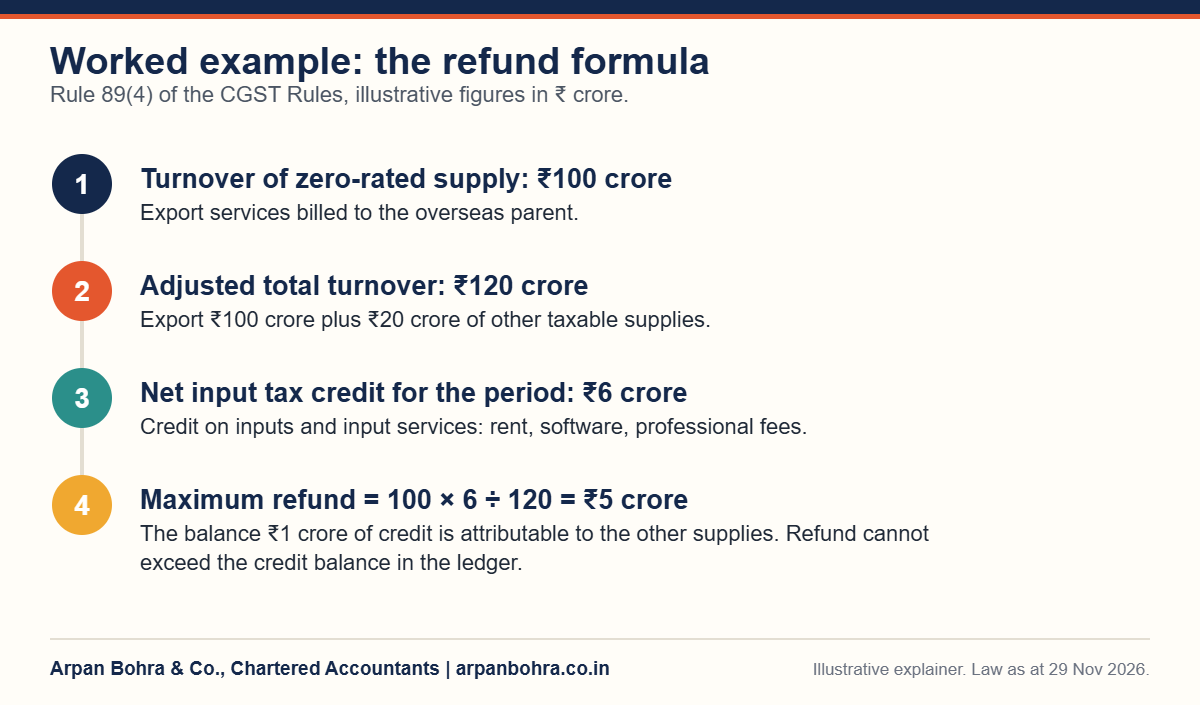
The refund of unutilised credit is limited by the formula in Rule 89(4) of the CGST Rules: zero-rated turnover multiplied by net input tax credit and divided by adjusted total turnover. The claim must be filed within two years from the relevant date.
What the 57th GST Council recommended
On 8 October 2026, the 57th GST Council recommended a phased shift to faster, system-driven refunds. This includes a shorter acknowledgement period (from 15 to 10 days) and 90% provisional sanction for eligible zero-rated and inverted duty structure claims. It also recommended omitting the distinct-person test in Section 2(6)(v). These are recommendations. They take effect only after legislative amendments, rules and notifications. See our summary of the 57th GST Council meeting.
Other GST points for GCCs
- Imports from the parent: management or technology recharges from the overseas group company can attract GST on a reverse charge basis. Credit is generally available if the service is used for business.
- Secondees: the recharge of seconded employees’ cost is a separate disputed area. See secondment and GST.
- Payment proof: mismatches between invoices, bank remittances and returns are a frequent reason for refund queries.
- Charging IGST to the overseas parent by default, then struggling to reverse it.
- Forgetting to renew the LUT for the new financial year.
- Treating a GCC branch as eligible for export without testing the distinct-person condition.
- Receiving part of the payment in rupees from a local account without checking RBI permission.
- Claiming a refund without reconciling returns, books and bank proof.
Frequently asked questions
Are GCC services to the parent always exports?
No. All five conditions of Section 2(6) must be met. Structure, payment and place of supply all matter.
Do I pay IGST if the parent is abroad?
Not if the supply qualifies as an export and you supply under a valid LUT. Otherwise you pay IGST and can claim a refund.
What changed for intermediary services?
Section 13(8)(b) of the IGST Act was omitted by the Finance Act 2026. The place of supply now follows the default rule, which is the recipient’s location. The definition of intermediary is unchanged.
How long do I have to claim a refund?
Two years from the relevant date, as defined in Section 54 of the CGST Act.
Does the 57th Council’s recommendation apply already?
No. It is a recommendation that needs amendments or notifications before it has legal effect.
Takeaway. For a GCC, GST is mostly a question of proof: the right structure, the right place of supply, the right LUT and clean payment records. Get those four right and refunds are far more likely to be smooth.
Arpan Bohra & Co., Chartered Accountants, Hyderabad. Website: https://www.arpanbohra.co.in/ | Email: ab@arpanbohra.co.in. For general information only. Tax law changes frequently and outcomes depend on facts, so consult a qualified professional before acting.
This article is for general information and is not professional advice. Law and rates change; please consult us before you act.