

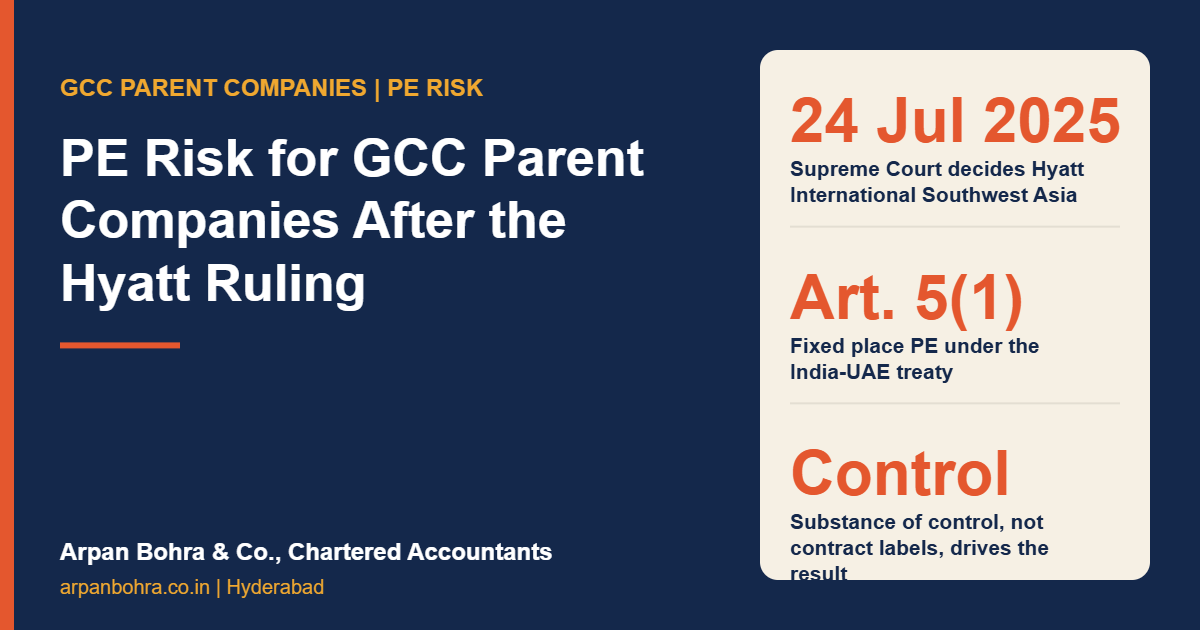
By Arpan Bohra & Co., Chartered Accountants, Hyderabad. Position of law as at 29 November 2026. General information, not advice for a specific case.
A vice-president from the US parent moves to Hyderabad for a year “to help the team”. She sits in the GCC office, approves the budget and decides who gets hired. Nothing in the paperwork has changed: the GCC is still a separate Indian company. But the tax question has. Has the parent itself now set up shop in India?
Three kinds of PE
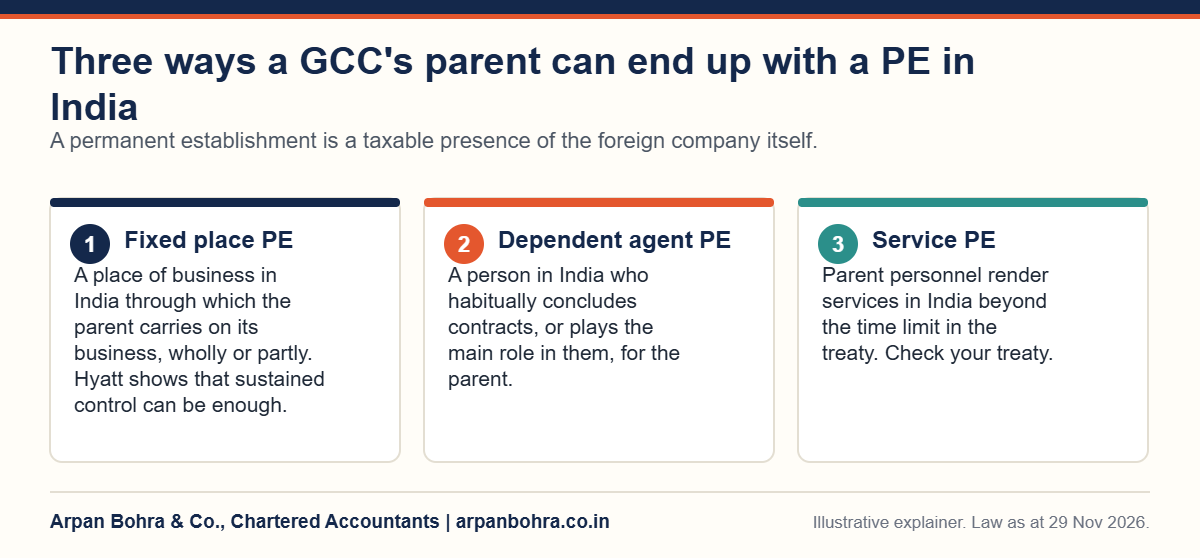
Treaties usually contain a time-based test for service PE. The India-UAE treaty considered in Hyatt, for example, refers to services rendered for more than nine months in any twelve-month period. Always read the treaty between India and the parent’s country.
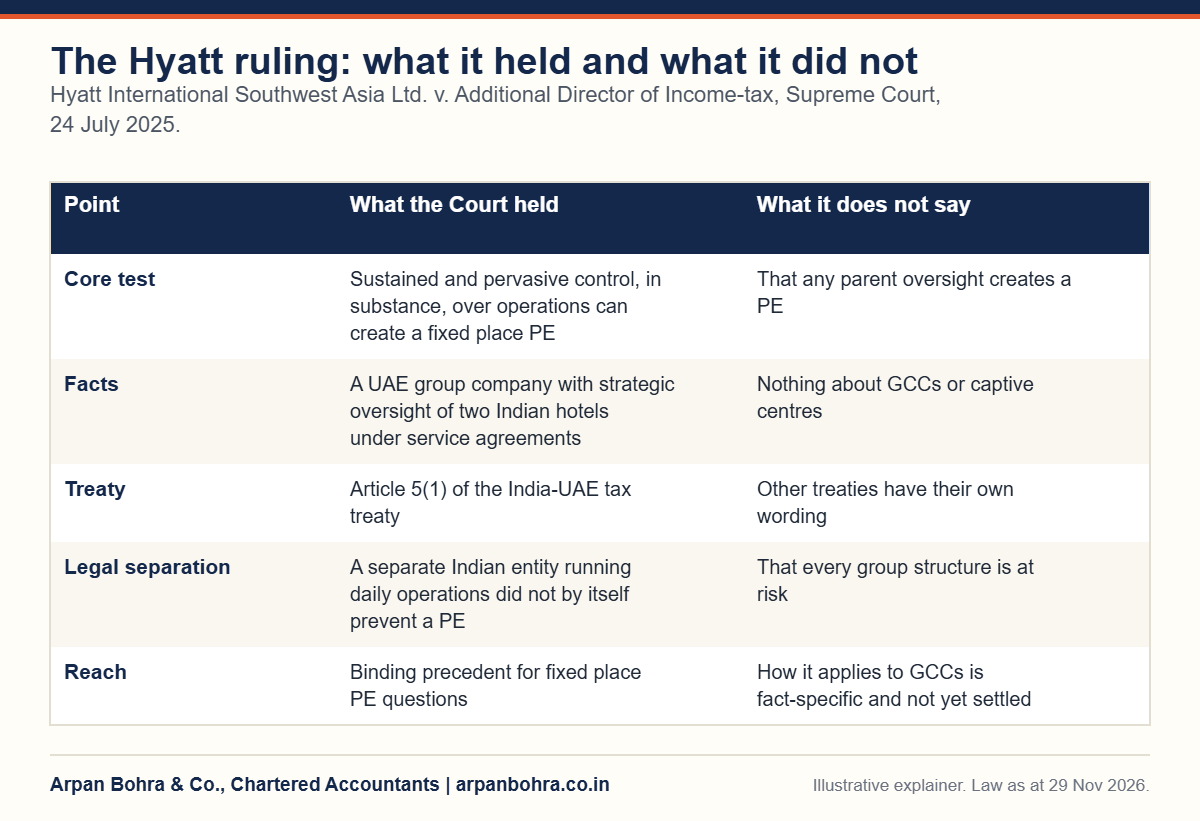
What the Supreme Court decided in Hyatt
Hyatt International Southwest Asia Ltd., a UAE tax resident, provided strategic oversight and know-how for two hotels in India under service agreements. The day-to-day operations were run by a separate Indian group company. The Supreme Court upheld the finding that Hyatt had a fixed place PE in India, because its control over the hotels’ strategic, operational and financial affairs was sustained, pervasive and enforceable. The ruling is reported as 2025 INSC 891.
Where GCC parents are exposed
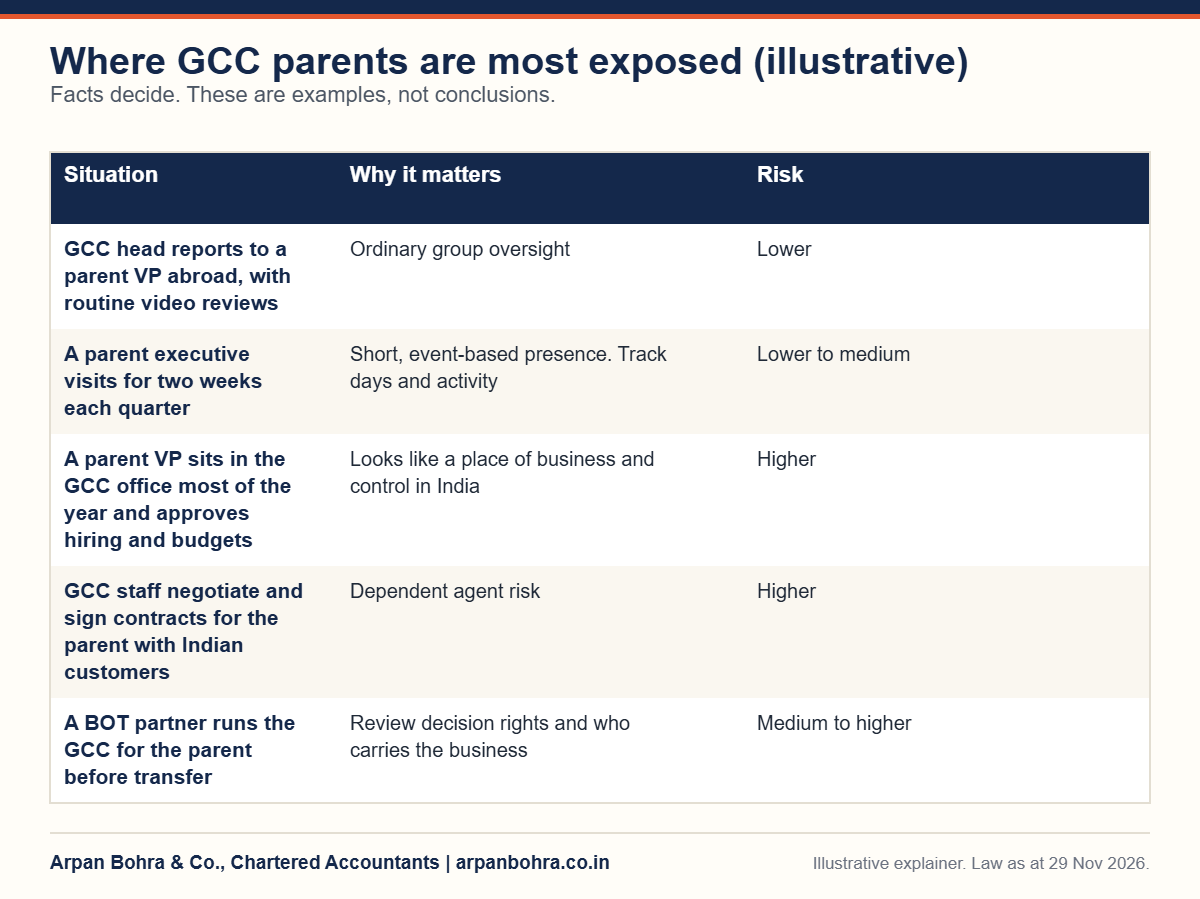
Build-operate-transfer arrangements deserve special attention. In the early phase, a service partner runs the centre for the parent. If the partner operates with significant authority on the parent’s behalf, the parent’s exposure should be assessed in the contract and in practice. See GCC structure and tax.
A practical governance review
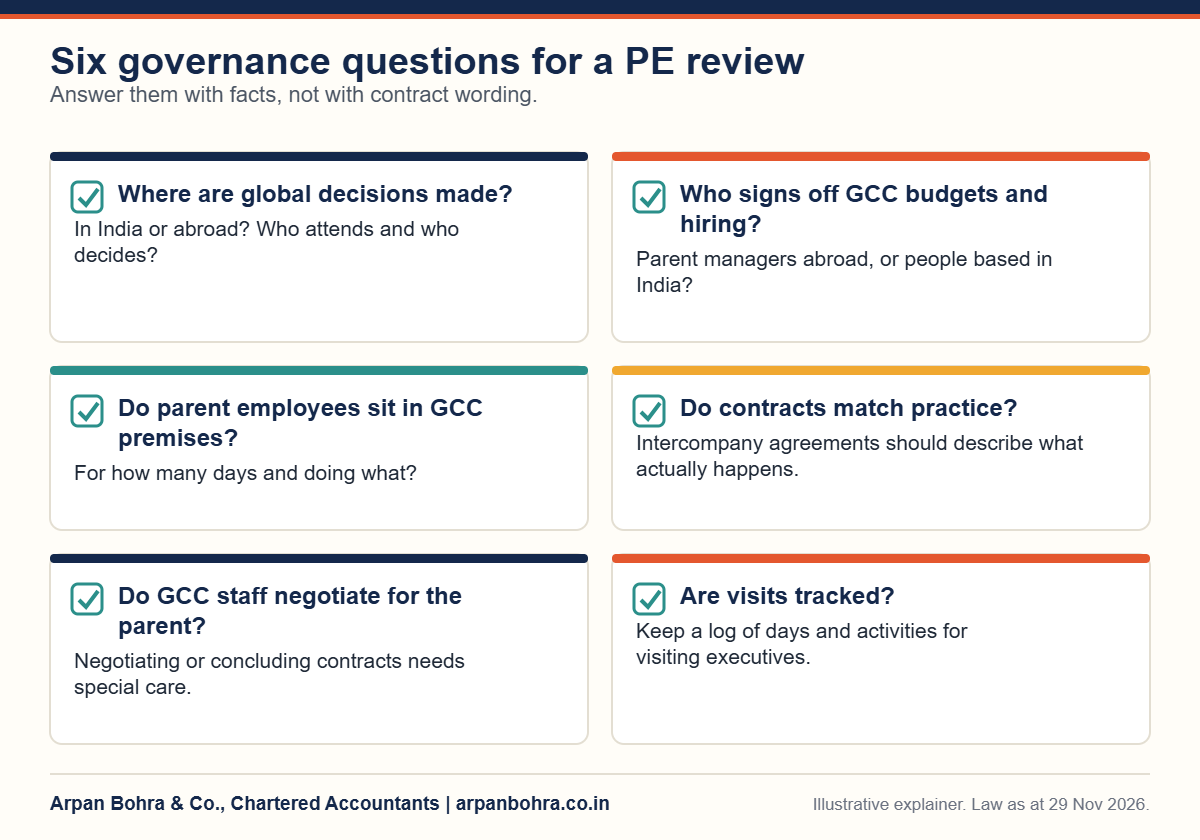
- Map decisions. Record where each major decision is taken and by whom.
- Align the paperwork. Intercompany agreements, delegation of authority and job descriptions should describe the real set-up.
- Control visits. Keep a simple log of executive days in India and what they did.
- Separate the GCC’s authority. GCC staff should act as GCC employees, with clear limits on negotiating or signing for the parent.
- Review annually. Mandate growth changes the risk. Re-test when new functions move to India.
Arm’s length pricing of the GCC’s own services remains the first line of defence, and safe harbour does not answer PE questions. How far arm’s length pay for the GCC reduces exposure for the parent depends on the kind of PE alleged and is not settled for every fact pattern.
- Assuming a separate Indian company is a complete shield.
- Sending executives to India without tracking days or activities.
- Letting GCC employees sign contracts for the parent informally.
- Writing agreements that do not match reality.
- Ignoring PE when the GCC expands into new global mandates.
Frequently asked questions
Does having a GCC create a PE for the parent?
Not automatically. The GCC is a separate taxpayer. The parent’s PE risk depends on the parent’s own presence, people and control in India.
Does Hyatt apply to GCCs?
It is a binding Supreme Court precedent on fixed place PE, but it was decided on hotel-sector facts and one treaty. Its application to GCCs depends on the facts.
What happens if a PE is found?
The profits attributable to the PE are taxable in India in the foreign company’s hands, along with interest and possible penalties. The foreign company may also have filing duties in India.
Can visiting executives create a PE?
Short visits for specific events are different from a standing presence with decision-making. Duration, purpose and authority all matter.
Is PE the same as transfer pricing?
No. Transfer pricing tests the price of the GCC’s services. PE tests whether the parent itself is taxable in India. A GCC may have to deal with both.
Takeaway. PE risk is a governance question dressed as a tax one. The groups that handle it well write down where decisions are made, keep their contracts honest and revisit the answer as the GCC grows.
Arpan Bohra & Co., Chartered Accountants, Hyderabad. Website: https://www.arpanbohra.co.in/ | Email: ab@arpanbohra.co.in. For general information only. Tax law changes frequently and outcomes depend on facts and the applicable treaty, so consult a qualified professional before acting.
This article is for general information and is not professional advice. Law and rates change; please consult us before you act.