

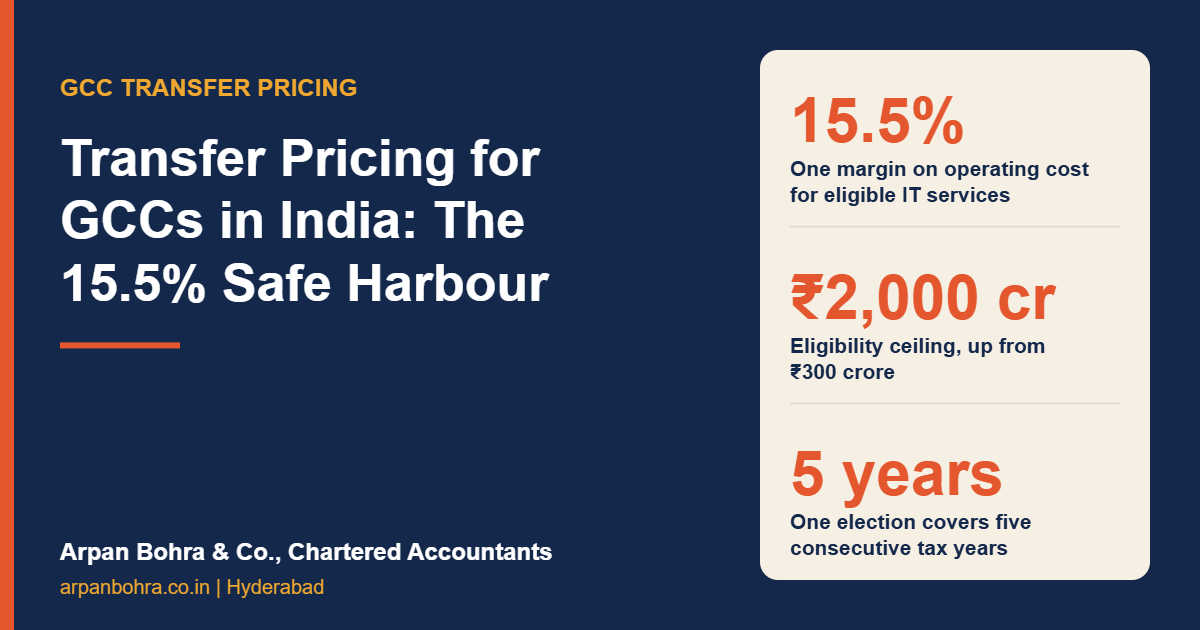
By Arpan Bohra & Co., Chartered Accountants, Hyderabad. Position of law as at 29 November 2026. General information, not advice for a specific case.
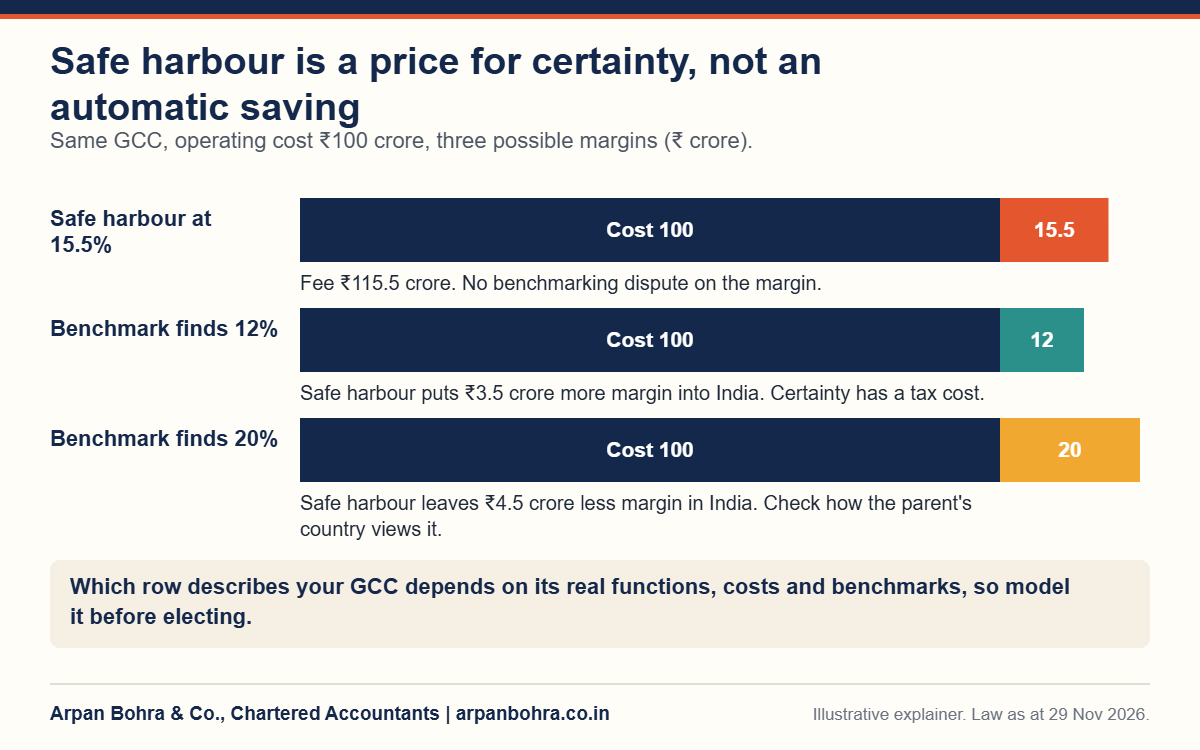
A GCC in Hyderabad spends ₹100 crore a year on people, rent and technology. Its US parent asks a simple question: what should we pay you? Whatever number is chosen, the Indian tax officer will ask whether it is fair. That is transfer pricing, and for GCCs it is the largest source of tax disputes. From 1 April 2026, the rules gave eligible GCCs a far wider safe route.
How GCCs are priced
Most GCCs work like a cost centre with a markup. The GCC adds up its operating costs (salaries, rent, software, depreciation and other operating expenses) and charges the parent that amount plus a percentage. Under safe harbour, that percentage is the prescribed margin. The crucial detail is what counts as operating cost under the rule, because the margin is calculated on that base. A cost wrongly left out lowers the fee and can defeat the safe harbour.
What changed from 1 April 2026
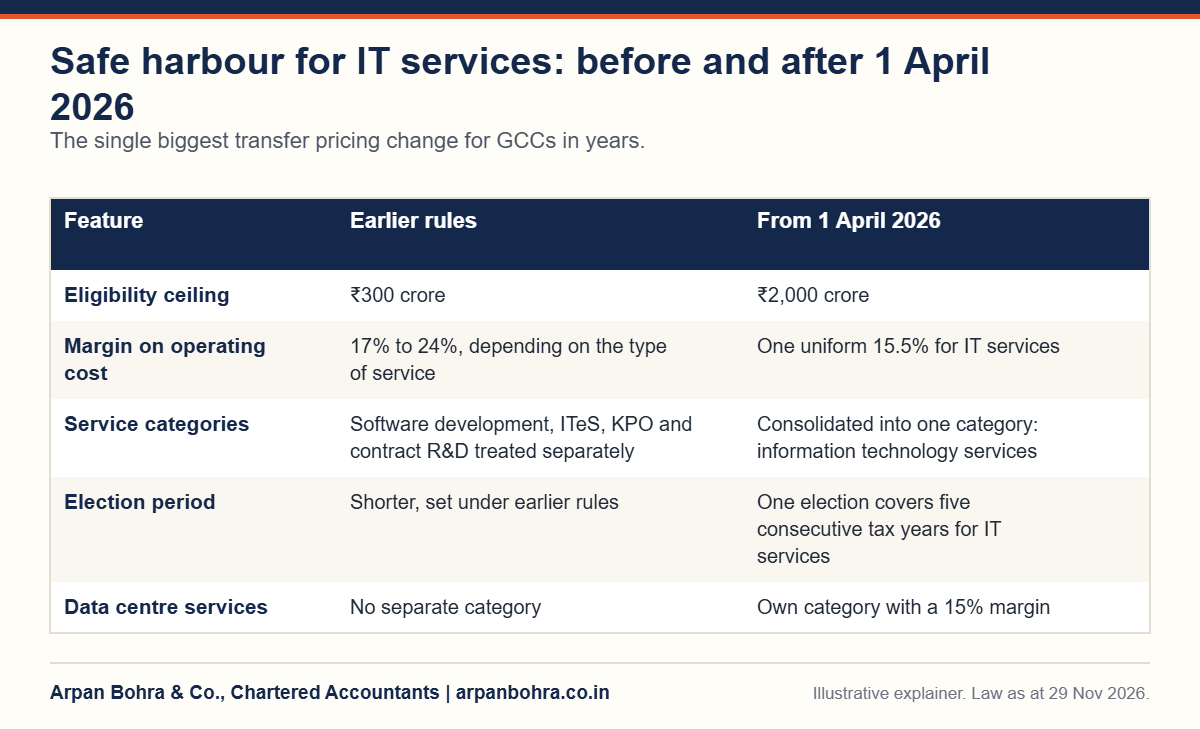
The Union Budget 2026-27 proposed, and the Income-tax Rules, 2026 now implement, a revised safe harbour for information technology services. Four older segments (software development, IT-enabled services, knowledge process outsourcing and software-related contract R&D) are merged into one category, with one margin.
Who can use it
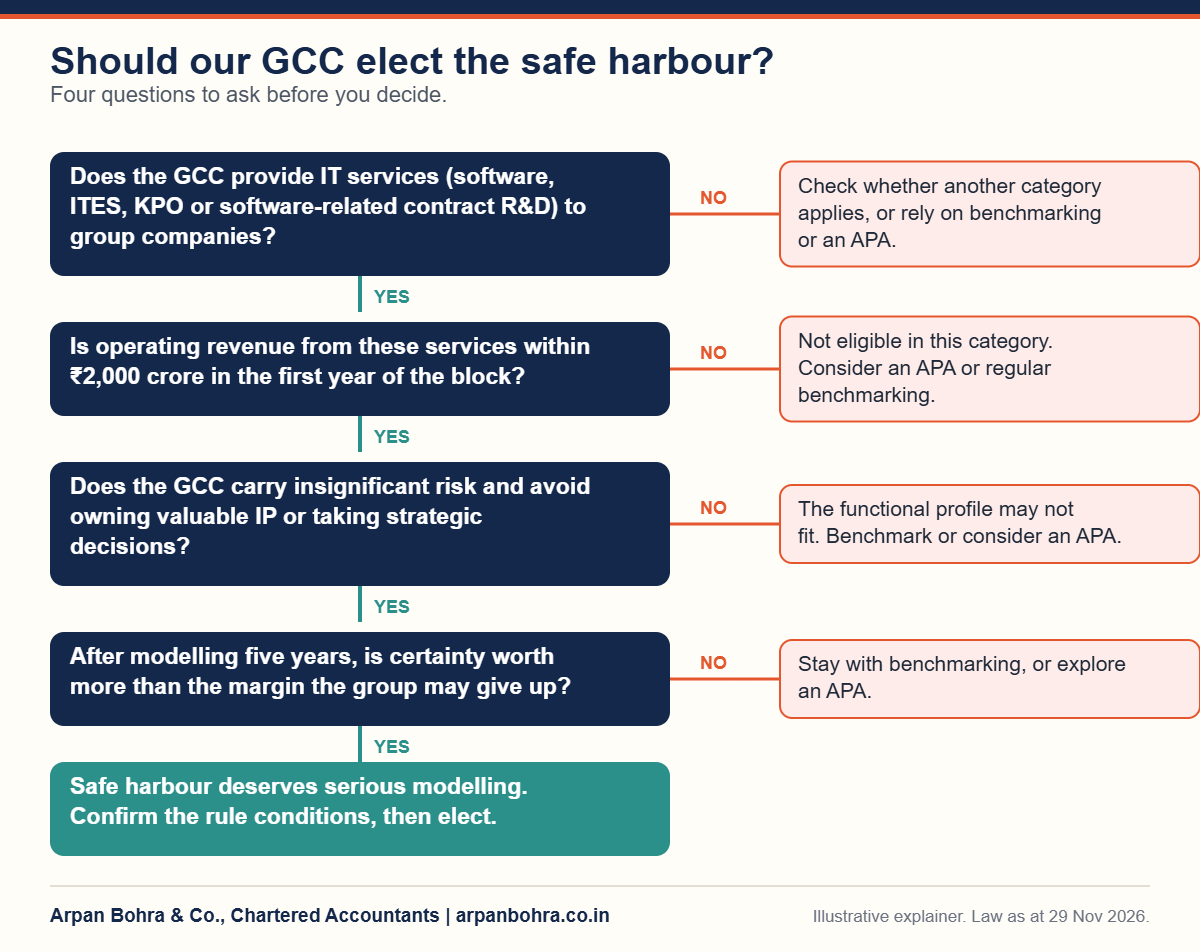
Safe harbour is built for routine, low-risk service providers. The rules look at what the GCC really does, not what the contract calls it.
| Illustrative GCC | What it does | Likely position |
|---|---|---|
| GCC A: software testing and support for the parent, revenue ₹400 crore | Routine work under parent direction | Good candidate. Model the margin. |
| GCC B: builds and owns a product platform, makes strategic roadmap decisions | Entrepreneurial functions and valuable IP | Safe harbour unlikely to fit. Benchmark or APA. |
| GCC C: IT services revenue of ₹2,500 crore in the first year | Routine work, but above the ceiling | Outside this safe harbour. Consider APA. |
The examples above are invented illustrations, not real client matters.
Safe harbour, APA or regular benchmarking?
| Route | What you get | Watch-out |
|---|---|---|
| Safe harbour | Pricing accepted without scrutiny of the margin. Simple compliance. | Fixed margin may be higher or lower than the true arm’s length result. The other country is not bound by it. |
| Advance pricing agreement (APA) | A negotiated agreement with the tax authority that covers future years and, in some cases, earlier years through roll-back. | Takes time and detailed disclosure. Suits larger or more complex GCCs. |
| Regular benchmarking | Price at the independent comparable range, defended in documentation. | Each year is open to audit and adjustment, which is the main source of GCC disputes. |
Other points to keep in mind
- Data centre services now have their own category with a 15% margin, separate from the 15.5% for IT services.
- Safe harbour covers the transfer pricing question only. Documentation, GST on the same fee and foreign-exchange realisation remain separate duties. See GST on GCC services.
- Years before 1 April 2026 continue to be governed by the earlier safe harbour rules and the Income-tax Act, 1961. Pending audits are discussed in GCC transfer pricing audit issues.
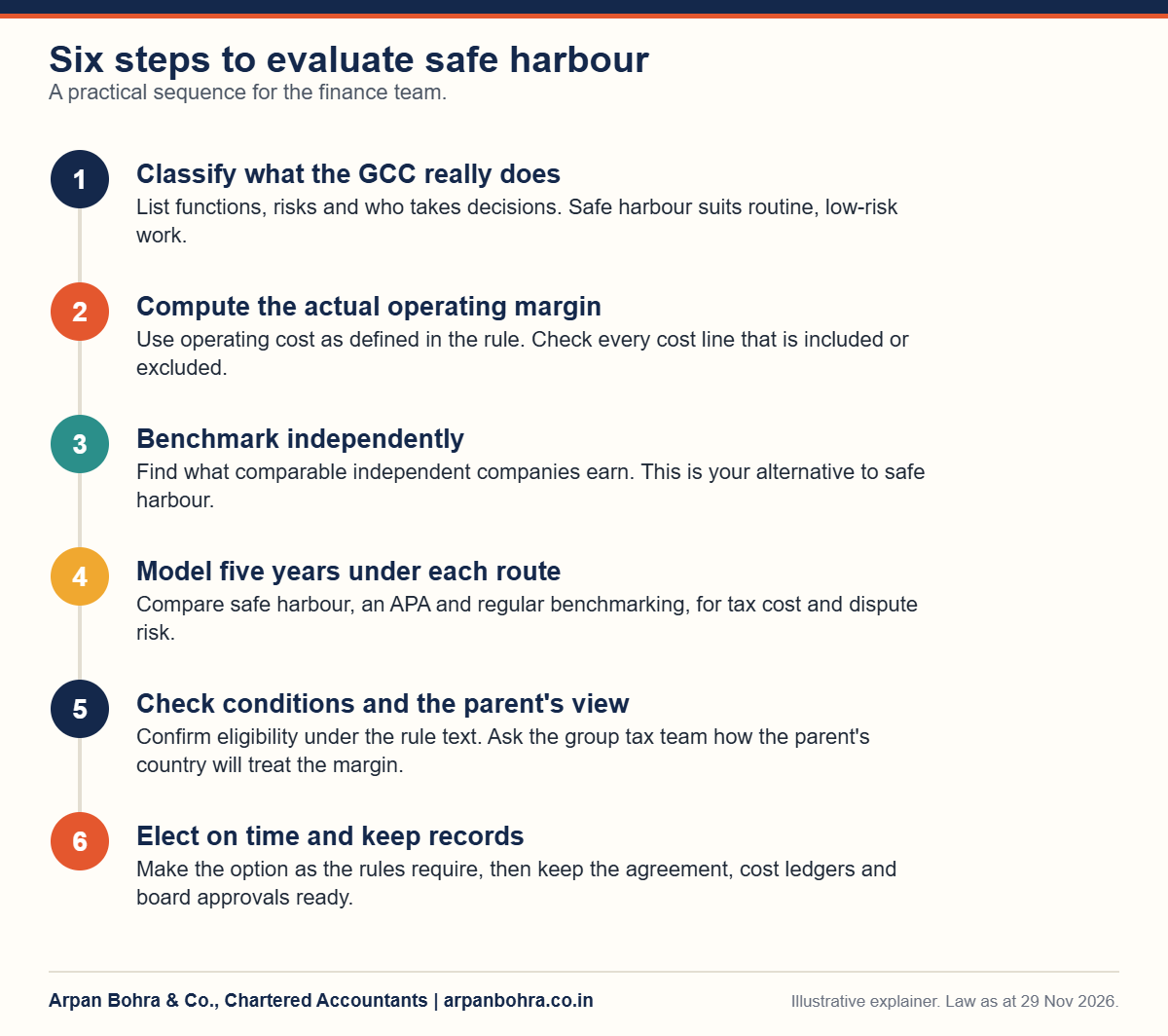
- Opting in because the margin looks attractive, without checking the functional profile.
- Calculating the margin on the wrong cost base.
- Forgetting that a five-year election cannot be treated as a one-year experiment.
- Not telling the parent’s tax team, so the same fee is challenged abroad.
Frequently asked questions
What is the safe harbour margin for GCCs from 1 April 2026?
15.5% on operating cost for eligible information technology services, with an operating revenue ceiling of ₹2,000 crore.
Does safe harbour apply automatically?
No. The GCC must be eligible and must make the election as the rules require.
How long does one election last?
For IT services, one election is intended to cover five consecutive tax years.
Is safe harbour better than an APA?
Neither is better in every case. Safe harbour is simpler but fixed. An APA can suit larger or complex GCCs. Model both.
Does safe harbour bind the parent’s country?
Not necessarily. Another country’s tax authority is not automatically bound by India’s safe harbour, so group tax teams should check double-taxation exposure.
Takeaway. The revised safe harbour turns transfer pricing from a yearly argument into a five-year decision. It deserves the same discipline as any other long-term commitment: understand the functions, model the numbers and document the choice.
Arpan Bohra & Co., Chartered Accountants, Hyderabad. Website: https://www.arpanbohra.co.in/ | Email: ab@arpanbohra.co.in. For general information only. Tax law changes frequently and outcomes depend on facts, so consult a qualified professional before acting.
This article is for general information and is not professional advice. Law and rates change; please consult us before you act.