

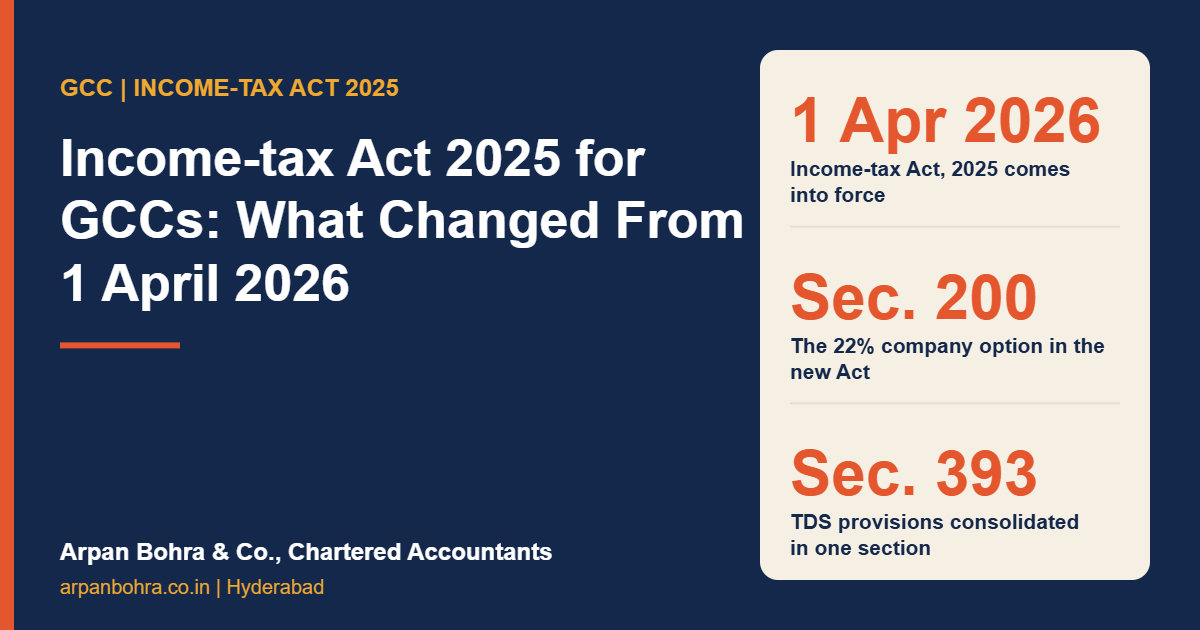
By Arpan Bohra & Co., Chartered Accountants, Hyderabad. Position of law as at 29 November 2026. General information, not advice for a specific case.
A GCC’s finance controller opens the first quarter’s files for FY 2026-27 and finds the section references have changed. The TDS table points to section 393. The 22% regime is under section 200. The word “assessment year” has gone. At the same time, the controller is still answering a transfer pricing notice for FY 2022-23 under the old Act. For GCCs, the new law is less a change of tax and more a year of running two laws side by side.
Old law and new law at a glance
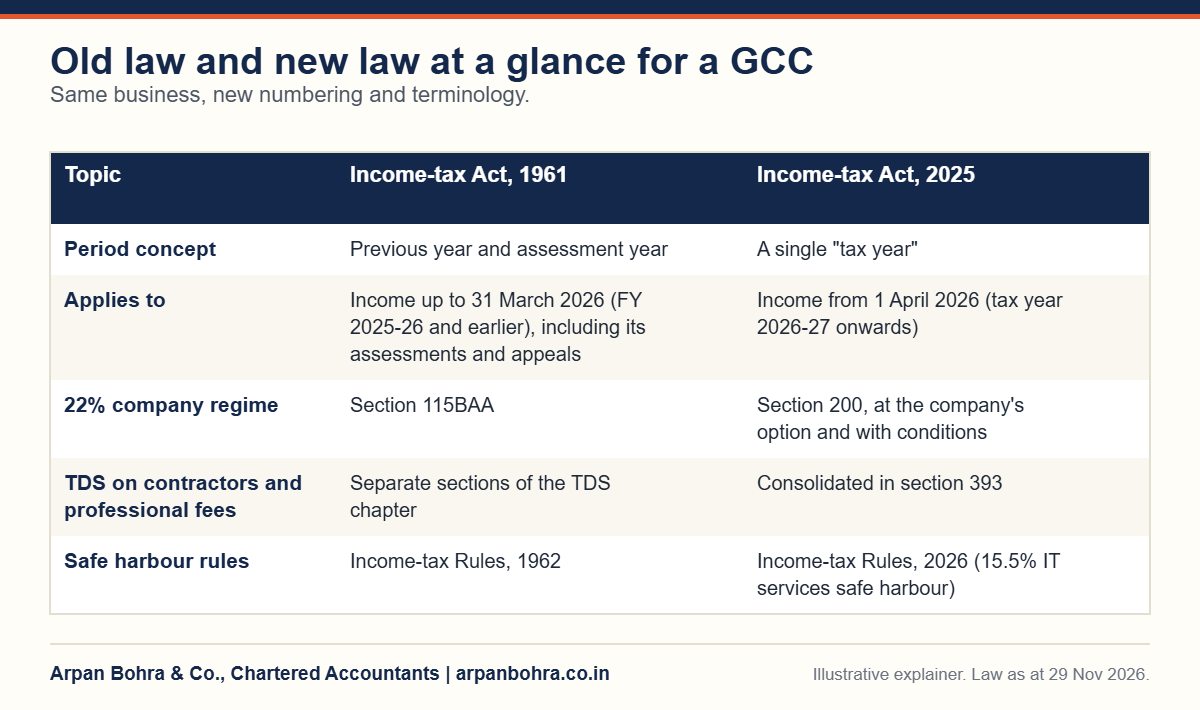
The central change is the “tax year”: income earned in the 12 months from 1 April is taxed in that same tax year, replacing the earlier distinction between the previous year and the assessment year. The CBDT has confirmed that income of FY 2025-26 remains under the 1961 Act and is assessed in assessment year 2026-27. Income from 1 April 2026 falls under the 2025 Act.
| Situation | Law that applies |
|---|---|
| Return for FY 2025-26 (assessment year 2026-27) | Income-tax Act, 1961 |
| Income earned from 1 April 2026 to 31 March 2027 | Income-tax Act, 2025 (tax year 2026-27) |
| Transfer pricing audit or appeal for FY 2023-24 | Income-tax Act, 1961 |
| Withholding on a payment made after 1 April 2026 | Check section 393 of the Income-tax Act, 2025 |
The 22% regime under section 200
A domestic company can still opt for a 22% tax rate. In the 2025 Act, this option is in section 200 and has conditions, including giving up certain deductions. With the 10% surcharge and 4% cess, the effective rate is about 25.17%. A GCC that already uses the regime does not lose it. A GCC that has deductions or incentives should compare the two paths each year. See also our reference article on income tax rates for tax year 2026-27.
Transfer pricing and safe harbour
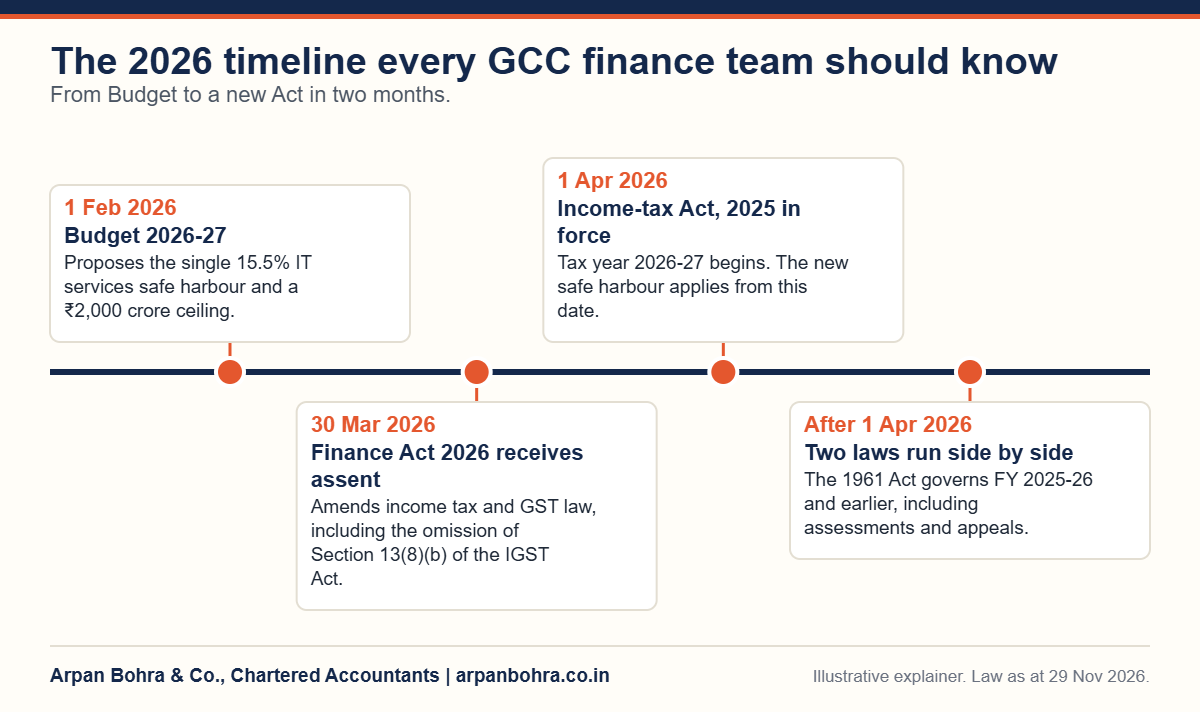
The arm’s length principle continues. What changed is the safe harbour. From 1 April 2026, the Income-tax Rules, 2026 provide a single 15.5% margin on operating cost for eligible IT services, a ₹2,000 crore ceiling and a five-year election. The rules also provide a 15% safe harbour for data centre services. See the full safe harbour guide and, for open audits, GCC transfer pricing audit issues.
Timeline of 2026
Other 2026 changes in the technology space
The Finance Act 2026 also introduced a tax exemption for foreign companies that provide global cloud services using data centres in India. This is relevant mainly to groups with infrastructure arms, not to a typical services GCC. A GCC with data centre operations should check whether the separate safe harbour category applies.
A transition checklist
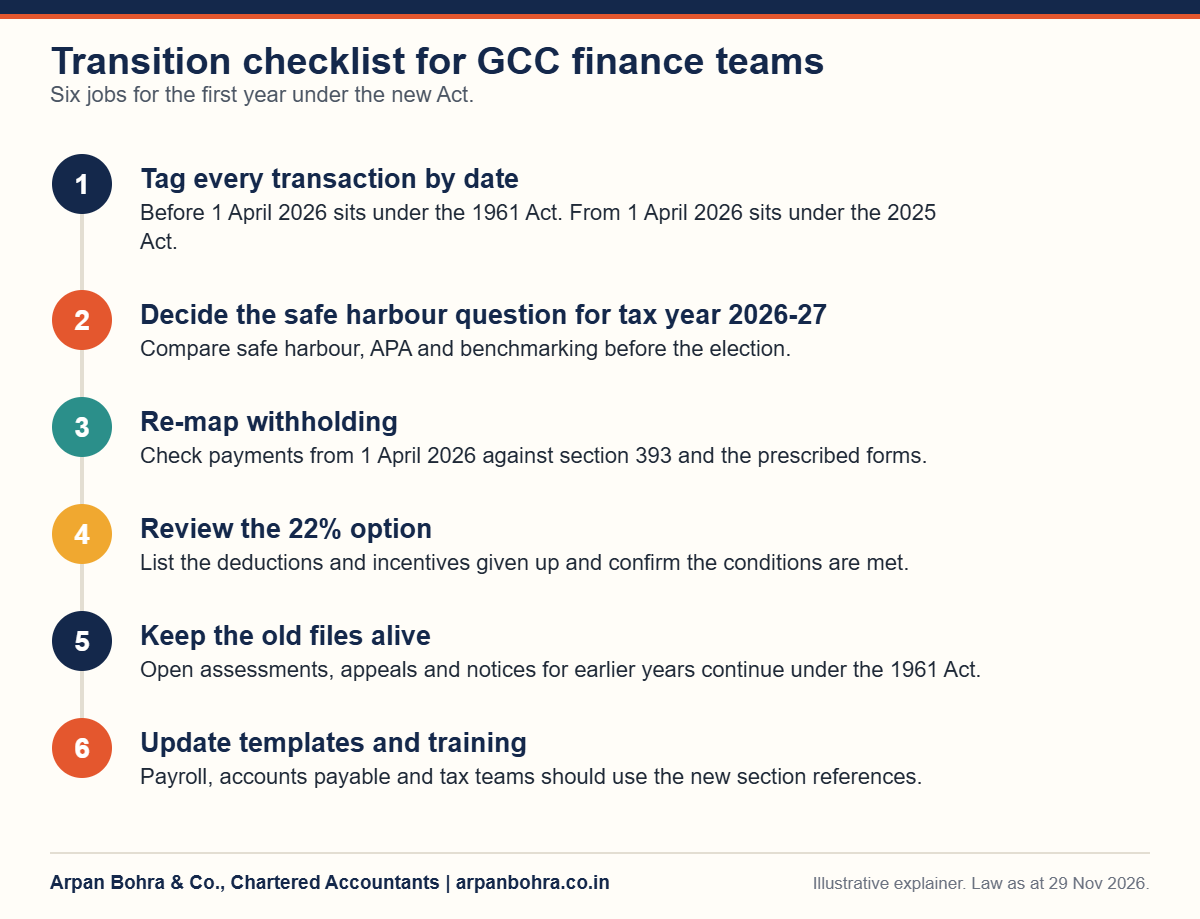
- Applying the new Act to FY 2025-26 income because the return is filed after 1 April 2026.
- Dropping the 1961 Act files while assessments and appeals are open.
- Using old section numbers on withholding certificates and templates.
- Assuming the 22% option needs no yearly review.
Frequently asked questions
When did the Income-tax Act, 2025 come into force?
On 1 April 2026. It applies from tax year 2026-27.
What is a tax year?
It replaces the previous year and assessment year. Income earned in the 12 months beginning 1 April is taxed in that same tax year.
Does the 22% regime continue?
Yes. It is available at a domestic company’s option under section 200 of the 2025 Act, with conditions.
Which Act applies to FY 2025-26?
The Income-tax Act, 1961, including for assessments and appeals concerning that year.
Where are the safe harbour rules now?
In the Income-tax Rules, 2026. From 1 April 2026, eligible IT services have a 15.5% margin and a ₹2,000 crore ceiling.
Did the new Act change the tax rates?
The Act was intended to reorganise and simplify the law rather than to change tax policy. Rates for each year are set out in the relevant Finance Act, so check the current rates for your income.
Takeaway. For GCCs, the new Act is mostly a mapping exercise plus one substantive change in the safe harbour. The safest approach is to tag every transaction by date, keep both rulebooks to hand and make the safe harbour decision deliberately.
Arpan Bohra & Co., Chartered Accountants, Hyderabad. Website: https://www.arpanbohra.co.in/ | Email: ab@arpanbohra.co.in. For general information only. Tax law changes frequently and outcomes depend on facts, so consult a qualified professional before acting.
This article is for general information and is not professional advice. Law and rates change; please consult us before you act.