

Every GST litigator has met the notice that quotes section 74 in full, says “fraud, wilful misstatement or suppression” in one breath and leaves the noticee guessing which of the three is alleged. Or the order that says only “reply has been considered”. Circular No. 258/04/2026-GST, dated 26 October 2026, is the Board’s attempt to address both ends of that problem in a single reference.
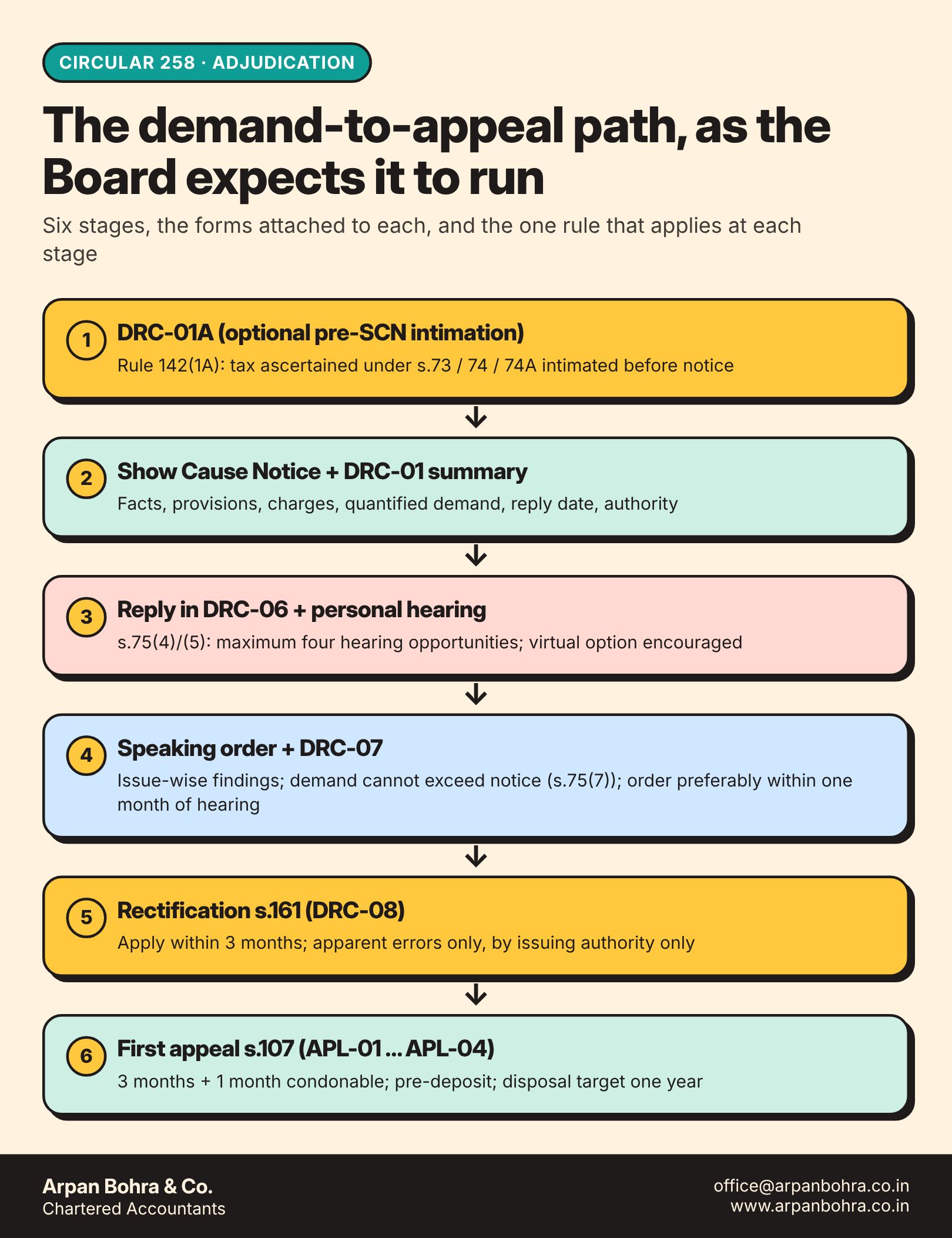
In short: it is a quality-control manual for the quasi-judicial chain under the CGST Act, 2017 — from the optional DRC-01A intimation to the First Appellate Authority’s order. It is addressed to officers, but nearly every paragraph is a standard against which a notice or order can be tested.
1. Before the notice: pre-SCN intimation
Rule 142(1A) allows the tax assessed as payable under section 73, 74 or 74A to be intimated in Part A of FORM GST DRC-01A before a notice is issued. The Circular says this should be done “wherever feasible”, because it lets the taxpayer clarify before formal proceedings begin.
2. The show cause notice
The Circular expects a notice to carry, ideally, six parts.
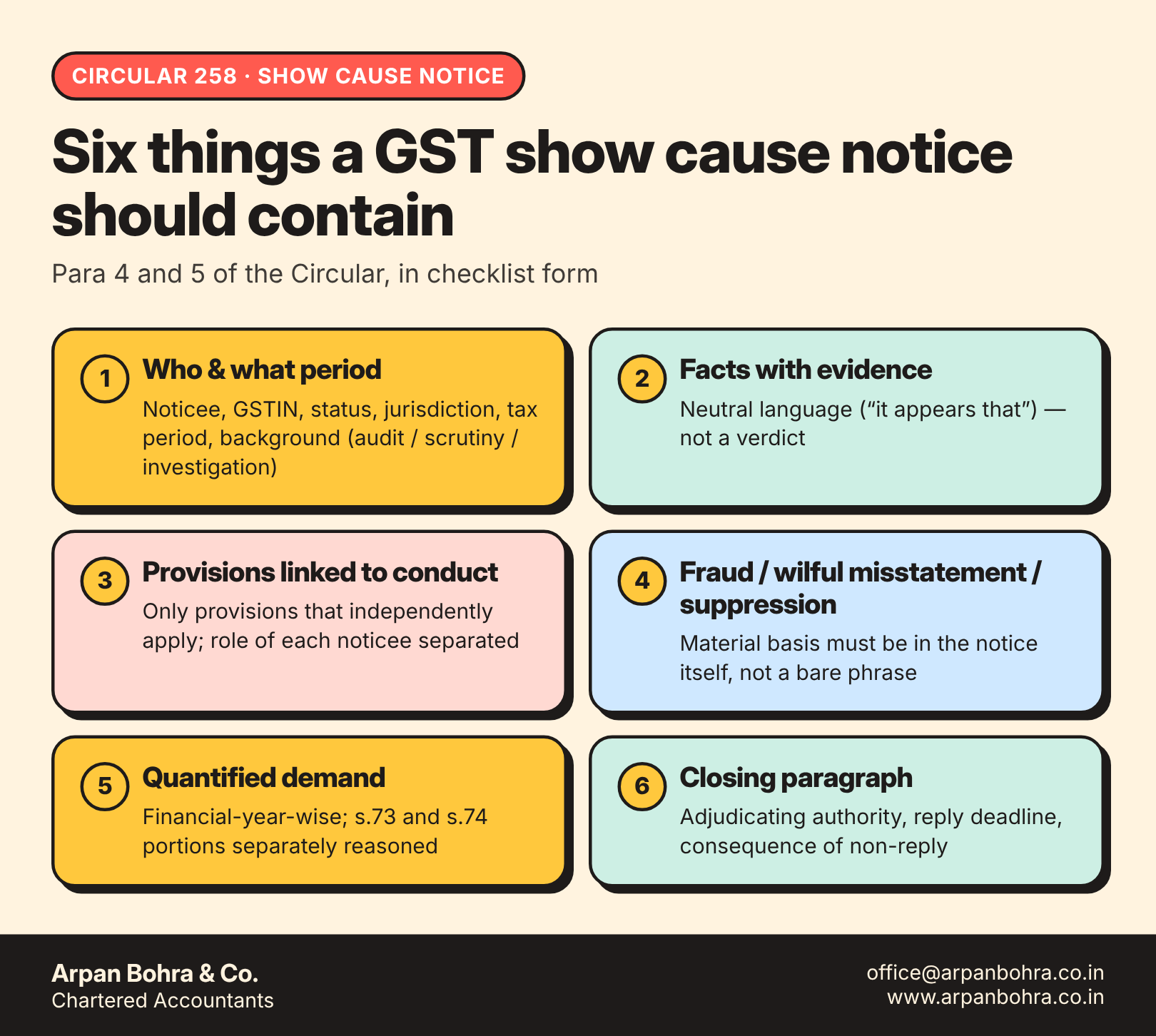
Two points deserve attention.
Notice must stand on its own. Para 4.4 relies on G.R. Infra Project Ltd v. State of Madhya Pradesh [(2026) 45 Centax 331 (S.C.), dated 19.08.2026, as cited in the Circular] for the proposition that what is needed to sustain a notice or order must be contained in it, and that a deficiency cannot later be cured. Para 4.1 cites the Telangana High Court in Nice Enterprises v. Deputy Commissioner (ST) [(2024) 21 Centax 554 (Telangana)] for the view that a notice merely reproducing statutory words violates natural justice. Reported coverage of the Supreme Court decision is available at LiveLaw.
Extended-period allegations. Paras 5 to 5.5 say the expressions “fraud”, “wilful misstatement” and “suppression” all import an intent to evade tax, citing the Andhra Pradesh High Court in Sriba Nirman Company v. Commissioner (Appeals) [(2025) 29 Centax 206 (A.P.)]. The Board states that section 74(1) or 74A(5)(ii) cannot be invoked merely for non-payment, or because a discrepancy surfaced in scrutiny; and that a second notice on the same facts and grounds for a later period is “generally not legally valid” unless new and independent grounds exist, later notices ordinarily going under section 73 or 74A(5)(i).
For notices relating to FY 2024-25 onwards, the Circular records that section 74A consolidates the time limit into a single 42-month period from the due date of the annual return, but the notice must still separately quantify and justify any portion alleged to involve intent to evade tax (para 6).
Other directions on notices: no parallel proceedings by CGST and State officers on the same subject matter (section 6; Armour Security (India) Ltd v. Commissioner, CGST, Delhi East [(2025) 33 Centax 222 (S.C.)], para 97 guidelines), service by the modes in section 169, issue of the summary in FORM GST DRC-01, and issuance well before the limitation date.
3. Personal hearing
| Direction | Reference |
|---|---|
| Maximum four hearing opportunities (section 75(5) bars more than three adjournments) | Para 10.1(i) |
| Reasons in writing for refusing an adjournment | Para 10.1(i) |
| Appearance through authorised representative under section 116 to be duly considered | Para 10.1(ii) |
| Virtual hearing option encouraged | Para 10.1(iii) |
| Record of each hearing to be incorporated in the order | Para 10.1(iv) |
| Order communicated promptly, preferably within one month of hearing | Para 10.1(v) |
| Fresh hearing if the adjudicating authority is transferred | Para 10.1(vi) |
4. The adjudication order
The Circular asks for a “speaking order” and reproduces the Saheli Leasing guidelines of the Supreme Court as a model. Specific expectations include:
- Findings on each issue, with reasons for accepting, partly accepting or rejecting each submission; generic expressions such as “reply has been considered” are to be avoided (para 11.5).
- Demand not to exceed the notice, and no confirmation on grounds not in the notice (section 75(7)); a new issue may be pursued by a separate notice (para 11.6).
- Case laws cited by both sides to be discussed; where a cited judgment is held inapplicable, reasons to be recorded (para 11.7).
- Use of AI tools only with human oversight and independent verification of citations (para 11.7.1).
- Tax, interest and penalty quantified issue-wise and year-wise, separately under CGST, SGST, IGST and UTGST, with a statement that interest runs to the date of payment (section 75(9)); penalty reasoned and not mechanical (section 126).
- Summary in FORM GST DRC-07 uploaded with the order.
- Where extended-period grounds are not supported, the demand is to be confined to section 73 or 74A(5)(i) (para 13).
5. Rectification under section 161
The Circular narrows this remedy: the application is to be made within three months; the order within six months (clerical or arithmetical errors excepted from the six-month cap); the power lies only with the authority that issued the document, not a superior officer; and the error must be “apparent on the face of the record”, tested against Arun Dev Upadhyaya v. Integrated Sales Service Ltd [(2023) 8 SCC 11]. Errors of law or those needing re-appreciation of facts belong to appeal. Disposal is through FORM GST DRC-08.
6. First appeal under section 107
- Scrutiny (Rule 108). Maintainability and completeness are checked, but merits should not be summarily rejected at registration of the appeal (para 15.1).
- Limitation. Three months from communication, plus one month where sufficient cause is shown. Limitation is to be decided as a separate preliminary issue; an appeal beyond the condonable period is not to be decided on merits “even where a prima facie case is discernible” (para 15.2).
- Hearing record. Dates communicated through the portal; hearing details to form part of the appellate order (para 15.4).
- Additional ground (section 107(10)) and evidence (Rule 112). Legal grounds arising from the existing demand are distinguished from new factual issues; additional evidence admitted only in Rule 112 circumstances, with opportunity to the adjudicating authority to rebut, and a hearing if rejected. Appeals are not to become a fresh investigation to repair the original order (paras 15.5, 15.6).
- Disposal. One year as far as possible (section 107(13)); cross-appeals to be decided by a composite order; summary in FORM GST APL-04 (paras 15.7, 15.8).
- Withdrawal. Rule 109C; after APL-02, subject to the Appellate Authority’s approval, to be decided within seven days (para 15.3).
- Paragraphs 10, 11 and 13 apply mutatis mutandis to appellate orders (para 16).
Where views can differ
Can a taxpayer rely on the Circular? Para 17 says the guidelines are illustrative and “must not be cited by proper officers in show cause notices, final or appellate orders”. It is silent on citation by taxpayers. One view is that a circular under section 168(1) binds the department, so a notice or order departing from it can be challenged on that footing. The contrary view is that the Circular is internal guidance and creates no independent right, so a challenge is better anchored on the statute and the underlying judgments the Circular itself cites. Pleading both is the more cautious approach in drafting.
Time-barred first appeals. Para 15.2 confirms that delay beyond the condonable period is not to be examined on merits. Whether a constitutional remedy is available in such a case remains a matter for the High Courts and is not addressed here (litigative).
Rectification versus appeal. The line between “apparent” error and a debatable one will be tested order by order. Whether time spent on a section 161 application is excluded for limitation of an appeal is not addressed in the Circular and should be checked for the relevant forum (confirm).
Litigation risk view
| Issue | Risk to the department’s order | Comment |
|---|---|---|
| Bare reproduction of “fraud / suppression” in a notice | High | Contrary to para 5.1 and the Supreme Court extract in it |
| Demand or ground beyond the notice | High | Section 75(7); para 11.6 |
| Generic “reply considered” findings | Moderate to High | Para 11.5 |
| Late-stage new facts in first appeal | Moderate | Paras 15.5, 15.6 |
| Appeal presented beyond one month condonation | High for the appellant | Para 15.2 |
Frequently asked questions
Is DRC-01A mandatory? The Circular says the intimation “may” be issued wherever feasible; it is not stated to be mandatory.
How many personal hearings can be given? The Circular indicates a maximum of four opportunities, being the original date plus three adjournments.
Is the Circular a substitute for the statutory provisions? No. It is an administrative guideline under section 168(1) and states that it is illustrative and non-exhaustive.
Does the 42-month limit apply to all years? The Circular ties the single 42-month period to section 74A, applicable from FY 2024-25 onwards. Earlier years continue under sections 73 and 74.
What if the appeal is a few days late? One month of condonation is available where sufficient cause is shown; beyond that, the Circular directs that the appeal not be decided on merits.
Sources
- CBIC Circular No. 258/04/2026-GST dated 26.10.2026 — CBIC website.
- Judgments are cited as they appear in the Circular; the text of each judgment should be read in the original before reliance.
Read the other circulars of 26 October 2026
- 8 GST Circulars in One Day: Circulars 257 to 264 of 2026 Decoded
- GST Registration in 2026: What Circular 257 Means for Your Documents, Premises Proof and REG-03
- GST Appeal Pre-deposit Decoded: Admitted Amount, 10% Deposit and Refund under Circular 259
- Input Service Distributor: Seven Answers from Circular 260 Every Multi-Location Business Should Read
- Banks and NBFCs: Claiming ITC under Section 17(4) and Reporting It Right in GSTR-3B (Circular 261)
- Demo Cars and ITC: Circular 262 Lifts the Block for Dealer-Agency Model Dealers
- Export Payments and GST: SNRR, Nostro, Set-off and Rule 96B under Circular 263
- Rule 96(10) Is Gone, and Retrospectively: What Circular 264 Means for Exporters
Arpan Bohra & Co., Chartered Accountants
Himayat Nagar, Hyderabad
Email: office@arpanbohra.co.in | GST queries: gst@arpanbohra.co.in / 9010558981
Website: www.arpanbohra.co.in | LinkedIn
Disclaimer. This article is a general educational discussion of the Circular and the provisions referred to. It is not legal advice or an opinion on any particular facts, creates no professional engagement, and is not a solicitation of work. Circulars, rules and judgments change and may be read differently by different forums; the original text of each document should be read before reliance, and professional advice taken on specific facts. Judgments are cited as they appear in the Circular unless a separate source is stated. Items marked (confirm) require verification against the current text of the law.
This article is for general information and is not professional advice. Law and rates change; please consult us before you act.