

A software group with its head office in Gachibowli, development centres in other States and a separate registration for each business vertical buys common services — cloud licences, audit, legal retainers — at one place and wants the credit to reach the units that benefit. Since ISD became mandatory for distributing such credit, three recurring doubts have surfaced: does each vertical need its own ISD, who has to satisfy section 16, and what exactly does “distribute in the same month” mean. Circular No. 260/06/2026-GST, dated 26 October 2026, answers seven questions on sections 2(61) and 20 and rules 39 and 54(1A) of the CGST Rules, 2017.
In short: more than one ISD registration per State is permitted; the ISD distributes and the recipient of credit complies with sections 16 and 17 and makes the reversals; credit is “available for distribution” once the ISD ascertains it as prima facie eligible; and credit transferred under rule 54(1A) is only a transfer mechanism, not turnover or NET ITC.
The clarifications
1. Is a separate ISD registration needed for each vertical or place of business?
Under section 25(2) and 25(4), separate registrations of verticals or places of business in a State are distinct persons. The Circular reads the provisions as placing no bar on more than one ISD registration for each vertical or place of business in a State. Each registrant that receives input service invoices for or on behalf of distinct persons, liable to be distributed under section 20, must obtain ISD registration. Under rule 39(1), credit goes only to the distinct person to whom it is attributable.
2. Who must satisfy section 16 conditions — ISD or recipient?
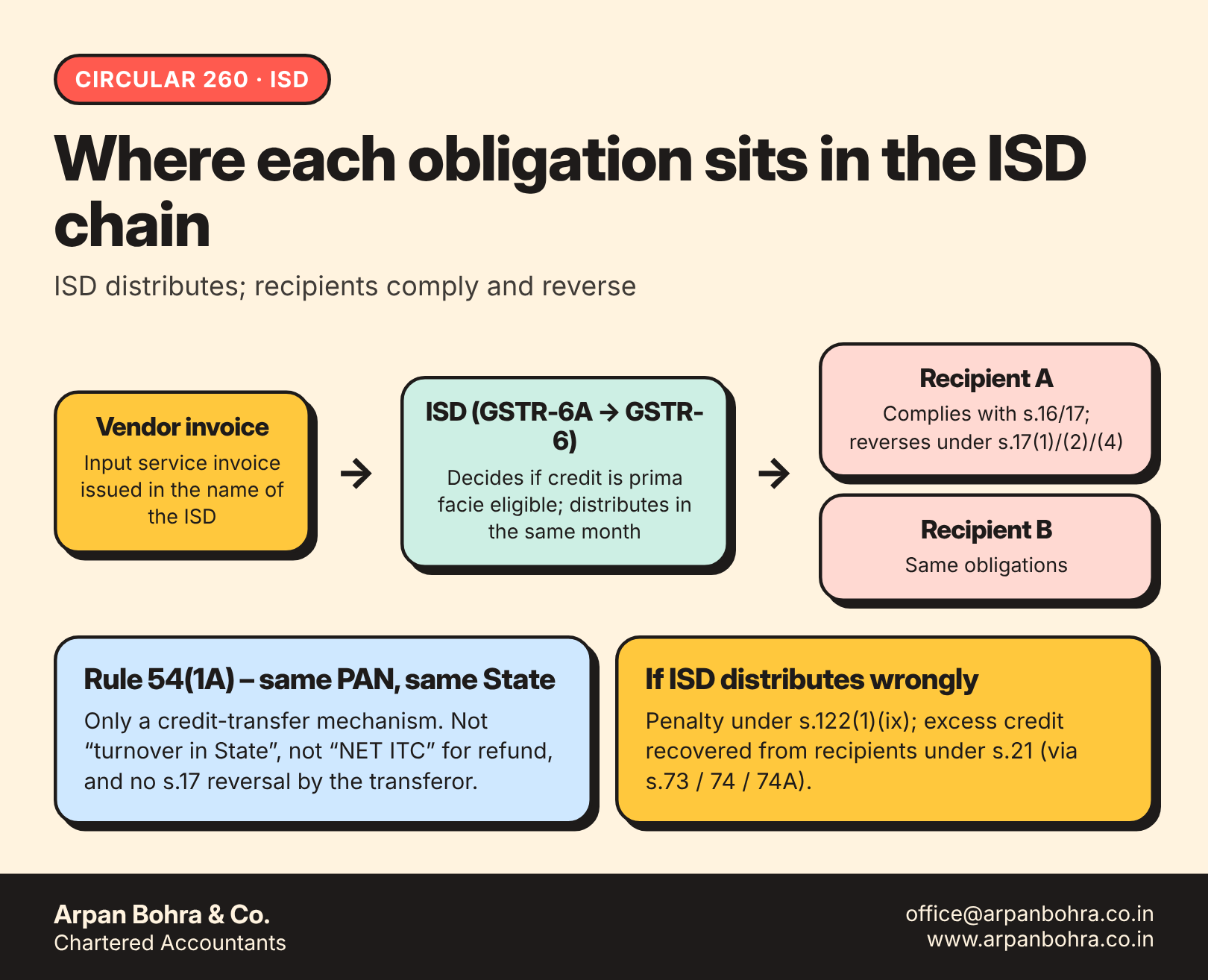
The ISD distributes in the manner of section 20. The recipient is liable to comply with the conditions for eligibility, including sections 16 and 17 and the rules. If the ISD distributes in contravention of section 20, it is liable to penalty under section 122(1)(ix) (₹10,000 or the amount of credit irregularly distributed, whichever is higher, as stated in the Circular); where this results in excess distribution, section 21 permits recovery from recipients, with interest, through sections 73, 74 or 74A.
3. What does “distribute in the same month” mean (rule 39(1)(a))?
The Circular distinguishes the receipt of an invoice in FORM GSTR-6A from the credit becoming available for distribution. Because the ISD sees the invoice first and is best placed to judge eligibility, credit is “available for distribution” only when the ISD ascertains it to be prima facie eligible. It must then distribute in the month of that ascertainment, separately as eligible and ineligible credit under rule 39(1)(g), and report in FORM GSTR-6.
4. Who makes section 17(1), 17(2) or 17(4) reversals?
The ISD distributes the entire credit to the recipients to whom it is attributable; the recipients make reversals under section 17(1) / 17(2) read with rules 42 and 43, or section 17(4) read with rule 38.
5. Is an invoice under rule 54(1A) part of “turnover in State”?
Rule 54(1A) lets a regular registrant with the same PAN and State as the ISD issue an invoice, credit note or debit note to the ISD to transfer credit — including credit on reverse-charge services. The Circular calls this “merely a credit transferring mechanism”. The amount, though it may be declared in the issuer’s GSTR-1, is not an outward supply, so it does not form part of “turnover in State” under section 2(112), nor of “adjusted total turnover” for the refund formula under section 54(3) read with rule 89, nor of the base for section 20 / rule 39 distribution.
6. Is credit transferred under rule 54(1A) “NET ITC” for refund under rule 89(4) and 89(5)?
No. It is not ITC of an inward supply of the transferor and does not qualify as NET ITC.
7. Does the transferor reverse under section 17?
No. The same-PAN, same-State person transfers the entire credit available on reverse-charge tax paid to the ISD. The recipients of credit then make section 17 reversals; that may include the transferor itself if it is among the recipients.
Practical reading
| Aspect | Question | Position stated |
|---|---|---|
| Number of ISD registrations per State | Is one ISD per State enough? | More than one is not barred |
| Eligibility under section 16 | ISD or recipient? | Recipient |
| Timing | Month of invoice receipt in GSTR-6A? | Month in which ISD ascertains prima facie eligibility |
| Rule 54(1A) invoice | Turnover / NET ITC? | Neither |
| Section 17 reversals | Transferor, ISD or recipient? | Recipients only |
Where views can differ
- “Prima facie eligible” is an ISD-level judgement. The Circular places the ascertainment burden on the ISD, yet leaves final section 16 compliance with the recipient. In a dispute, whether an ISD error in ascertainment affects the recipient’s entitlement, or only exposes the ISD to section 122(1)(ix), will depend on the facts (litigative).
- Refund-formula effect. For exporters using rule 89, excluding rule 54(1A) amounts from turnover and from NET ITC changes the computation; past refund claims that included these amounts may need review. The Circular does not state whether it is clarificatory for past periods (confirm).
- Mixed-use credit. Because recipients make the section 17 reversals, a recipient with exempt or non-business supplies carries the reversal even when the ISD sits elsewhere.
Risk view
| Issue | Risk |
|---|---|
| Distribution of credit to a recipient to whom it is not attributable | High: section 122(1)(ix) penalty and section 21 recovery |
| Delay in distributing after ascertainment | Moderate: rule 39(1)(a) |
| Including rule 54(1A) invoices in turnover / NET ITC | Moderate for refund claimants |
| Not separating eligible and ineligible credit in GSTR-6 | Moderate: rule 39(1)(g) |
Frequently asked questions
Can one entity have two ISD registrations in the same State? The Circular finds no bar where separate verticals or places of business are separately registered.
Does the ISD claim ITC itself? No; ISD distributes. The Circular notes the ISD is not required to avail credit itself, but is the best placed to ascertain eligibility.
Do reverse-charge services count? Yes, invoices for services liable to reverse charge are within section 2(61); rule 54(1A) was introduced to ensure the tax is paid before credit is transferred.
Does the section 17(5) blocked credit go to recipients? It is to be distributed separately as ineligible credit under rule 39(1)(g), as the Circular describes.
Where is the distribution reported? FORM GSTR-6, on the basis of GSTR-6A, under rule 65.
Sources
- CBIC Circular No. 260/06/2026-GST dated 26.10.2026 — CBIC website.
- Sections 2(61), 20, 21, 25 and 122(1)(ix) CGST Act, 2017; rules 39, 54(1A), 65 and 89 CGST Rules, 2017.
Read the other circulars of 26 October 2026
- 8 GST Circulars in One Day: Circulars 257 to 264 of 2026 Decoded
- GST Registration in 2026: What Circular 257 Means for Your Documents, Premises Proof and REG-03
- From Show Cause Notice to First Appeal: What Circular 258 Expects of GST Officers
- GST Appeal Pre-deposit Decoded: Admitted Amount, 10% Deposit and Refund under Circular 259
- Banks and NBFCs: Claiming ITC under Section 17(4) and Reporting It Right in GSTR-3B (Circular 261)
- Demo Cars and ITC: Circular 262 Lifts the Block for Dealer-Agency Model Dealers
- Export Payments and GST: SNRR, Nostro, Set-off and Rule 96B under Circular 263
- Rule 96(10) Is Gone, and Retrospectively: What Circular 264 Means for Exporters
Arpan Bohra & Co., Chartered Accountants
Himayat Nagar, Hyderabad
Email: office@arpanbohra.co.in | GST queries: gst@arpanbohra.co.in / 9010558981
Website: www.arpanbohra.co.in | LinkedIn
Disclaimer. This article is a general educational discussion of the Circular and the provisions referred to. It is not legal advice or an opinion on any particular facts, creates no professional engagement, and is not a solicitation of work. Circulars, rules and judgments change and may be read differently by different forums; the original text of each document should be read before reliance, and professional advice taken on specific facts. Judgments are cited as they appear in the Circular unless a separate source is stated. Items marked (confirm) require verification against the current text of the law.
This article is for general information and is not professional advice. Law and rates change; please consult us before you act.