

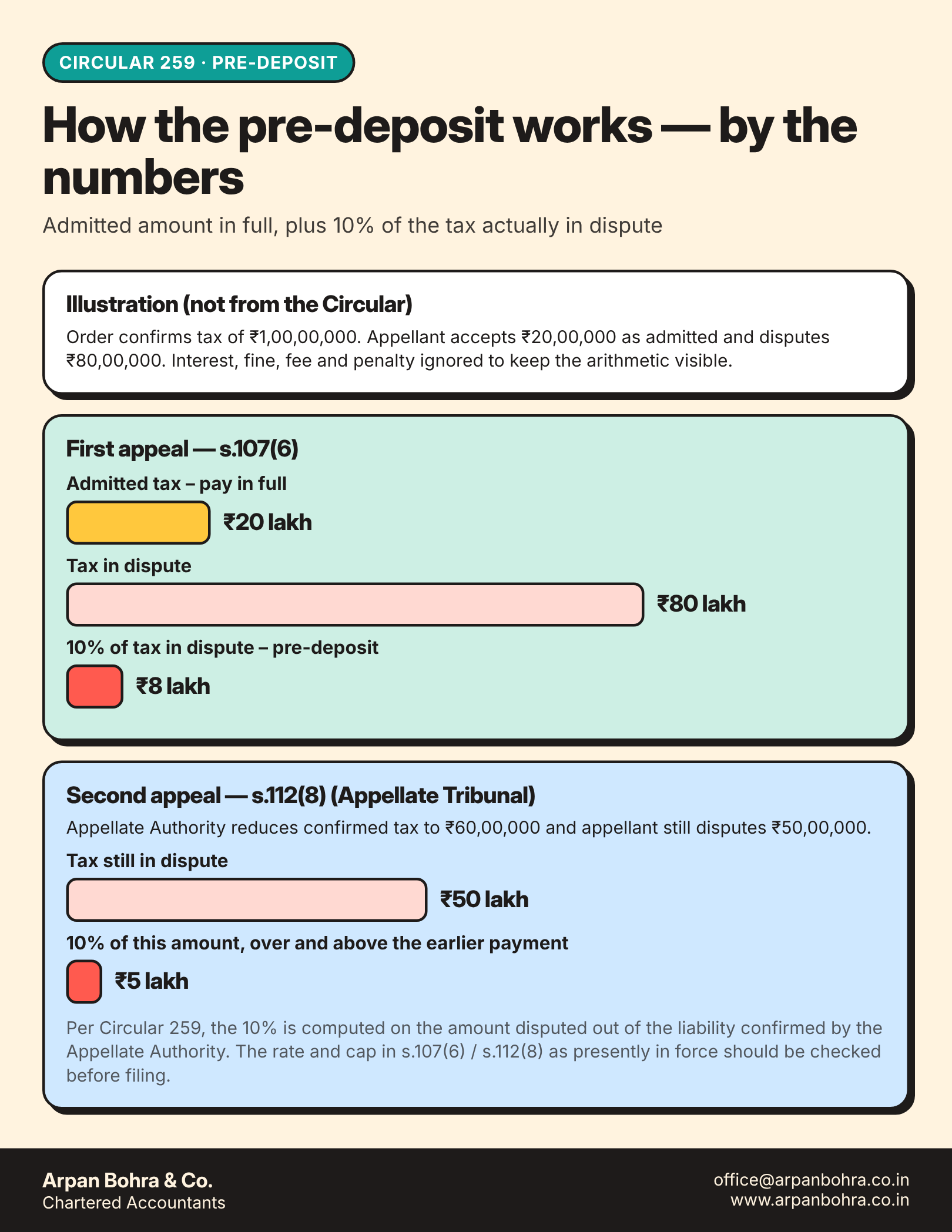
A manufacturer receives an order confirming ₹1 crore of tax. Accounts agrees that ₹20 lakh is payable, the rest is contested. The appeal portal asks for two things: pay what is admitted, and deposit a percentage of what is disputed. How the two are split — and again at the second appeal — is where officers and taxpayers have, in the Board’s words, taken “varying interpretations”. Circular No. 259/05/2026-GST, dated 26 October 2026, addresses six such points.
In short: the admitted amount must be paid in full; the pre-deposit is 10% of the remaining tax in dispute (as the Circular states it); the Tribunal stage is computed on what remains disputed out of the liability confirmed by the first appellate authority; and refunds are claimed through FORM GST RFD-01 and cannot be withheld merely because the department intends to appeal.
The six clarifications
| # | Question | Clarification in the Circular |
|---|---|---|
| 1 | What are “admitted amount” and “tax in dispute”? | Admitted amount = the portion of tax, interest, fine, fee and penalty from the impugned order which the taxpayer acknowledges as payable and does not intend to challenge. It must be paid in full before filing. The balance contested is “tax in dispute”, and the pre-deposit (10%) is calculated on that tax component. The taxpayer decides the split at the time of filing; it is captured in Table 14 of APL-01 and Table 20 of APL-05. |
| 2 | Quantum for appeal to the Appellate Tribunal if the Appellate Authority modified the liability | Admitted part in full, plus 10% of the remaining tax in dispute, in addition to what was paid at first appeal. The 10% is computed with reference to the liability confirmed by the Appellate Authority which the appellant disputes. |
| 3 | Must the order expressly direct refund of pre-deposit? | No. Where an amount paid under section 107(6) or 112(8) becomes refundable consequent to an order, the order need not say so; the refund claim is filed under S. No. 7 of FORM GST RFD-01 (“on account of order”). |
| 4 | Refund where the department contemplates further appeal | Refund is payable on a favourable decision unless the order is stayed by the Tribunal or a Court. It should not be denied merely because the department intends to, or has, filed an appeal. |
| 5 | Date of payment for interest under section 115 | Pre-deposit is paid separately at each appeal level; the date for interest is determined separately for each level, by the actual date of each payment. |
| 6 | Refund when the Tribunal remands | Refund is payable on remand. In a partial remand where part of the demand is upheld, refund is released only after the confirmed amount, with applicable interest, is recovered or adjusted against the pre-deposit. |
Practical points emerging from the Circular
The split is the appellant’s decision, at the time of filing. A mistake in the admitted-versus-disputed split cannot be corrected by the officer; the portal tables (Table 14 of APL-01, Table 20 of APL-05) are where the choice is recorded. Because the admitted amount is outside the appeal and must be paid in full, characterising an item as “admitted” has a consequence beyond the deposit.
The Tribunal stage is not a repeat of the first stage. It is an additional deposit, calculated afresh on the amount still disputed after the first appellate order. This matters where the first appellate authority has reduced the demand.
Refund follows the order, not the department’s intentions. On a favourable order, the refund application is the route. The Circular directs that the pending possibility of a departmental appeal is not a ground to deny it, unless there is a stay.
Interest on refund runs by tranche. Where pre-deposit was made at both levels, each tranche carries interest from its own payment date.
Remand cases. Where the matter goes back to the adjudicating authority, the refund is to be granted, subject to set-off in a partial remand where part of the tax is already upheld.
Where views can differ
- Rate and cap. The Circular describes both section 107(6) and section 112(8) as requiring 10% of tax in dispute. The statutory text, including any cap and any change made by later Finance Acts, should be read directly from the Act as presently amended before computing a deposit (confirm). This article reproduces the Circular and does not substitute for the section.
- What is “admitted”? The Circular leaves the choice to the appellant. Whether an amount paid under protest during investigation or recovery can be treated as the admitted amount, or as a pre-deposit, is a question of appropriation and may be contested (litigative).
- Interest component. The Circular refers to “tax in dispute” for the 10%; interest, fine and penalty in dispute are not part of the base on this reading.
Risk view
| Scenario | Risk | Comment |
|---|---|---|
| Admitted amount not paid in full | High | Statutory requirement for admission of appeal |
| Tribunal deposit computed on original demand instead of first-appeal confirmed demand | Moderate | Para 2 of the table: computed on liability confirmed by Appellate Authority |
| Refund claimed under wrong category in RFD-01 | Moderate | Should be S. No. 7, “on account of order” |
| Refund held back pending a departmental appeal | Favourable to taxpayer | Circular says refund cannot be denied on that ground unless stayed |
Frequently asked questions
Is the pre-deposit paid again for the Tribunal? Yes. It is a separate deposit, in addition to the amount paid for the first appeal.
Does the appellate order have to say “refund the pre-deposit”? No; the refund claim is filed on the basis of the order.
Where is the admitted-versus-disputed choice made? In Table 14 of FORM GST APL-01 for the first appeal and Table 20 of APL-05 for the appeal before the Tribunal, as per the Circular.
Can the department hold the refund if it plans to appeal? The Circular says not, unless the order is stayed.
Which date counts for interest on the refund? The actual date of each payment, separately for the first-appeal and Tribunal-stage deposits.
Sources
- CBIC Circular No. 259/05/2026-GST dated 26.10.2026 — CBIC website.
- Sections 107, 112, 115 and Rule 113, CGST Act and Rules, 2017 — to be read in the text as presently in force.
Read the other circulars of 26 October 2026
- 8 GST Circulars in One Day: Circulars 257 to 264 of 2026 Decoded
- GST Registration in 2026: What Circular 257 Means for Your Documents, Premises Proof and REG-03
- From Show Cause Notice to First Appeal: What Circular 258 Expects of GST Officers
- Input Service Distributor: Seven Answers from Circular 260 Every Multi-Location Business Should Read
- Banks and NBFCs: Claiming ITC under Section 17(4) and Reporting It Right in GSTR-3B (Circular 261)
- Demo Cars and ITC: Circular 262 Lifts the Block for Dealer-Agency Model Dealers
- Export Payments and GST: SNRR, Nostro, Set-off and Rule 96B under Circular 263
- Rule 96(10) Is Gone, and Retrospectively: What Circular 264 Means for Exporters
Arpan Bohra & Co., Chartered Accountants
Himayat Nagar, Hyderabad
Email: office@arpanbohra.co.in | GST queries: gst@arpanbohra.co.in / 9010558981
Website: www.arpanbohra.co.in | LinkedIn
Disclaimer. This article is a general educational discussion of the Circular and the provisions referred to. It is not legal advice or an opinion on any particular facts, creates no professional engagement, and is not a solicitation of work. Circulars, rules and judgments change and may be read differently by different forums; the original text of each document should be read before reliance, and professional advice taken on specific facts. Judgments are cited as they appear in the Circular unless a separate source is stated. Items marked (confirm) require verification against the current text of the law.
This article is for general information and is not professional advice. Law and rates change; please consult us before you act.