

A founder in a co-working space near HITEC City files a GST registration application on a Monday. By Friday, a query arrives in FORM GST REG-03 asking for an electricity bill of a building she has never owned. Two weeks later the application is rejected because she did not reply in time. Nothing in her business was irregular; the paperwork simply did not line up with how the portal and the officer read it.
Circular No. 257/03/2026-GST, issued by the CBIC on 26 October 2026, is aimed at exactly this gap. Unlike earlier instructions that told officers how to process applications, this Circular is addressed to the applicant side as well: it explains what must be filed, which document proves which premises, and what an officer may and may not ask for.
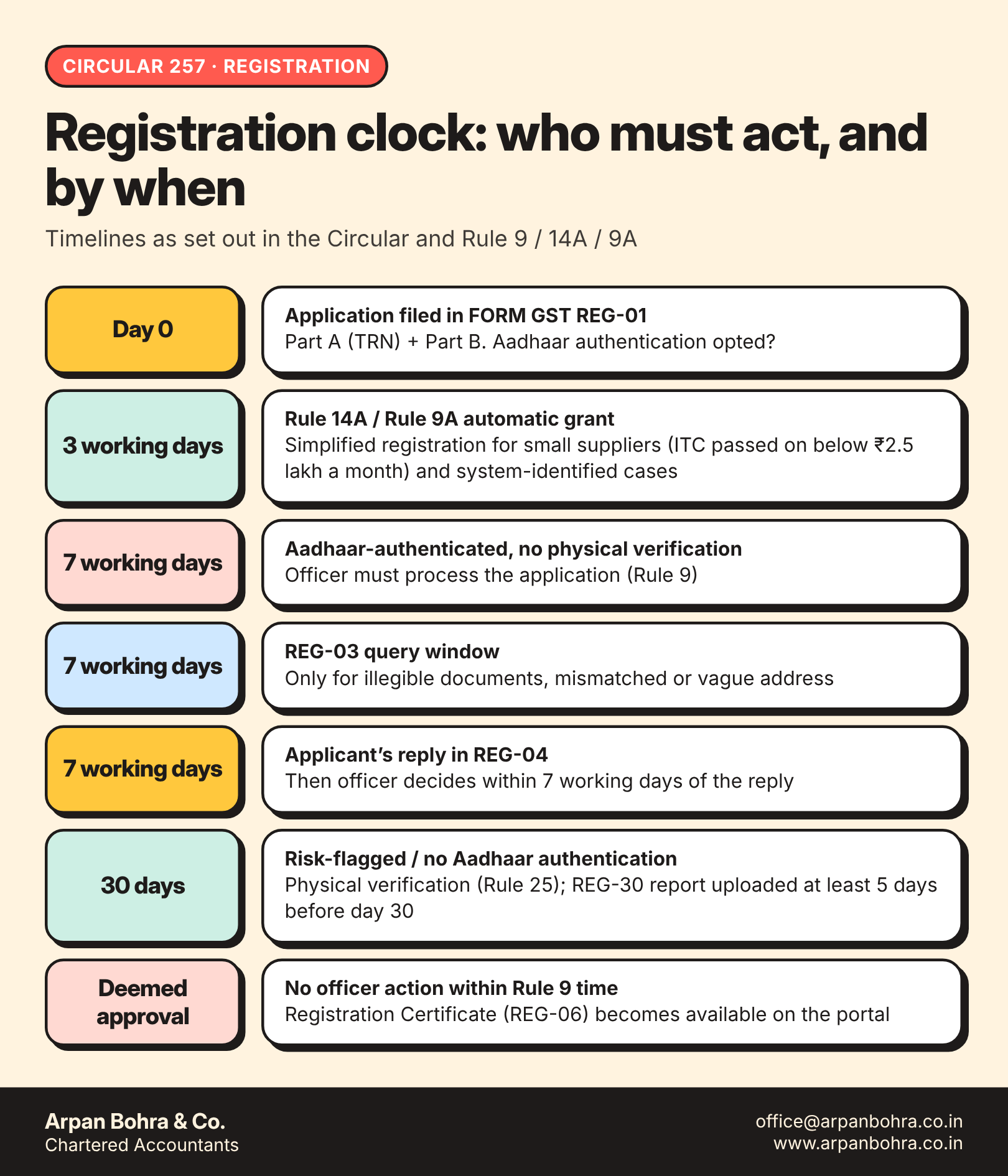
In short: the Circular consolidates registration practice into one reference, annexes 51 FAQs and a document checklist, tells officers to use FORM GST REG-03 only for three defined deficiencies, and restates the processing clocks under Rule 9, Rule 9A and Rule 14A of the CGST Rules, 2017.
Why the Circular was issued
The Board records that delays and rejections are often traced to missing, inconsistent or illegible information, particularly identity details, proof of the principal place of business, constitution of the business and the authorised signatory. It also records the opposing concern: fake registrations obtained on other persons’ identities to pass on ineligible ITC. The Circular is issued under section 168(1) of the CGST Act, 2017 and complements Instruction No. 03/2025-GST dated 17 April 2025 meant for tax officers.
Filing the application: points that decide whether it moves
Part A (TRN stage). The legal name must match the PAN and, for companies, the MCA incorporation certificate. For a proprietorship, the proprietor’s name goes against “Legal Name”. State and district of the principal place of business must be correct, and where the e-mail and mobile number are linked to the PAN, those same details should be used.
Part B. The correct constitution of business, reason for registration and category (composition, casual taxable person, Rule 14A, SEZ) must be selected. Partnership deed, registration certificate or Karta documents are uploaded as per Annexure-II. Photographs must be of the individual alone, recent, colour, full frontal and not a cropped identity document.
Authorised signatory. Up to ten authorised signatories can be added, each with an authorisation letter and photograph. The FAQ suggests adding a primary and an alternate signatory so that an unavailable DSC or e-sign does not stall the process.
Principal place of business (PPoB). The Circular calls wrong or vague PPoB details “one of the major reasons” for queries and rejections. The address must be specific down to shop, flat or plot, with correct PIN code, and must match the uploaded proof. A Post Office Box or courier address is not acceptable (FAQ 32). Unmanned installations such as telecom towers and ATMs need not be declared as a PPoB or additional place of business.
Bank account. Not mandatory at the time of application, but Rule 10A requires details within 30 days of grant or before furnishing GSTR-1 / IFF, whichever is earlier. Up to ten accounts may be listed.
Premises proof: the central table
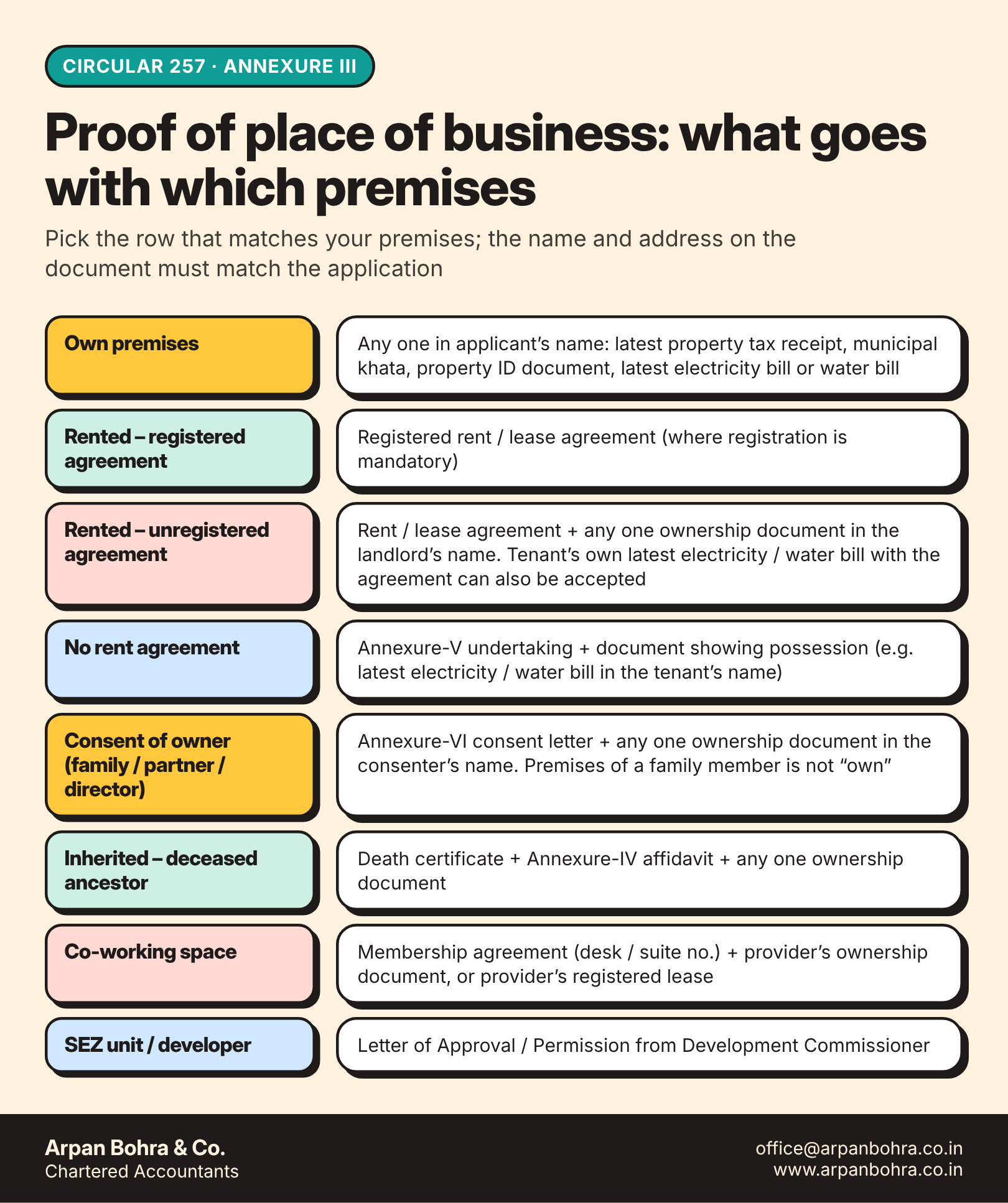
Three clarifications will matter in practice:
- Premises in the name of a spouse, parent, sibling, partner or director are not “own” premises. The applicant selects “Consent” and uploads the Annexure-VI consent letter plus an ownership-type document of the consenter. Where premises are co-owned by several persons, consent of all co-owners is stated to be needed for this route (para 3.8.4.1), while FAQ 37 says no consent is needed when one co-owner of a jointly owned property registers on it and the supporting document shows ownership of both.
- For a co-working space, the membership agreement must identify the period, the desk, cabin or suite number, and whether the provider owns or leases the building. This is directly relevant to start-ups operating from shared offices in HITEC City, Gachibowli, Kondapur and the Financial District.
- Udyam / MSME certificate is neither required nor acceptable as PPoB proof (FAQ 36).
What an officer may and may not do
A REG-03 notice may be issued only where (i) a document is incomplete or illegible, (ii) the address does not match the document or the document does not appear to be valid address proof, or (iii) the address is incomplete or vague. Para 5.4.1 specifically criticises queries asking for the applicant’s residential address to be in the same city, for a Udyam certificate, or questioning whether the stated activity can be carried out from the premises. Para 6 adds that officers should not classify electricity connections as domestic or commercial, scrutinise bill amounts, or deem residential premises unfit for business. Utility bills are to be checked only for name and address; rent agreements for validity, both parties’ names and the exact address.
FAQ 30 confirms that an applicant’s residence need not be in the same State or city as the PPoB.
Timelines in one view
| Situation | Time | Source in Circular |
|---|---|---|
| Aadhaar authenticated, no physical verification flagged | Processed in 7 working days | Para 5.1 |
| Aadhaar not opted / failed, or risk-flagged, or officer-directed verification | 30 days, after physical verification (Rule 25) | Para 5.1, 5.6 |
| Rule 14A simplified registration; Rule 9A system-identified cases | Automatic grant in 3 working days | Para 5.3 |
| REG-03 notice | Within 7 working days (30 days where physical verification applies) | Para 5.4, 5.4.2 |
| Reply in REG-04 | 7 working days from receipt of notice | Para 5.5 |
| Decision after reply | 7 working days; rejection only by reasoned REG-05 | Para 5.5 |
| Facilitation Centre visit for biometric / original verification | Within 15 days of TRN (FAQ 13) | Annexure-I |
| No action by officer in Rule 9 time | Deemed approval | Para 5.7 |
Simplified registration under Rule 14A
According to FAQ 8 and 9, the optional scheme operates from 1 November 2025. The applicant must file REG-01, opt for Aadhaar authentication and declare that outward taxable supplies to registered persons will not involve total tax above ₹2.5 lakh in a month, and that no second registration will be taken in the same State on the same PAN under Rule 14A. To leave the scheme, REG-32 is filed with all pending returns, subject to at least one return period having been filed after registration; thereafter normal registration processing applies (para 6.1, FAQ 10).
Points on which views can differ
- Binding force on officers. The Circular is issued under section 168(1) and speaks in directive language for officers (para 6). Where a REG-03 query goes beyond the three permitted heads, a rejection that relies on that query is open to challenge in appeal; whether an appellate forum treats the para 5.4 limit as mandatory or only as guidance will depend on the facts and the forum.
- Consent for co-owned property. Para 3.8.4.1 and FAQ 37 address different situations; a careful reading separates “premises owned by someone else, made available on consent” from “premises owned jointly, with one co-owner applying”.
- State-specific fields. Para 3.10 lists Maharashtra, Rajasthan, Odisha, Andhra Pradesh, Assam and Madhya Pradesh as examples where electricity connection details are mandatory. Telangana is not named in that illustrative list; the portal form itself should be treated as the final reference for Telangana applications (confirm).
Risk view
| Area | Level | Reason |
|---|---|---|
| Premises-proof mismatch (name or address) | High | Named in the Circular as a leading cause of queries and rejection |
| Non-reply to REG-03 within 7 working days | High | Application may be rejected |
| Unwarranted queries beyond para 5.4 | Moderate for the officer, favourable for the applicant | Contrary to para 5.4.1 and 6 |
| Missed Facilitation Centre visit | Moderate | Application may not be processed further |
Frequently asked questions
Is a rent agreement always enough as premises proof? Not always. A registered agreement suffices where registration is mandatory; an unregistered agreement must be accompanied by an ownership-type document in the landlord’s name, unless the tenant’s own latest utility bill is furnished with the agreement.
Can a Udyam certificate be uploaded as address proof? No. The Circular says it is neither required nor treatable as proof of premises.
What if an application is rejected? FAQ 18 states that a fresh application may be filed after correcting the deficiencies. A grievance on delay or unwarranted queries can be raised with the jurisdictional Chief Commissioner of Central Tax or Commissioner of State Tax on the special e-mail identified by the zone or State (para 8).
Who can be an authorised signatory? Any person who is not a minor; for a non-resident taxable person (REG-09) the signatory must be an Indian national (FAQ 48).
Can the same premises be a PPoB for more than one registration? FAQ 33 permits one registration with one PPoB and the other branches as additional places, or multiple registrations for branches, with proof for each place.
Source
- CBIC Circular No. 257/03/2026-GST dated 26.10.2026 — available on the CBIC website.
- GST Portal — registration user manual referred to in para 3.2 and FAQ 11.
Read the other circulars of 26 October 2026
- 8 GST Circulars in One Day: Circulars 257 to 264 of 2026 Decoded
- From Show Cause Notice to First Appeal: What Circular 258 Expects of GST Officers
- GST Appeal Pre-deposit Decoded: Admitted Amount, 10% Deposit and Refund under Circular 259
- Input Service Distributor: Seven Answers from Circular 260 Every Multi-Location Business Should Read
- Banks and NBFCs: Claiming ITC under Section 17(4) and Reporting It Right in GSTR-3B (Circular 261)
- Demo Cars and ITC: Circular 262 Lifts the Block for Dealer-Agency Model Dealers
- Export Payments and GST: SNRR, Nostro, Set-off and Rule 96B under Circular 263
- Rule 96(10) Is Gone, and Retrospectively: What Circular 264 Means for Exporters
Arpan Bohra & Co., Chartered Accountants
Himayat Nagar, Hyderabad
Email: office@arpanbohra.co.in | GST queries: gst@arpanbohra.co.in / 9010558981
Website: www.arpanbohra.co.in | LinkedIn
Disclaimer. This article is a general educational discussion of the Circular and the provisions referred to. It is not legal advice or an opinion on any particular facts, creates no professional engagement, and is not a solicitation of work. Circulars, rules and judgments change and may be read differently by different forums; the original text of each document should be read before reliance, and professional advice taken on specific facts. Judgments are cited as they appear in the Circular unless a separate source is stated. Items marked (confirm) require verification against the current text of the law.
This article is for general information and is not professional advice. Law and rates change; please consult us before you act.