

A non-banking finance company headquartered in the Financial District, Hyderabad has a lending arm, a bullion-trading desk and a small advisory vertical, each separately registered. Its tax team has been following section 17(4) in one State and the proportionate method of section 17(2) in another. Which is right, and how should the 50% restriction actually be keyed into GSTR-3B? Circular No. 261/07/2026-GST, dated 26 October 2026, responds to “varying practices” across banks and financial institutions.
In short: only registrations engaged in accepting deposits and extending loans and advances can opt for section 17(4); if one such registration opts, all such registrations of the same entity must comply; the second-proviso relaxation applies only to supplies from a same-PAN registrant that has also opted; and GSTR-3B has a prescribed sequence of reversal and availment.
Clarification 1: who can opt, and what follows
Section 17(4) gives banking companies and financial institutions, including NBFCs, engaged in accepting deposits and extending loans and advances an option to take 50% of eligible ITC instead of proportionate availment under section 17(2). The Circular holds:
| Registration (distinct person) of a bank / NBFC | Position |
|---|---|
| Not engaged in deposits, loans or advances (e.g. exclusively bullion trading) | Neither has the option nor is required to comply with section 17(4) |
| Engaged in deposits / loans / advances (and possibly other services as well) | Has the option |
| One such registration opts | All such registrations of the entity must comply with section 17(4) |
Clarification 2: scope of the second proviso
The second proviso to section 17(4) relaxes the 50% restriction for tax paid on supplies by a registered person having the same PAN. The Circular reads it within the framework of section 17(4) as applicable to registrants that have opted. Accordingly, the relaxation is available only for supplies received from another same-PAN registrant who has also opted to comply with section 17(4).
Clarification 3: reporting in GSTR-3B (Rule 38)
The Circular builds on Circular No. 170/02/2022-GST dated 06.07.2022 and the Invoice Management System (IMS), available from October 2024.
A. Where IMS was not used
- Ascertain eligibility of the ITC auto-populated from GSTR-2B (other than reverse-charge inward supplies) and of ITC claimed on reverse-charge supplies.
- For ITC found eligible under section 16:
- credit for non-business use, and credit attributable to section 17(5) supplies, is permanently reversed in Table 4(B)(1);
- credit referred to in the second proviso is availed;
- 50% of the remaining amount is admissible and availed; the balance is permanently reversed in Table 4(B)(1) of the same period.
- ITC that cannot be ascertained as eligible because a section 16 condition is not yet met, but may become eligible later, is temporarily reversed in Table 4(B)(2).
- On fulfilment of conditions, it may be reclaimed through Table 4(A)(5) of a later return, within the section 16(4) time limit, running through step 2 again, and shown also in Table 4(D)(1).
B. After IMS-related rule amendments are notified (and where IMS has already been used)
Invoices whose ITC is presently ineligible but may become eligible are to be kept pending on IMS, so that they do not appear in GSTR-2B or auto-populate GSTR-3B. Accepted and deemed-accepted invoices flow into GSTR-2B and GSTR-3B, and the same step-2 procedure applies.
C. Past periods. Field formations are advised not to take an adverse view of a different reporting methodology followed earlier, as long as the amount of ITC availed under section 17(4) is “in congruence with” the principles above.
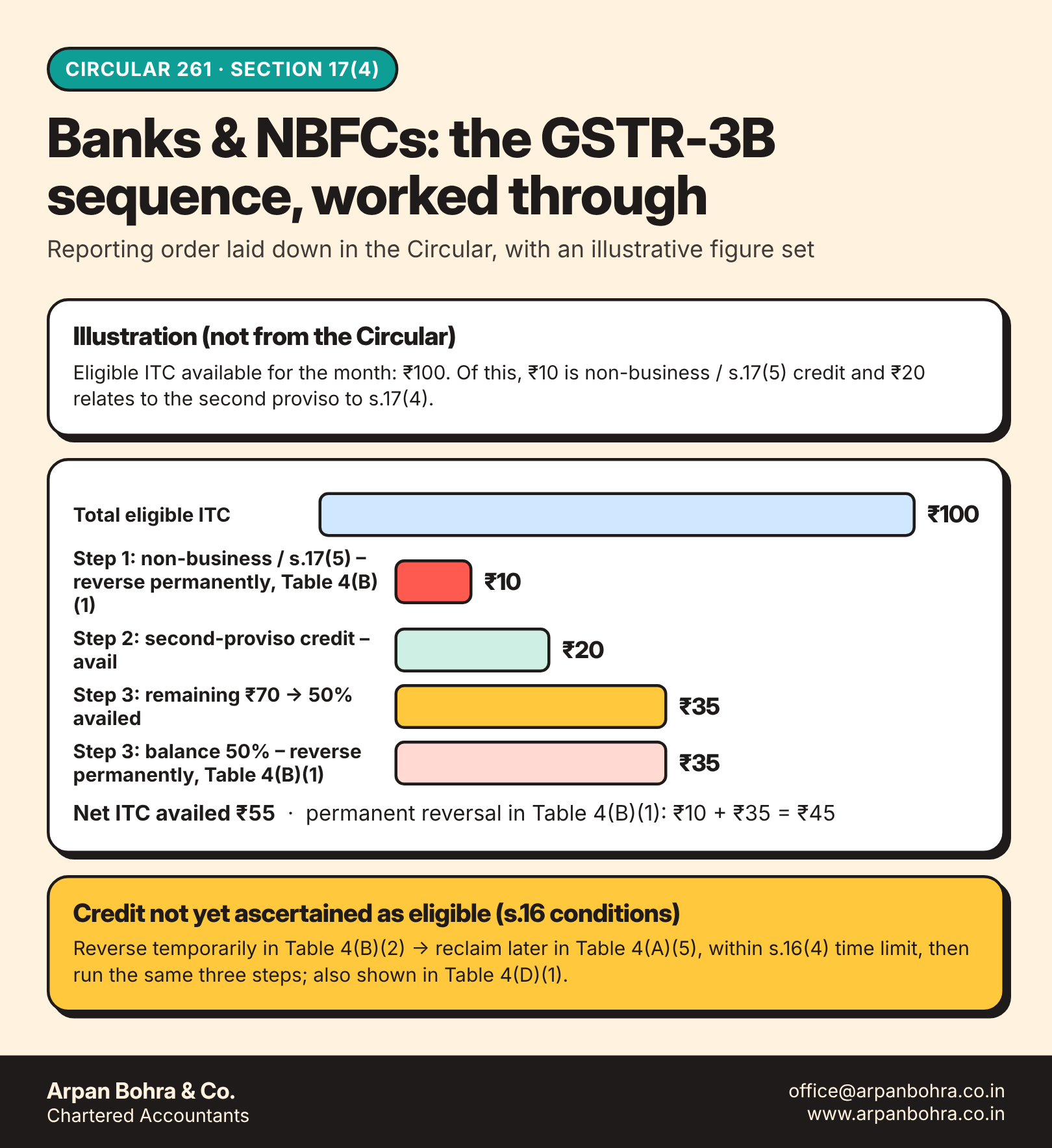
Worked example (illustrative, not from the Circular)
Eligible ITC in the month ₹100; ₹10 relates to non-business use or section 17(5); ₹20 falls under the second proviso.
| Step | Amount (₹) | Treatment |
|---|---|---|
| Non-business / section 17(5) credit | 10 | Permanently reversed, Table 4(B)(1) |
| Second-proviso credit | 20 | Availed |
| Remaining | 70 | 50% = 35 availed; 35 permanently reversed, Table 4(B)(1) |
| Net ITC availed | 55 | Total permanent reversal in 4(B)(1): 45 |
Where views can differ
- Mixed registrations. The “all such registrations must comply” rule effectively links group-level choices. Entities that earlier chose differently for different registrations will have to reconcile past positions; the Circular’s comfort on reporting method for past periods relates to how ITC was reported, not to the choice between sections 17(2) and 17(4) itself (litigative).
- Bullion and other non-financing registrations. The Circular says such registrations neither have the option nor the obligation. Whether such a registration could still claim blocked-credit treatment under section 17(2) rules is governed by that sub-section and rules 42 and 43; the Circular does not elaborate (confirm).
- IMS rule amendments. Part B depends on rule amendments “after” they are notified; until then taxpayers who have used IMS are covered by the same direction.
Risk view
| Issue | Risk |
|---|---|
| Opting for 17(4) in one registration and 17(2) in another | High — contrary to Clarification 1(c) |
| Claiming second-proviso relaxation on supplies from a non-opted same-PAN registrant | High |
| Showing temporary reversal in Table 4(B)(1) instead of 4(B)(2) | Moderate — misreporting; reclaim route lost |
| Different past reporting methodology with correct end-amount | Low — adverse view discouraged by the Circular |
Frequently asked questions
Can a bullion-trading registration of an NBFC take 50% ITC? The Circular says it neither has the option nor is required to comply with section 17(4).
Where is permanent reversal shown? Table 4(B)(1) of FORM GSTR-3B.
Where is temporary reversal shown? Table 4(B)(2); reclaim through Table 4(A)(5) and Table 4(D)(1).
Does IMS change the 50% rule? No. IMS decides which invoices reach GSTR-2B; the 50% sequence applies to what is then auto-populated.
Is there relief for past reporting? The Circular discourages an adverse view of a different methodology for past periods if the ITC availed under section 17(4) is consistent with its principles.
Sources
- CBIC Circular No. 261/07/2026-GST dated 26.10.2026 — CBIC website.
- Section 17(2), 17(4), 17(5), 16(4) CGST Act, 2017; Rule 38 CGST Rules, 2017; Circular No. 170/02/2022-GST dated 06.07.2022.
Read the other circulars of 26 October 2026
- 8 GST Circulars in One Day: Circulars 257 to 264 of 2026 Decoded
- GST Registration in 2026: What Circular 257 Means for Your Documents, Premises Proof and REG-03
- From Show Cause Notice to First Appeal: What Circular 258 Expects of GST Officers
- GST Appeal Pre-deposit Decoded: Admitted Amount, 10% Deposit and Refund under Circular 259
- Input Service Distributor: Seven Answers from Circular 260 Every Multi-Location Business Should Read
- Demo Cars and ITC: Circular 262 Lifts the Block for Dealer-Agency Model Dealers
- Export Payments and GST: SNRR, Nostro, Set-off and Rule 96B under Circular 263
- Rule 96(10) Is Gone, and Retrospectively: What Circular 264 Means for Exporters
Arpan Bohra & Co., Chartered Accountants
Himayat Nagar, Hyderabad
Email: office@arpanbohra.co.in | GST queries: gst@arpanbohra.co.in / 9010558981
Website: www.arpanbohra.co.in | LinkedIn
Disclaimer. This article is a general educational discussion of the Circular and the provisions referred to. It is not legal advice or an opinion on any particular facts, creates no professional engagement, and is not a solicitation of work. Circulars, rules and judgments change and may be read differently by different forums; the original text of each document should be read before reliance, and professional advice taken on specific facts. Judgments are cited as they appear in the Circular unless a separate source is stated. Items marked (confirm) require verification against the current text of the law.
This article is for general information and is not professional advice. Law and rates change; please consult us before you act.