

A premium-car showroom on the Hyderabad outer ring road does not sell cars on its own account any more. The manufacturer bills the customer directly; the showroom earns a facilitation fee, and keeps three cars for test drives that it buys on tax invoices. In September 2024 the Board said ITC on such cars was blocked under section 17(5)(a). Circular No. 262/08/2026-GST, dated 26 October 2026, reverses that.
In short: para 4.6 of Circular No. 231/25/2024-GST dated 10.09.2024 is withdrawn, and it is clarified that ITC on demo vehicles is not blocked under section 17(5)(a) for a dealer working under the dealer-agency model.
Provision involved
Section 17(5)(a) blocks ITC on motor vehicles for transporting persons with approved seating capacity of not more than thirteen persons (including the driver), except when used for (A) further supply of such motor vehicles, (B) transportation of passengers, or (C) imparting training on driving such motor vehicles.
What the earlier circular said
Para 4.6 of Circular 231/25/2024-GST said a dealer that merely acts as an agent or service provider to the manufacturer is not making the supply of motor vehicles on its own account. The demo vehicle therefore could not be said to be used for further supply, and ITC on it was not saved from the block in clause (A).
What the new Circular says
The Board notes two business models:
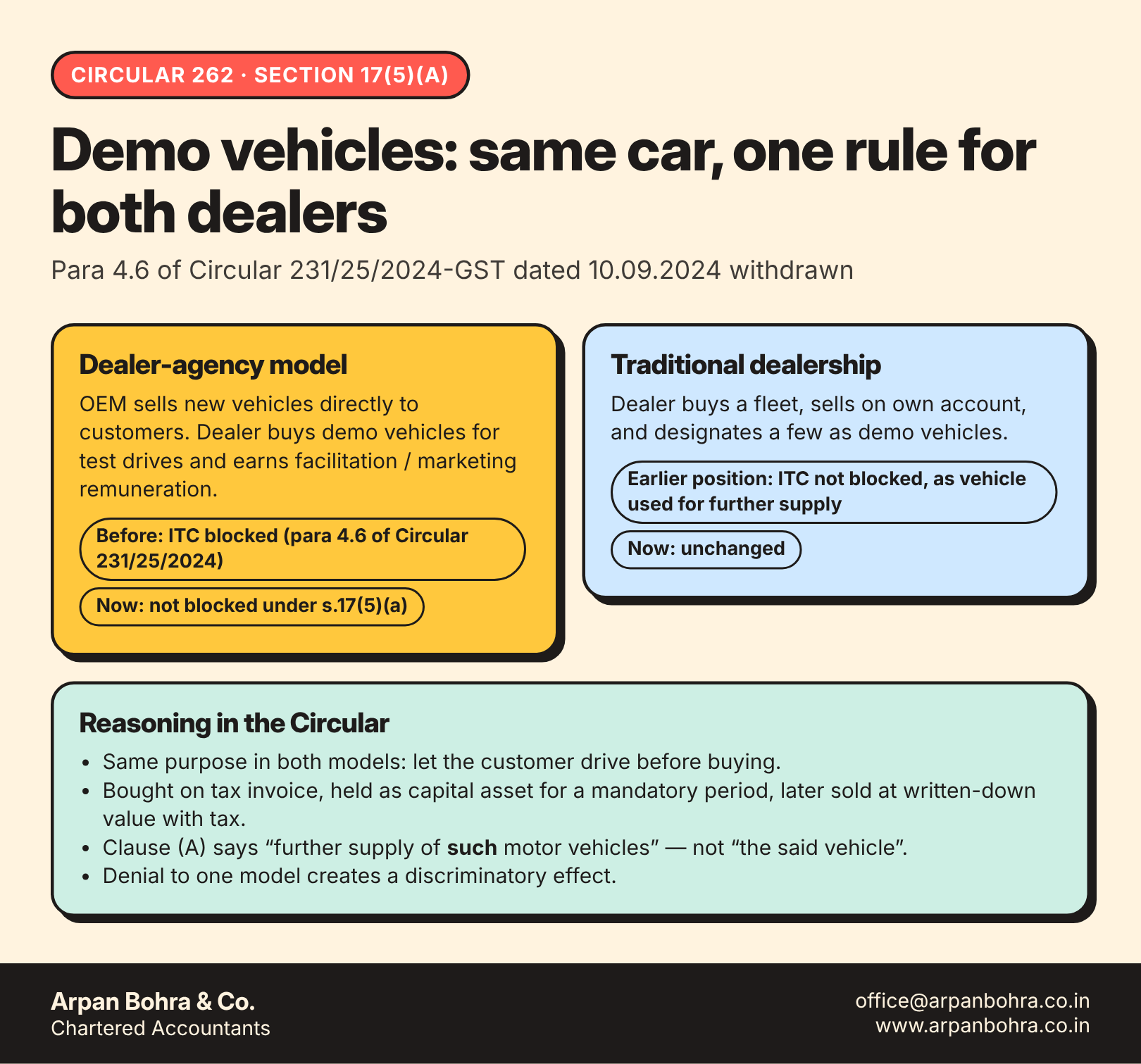
- Dealer-agency model — the dealer buys demo or test-drive vehicles from the manufacturer; new vehicles are sold by the manufacturer directly to customers.
- Traditional dealership — the dealer buys a fleet, sells on its own account and designates some vehicles for demonstration.
Reasoning recorded in paras 5 and 6:
- In both models the demo vehicle serves the same purpose — letting the customer experience the drive before buying.
- In both, vehicles are bought on tax invoices from the manufacturer, usually carried as capital assets, held for a mandatory period, then generally sold at written-down value with applicable tax.
- Both are treated at par under the Central Motor Vehicles Rules, 1989.
- Denial to one model creates a discriminatory effect.
- The phrase in clause (A) is “further supply of such motor vehicles”, not “said” vehicles; ITC is thus allowed not only for the specific vehicle sold, but for vehicles used for further supply of similar vehicles.
Effect
| Dealer | Position after Circular 262 |
|---|---|
| Dealer-agency model | ITC on demo vehicles not blocked under section 17(5)(a) |
| Traditional dealer | Position unchanged: not blocked as vehicles are used for further supply |
Points for reading the Circular carefully
- Other conditions still apply. The clarification removes the section 17(5)(a) block; eligibility under section 16 (tax invoice, receipt, return filing, payment to supplier) and use in the course or furtherance of business are independent conditions.
- Subsequent sale. The Circular notes the vehicle is usually sold later at written-down value with applicable tax. Reversals and valuation on disposal of capital goods continue to follow the Act and rules; the Circular does not alter them.
- Past periods. The Circular withdraws para 4.6 and states the position without describing it as prospective. Where ITC was reversed or denied earlier on the strength of para 4.6, or demands were raised for it, the dealer may consider whether the clarification supports re-claim or defence. Time limits under section 16(4) for fresh claims, and the status of pending proceedings, are not addressed (litigative; confirm for each case).
- Demo cars not used for test drives. The reasoning rests on use as demonstration vehicles. A vehicle used for staff or personal use is a different factual position.
Litigation view
| Issue | View |
|---|---|
| Pending SCN denying ITC on demo cars on the basis of para 4.6 | Strengthened position; the withdrawn para can no longer support the demand |
| Orders already confirmed | Appeal route and limitation to be examined case by case |
| Re-claim of reversed ITC | Subject to section 16(4) and any timing restrictions; not addressed in the Circular |
| Risk of departmental reliance on facts (e.g. vehicles used otherwise) | Moderate |
Frequently asked questions
Does this apply to every vehicle a dealer buys? The clarification is on demo vehicles used to promote sales of such vehicles; vehicles bought for other purposes are outside it.
Which circular is withdrawn? Para 4.6 of Circular No. 231/25/2024-GST dated 10.09.2024.
Is ITC available for vehicles of any seating capacity? Section 17(5)(a) applies to vehicles with approved seating capacity of not more than thirteen persons including the driver.
Does the Circular say anything about the later sale of the demo vehicle? It records that applicable tax is payable on such sale; it does not change the manner of computation.
Who is covered? The clarification expressly covers the dealer in the dealer-agency model, i.e. one who keeps demo vehicles while the manufacturer sells directly to customers.
Sources
- CBIC Circular No. 262/08/2026-GST dated 26.10.2026 and Circular No. 231/25/2024-GST dated 10.09.2024 — CBIC website.
- Section 17(5)(a), CGST Act, 2017.
Read the other circulars of 26 October 2026
- 8 GST Circulars in One Day: Circulars 257 to 264 of 2026 Decoded
- GST Registration in 2026: What Circular 257 Means for Your Documents, Premises Proof and REG-03
- From Show Cause Notice to First Appeal: What Circular 258 Expects of GST Officers
- GST Appeal Pre-deposit Decoded: Admitted Amount, 10% Deposit and Refund under Circular 259
- Input Service Distributor: Seven Answers from Circular 260 Every Multi-Location Business Should Read
- Banks and NBFCs: Claiming ITC under Section 17(4) and Reporting It Right in GSTR-3B (Circular 261)
- Export Payments and GST: SNRR, Nostro, Set-off and Rule 96B under Circular 263
- Rule 96(10) Is Gone, and Retrospectively: What Circular 264 Means for Exporters
Arpan Bohra & Co., Chartered Accountants
Himayat Nagar, Hyderabad
Email: office@arpanbohra.co.in | GST queries: gst@arpanbohra.co.in / 9010558981
Website: www.arpanbohra.co.in | LinkedIn
Disclaimer. This article is a general educational discussion of the Circular and the provisions referred to. It is not legal advice or an opinion on any particular facts, creates no professional engagement, and is not a solicitation of work. Circulars, rules and judgments change and may be read differently by different forums; the original text of each document should be read before reliance, and professional advice taken on specific facts. Judgments are cited as they appear in the Circular unless a separate source is stated. Items marked (confirm) require verification against the current text of the law.
This article is for general information and is not professional advice. Law and rates change; please consult us before you act.