

For seven years, exporters who bought inputs under concessional or exempt notifications were told that their IGST refund on exports was barred by rule 96(10) of the CGST Rules, 2017. The rule was omitted from 8 October 2024. The question that has kept the High Courts busy is whether the omission helps only exports from that date or reaches back to 23 October 2017, when the rule came in. Circular No. 264/10/2026-GST, dated 26 October 2026, gives the Board’s answer after the Supreme Court’s ruling.
In short: the Board now accepts that the omission of rule 96(10) is effective retrospectively from 23.10.2017, and that pending proceedings on rule 96(10) are to be dealt with accordingly. The same treatment applies, mutatis mutandis, to the omission of rules 89(4A) and 89(4B).
Background in the Circular
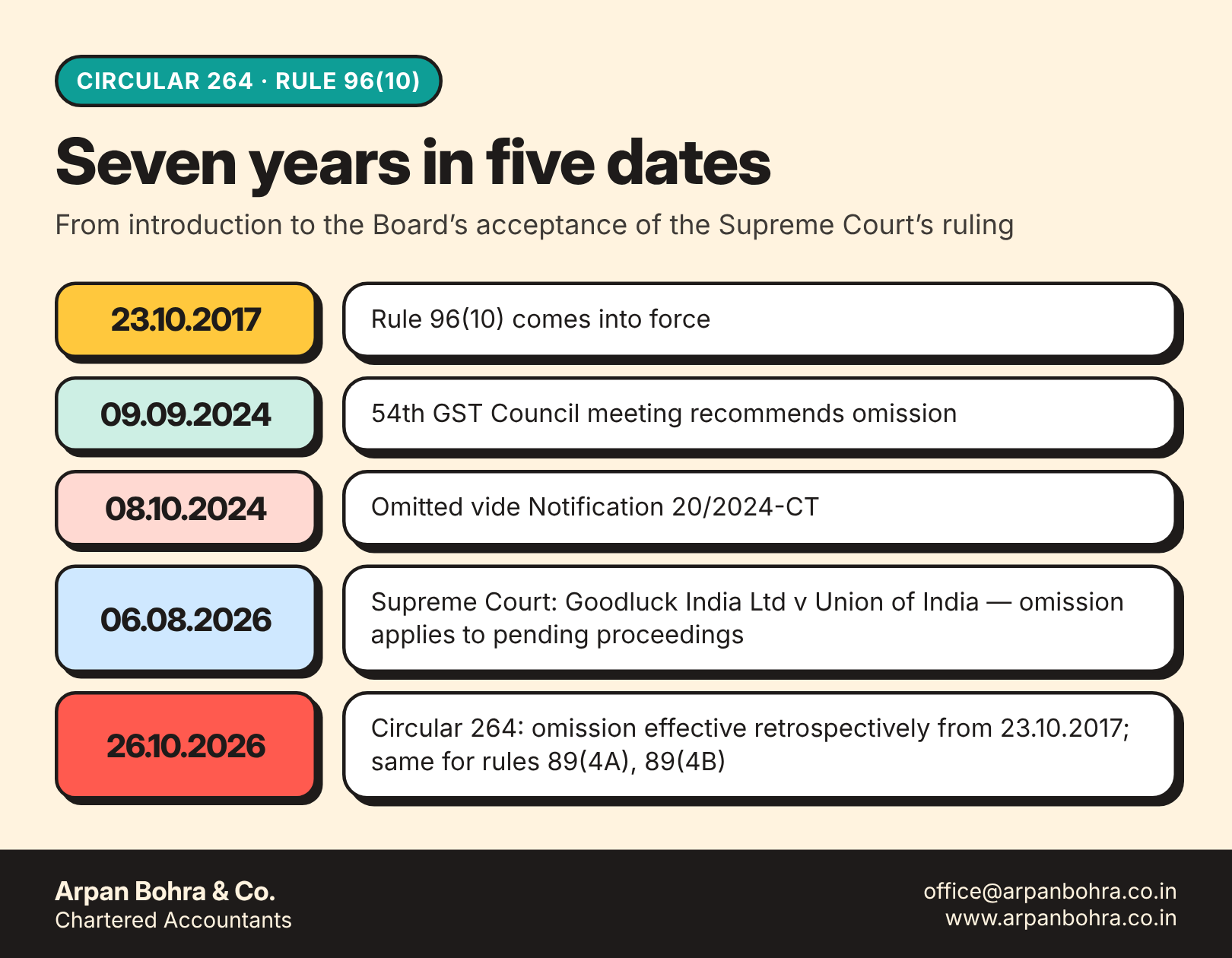
Rule 96(10) came into effect on 23.10.2017 to prevent a double benefit: an exporter who enjoyed IGST exemption on procurement under specified notifications should not also claim IGST refund on export of the resulting goods. After difficulties raised by exporters, the 54th GST Council meeting on 09.09.2024 recommended its omission. It was omitted w.e.f. 08.10.2024 by the CGST (Second Amendment) Rules, 2024, notified vide Notification No. 20/2024-Central Tax dated 08.10.2024, prospectively as then notified.
The Supreme Court decision
Para 4 of the Circular refers to the judgment dated 06.08.2026 in SLP (Civil) No. 24550 of 2025, M/s Goodluck India Limited & Anr. v. Union of India & Ors., with connected matters. The Court held that, in the absence of any saving clause or sunset clause accompanying the omission, the omission applies to all proceedings pending on the date of omission. It relied on the Constitution Bench in Kolhapur Canesugar Works Ltd v. Union of India [(2000) 2 SCC 536], under which section 6 of the General Clauses Act, 1897 does not apply to the omission of a rule; pending proceedings continue only where an express provision or legal device preserves them. Reported coverage: Verdictum.
Position stated by the Board (para 6)
- The omission of rule 96(10) is effective retrospectively from 23.10.2017.
- Field formations are to deal with pending proceedings concerning rule 96(10) in accordance with the judgment.
- The same applies mutatis mutandis to the omission of rules 89(4A) and 89(4B).
Practical reading
| Category | Reading of the Circular |
|---|---|
| Pending refund claims, show cause notices, appeals, writs involving rule 96(10) | To be dealt with in line with the Goodluck India ruling |
| Rejected refund claims where proceedings are no longer pending | Not specifically addressed; position depends on whether the matter was pending on 08.10.2024 and on limitation |
| Refunds under rules 89(4A) and 89(4B) | Same treatment, “mutatis mutandis” |
Where views can differ
- “Pending” as on the date of omission. The ruling, as described in the Circular, turns on proceedings pending as on the date of omission (08.10.2024). A claim that was closed before that date, even if wrongly denied, may not be revived by the ruling alone; limitation and remedy then become the issue (litigative).
- Para 6 versus the Circular’s own reasoning. Para 3 describes the omission as prospective by notification; para 6 treats it as retrospective by judicial effect. In pending matters, objections based on rule 96(10) for the period 23.10.2017 to 07.10.2024 will have to be examined in the light of para 6.
- Extension to 89(4A) and 89(4B). The Circular extends this by a mutatis mutandis clause without separate reasoning. A taxpayer in a dispute on those rules should still plead the Circular and the underlying judgment (confirm).
- Interest on delayed refunds. The Circular is silent on interest; entitlement would follow section 56 and the facts (not addressed).
Litigation view
| Issue | Risk to the department’s position |
|---|---|
| Notices or refund rejections relying on rule 96(10) in pending matters | High |
| Recovery of refunds already sanctioned on the basis of rule 96(10) | High for the department |
| Closed matters | Uncertain; limitation and remedy to be assessed individually |
Frequently asked questions
What was rule 96(10)? A restriction that denied IGST refund on exports where specified exemption or concessional notifications were used for inputs.
When was it omitted? With effect from 08.10.2024 by Notification No. 20/2024-Central Tax dated 08.10.2024.
What does the Circular say about the omission date? It clarifies that the omission is effective retrospectively from 23.10.2017.
Is there a deadline to apply under this Circular? The Circular does not state one; ordinary limitation and the stage of the proceedings will matter.
Does it apply to rules 89(4A) and 89(4B)? Yes, mutatis mutandis.
Sources
- CBIC Circular No. 264/10/2026-GST dated 26.10.2026 — CBIC website.
- Notification No. 20/2024-Central Tax dated 08.10.2024; Supreme Court of India judgment dated 06.08.2026 in Goodluck India Limited v. Union of India (SLP (C) No. 24550 of 2025), as cited in the Circular and reported at the link above.
Read the other circulars of 26 October 2026
- 8 GST Circulars in One Day: Circulars 257 to 264 of 2026 Decoded
- GST Registration in 2026: What Circular 257 Means for Your Documents, Premises Proof and REG-03
- From Show Cause Notice to First Appeal: What Circular 258 Expects of GST Officers
- GST Appeal Pre-deposit Decoded: Admitted Amount, 10% Deposit and Refund under Circular 259
- Input Service Distributor: Seven Answers from Circular 260 Every Multi-Location Business Should Read
- Banks and NBFCs: Claiming ITC under Section 17(4) and Reporting It Right in GSTR-3B (Circular 261)
- Demo Cars and ITC: Circular 262 Lifts the Block for Dealer-Agency Model Dealers
- Export Payments and GST: SNRR, Nostro, Set-off and Rule 96B under Circular 263
Arpan Bohra & Co., Chartered Accountants
Himayat Nagar, Hyderabad
Email: office@arpanbohra.co.in | GST queries: gst@arpanbohra.co.in / 9010558981
Website: www.arpanbohra.co.in | LinkedIn
Disclaimer. This article is a general educational discussion of the Circular and the provisions referred to. It is not legal advice or an opinion on any particular facts, creates no professional engagement, and is not a solicitation of work. Circulars, rules and judgments change and may be read differently by different forums; the original text of each document should be read before reliance, and professional advice taken on specific facts. Judgments are cited as they appear in the Circular unless a separate source is stated. Items marked (confirm) require verification against the current text of the law.
This article is for general information and is not professional advice. Law and rates change; please consult us before you act.