

By Arpan Bohra & Co., Chartered Accountants, Hyderabad. Position of law as at 29 November 2026. General information, not advice for a specific case.
A European manufacturer is about to open a technology centre near Gachibowli. Its legal team asks: subsidiary, branch, LLP, or hire a partner under a build-operate-transfer (BOT) model? The company will live with this decision for years, and unwinding it later is expensive. Each option produces a different tax result, so the choice is worth a careful look first.
Wholly owned subsidiary
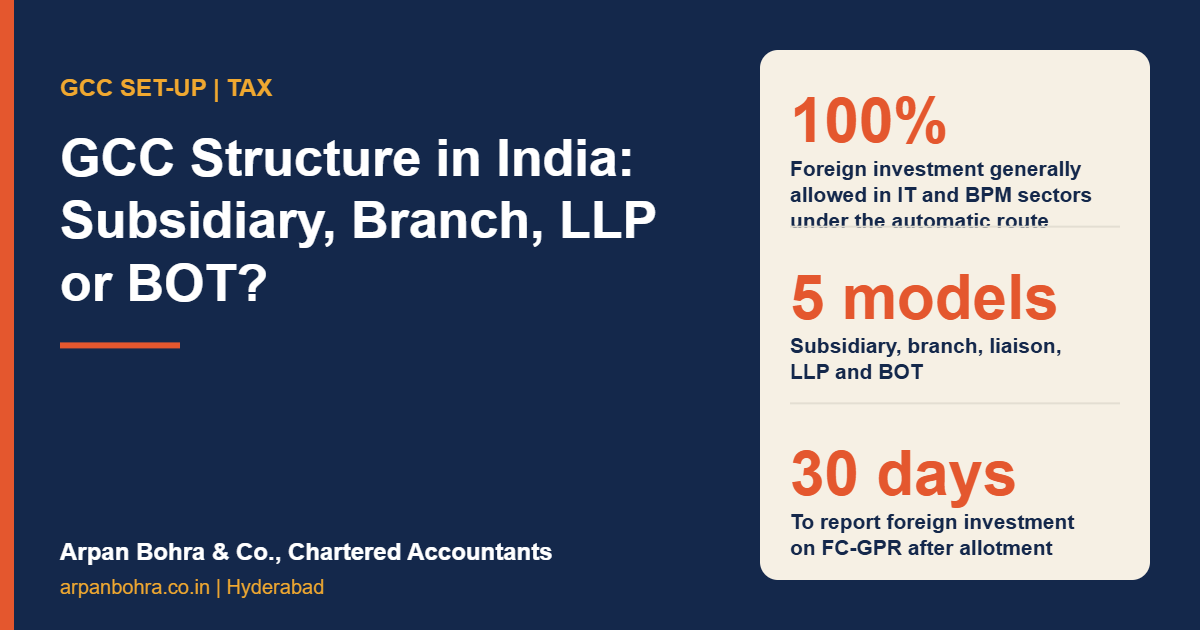
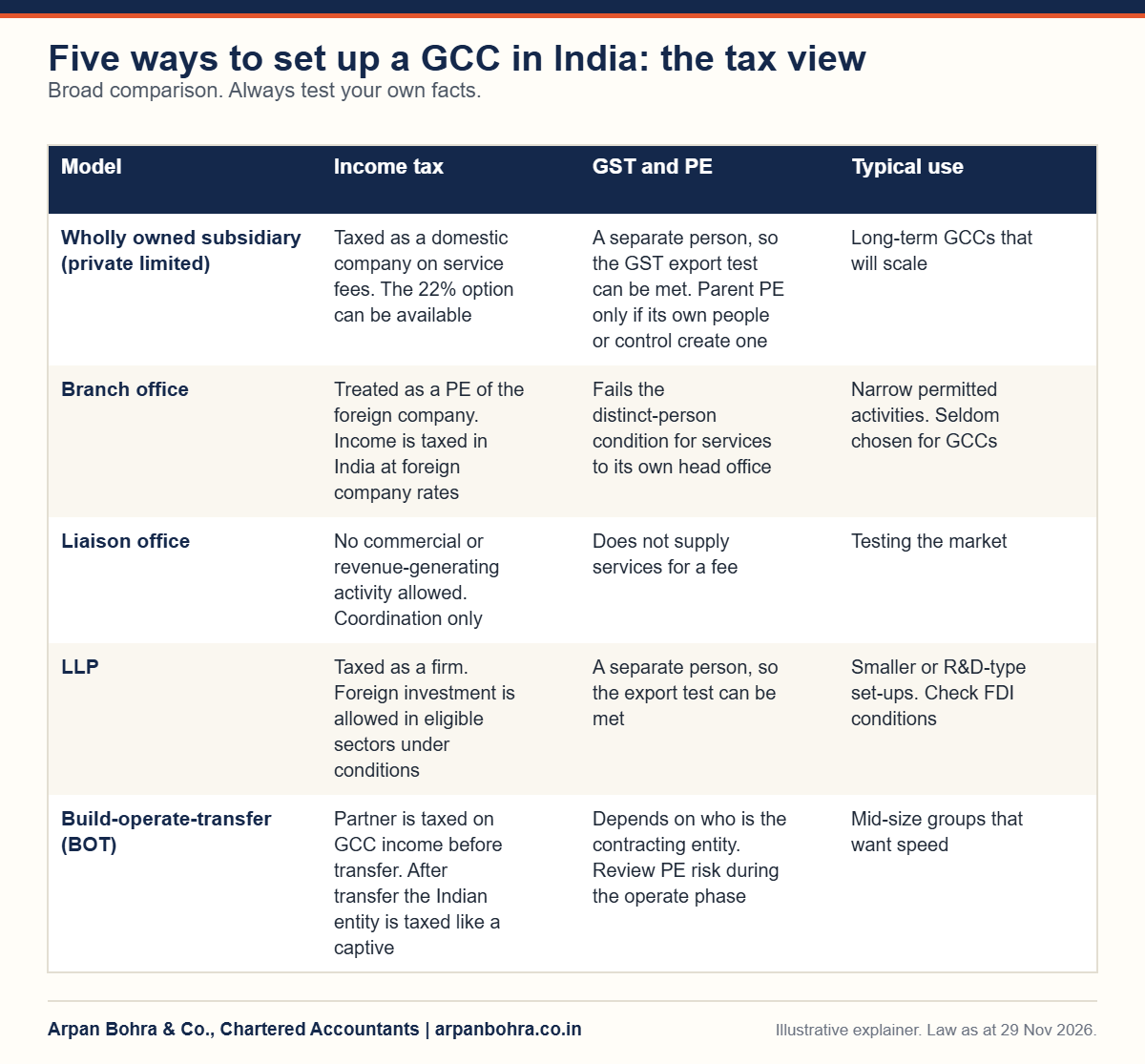
This is the usual route. Most IT services, software development, business process management, consulting and R&D sectors permit up to 100% foreign investment under the automatic route, subject to sector conditions. The subsidiary is taxed as a domestic company on the fees it earns from the group, with the option of the 22% regime (see Income-tax Act 2025 for GCCs). Its fees to the parent must meet transfer pricing rules (safe harbour guide).
FEMA reporting follows: shares must be allotted within 60 days of receiving the funds, Form FC-GPR is due within 30 days of allotment and the FLA return is due by 15 July each year. Our guide to FEMA foreign investment reporting covers the process.
Branch and liaison offices
A branch office of the foreign company is, for tax, a permanent establishment, and its income is taxed in India at the rates for foreign companies. Under GST, a branch and its overseas head office are establishments of a distinct person, so services to the head office may not qualify as exports (see GST on GCC services). A liaison office, by contrast, is limited to coordination and communication and cannot do commercial or revenue-generating work. Both are seldom the right fit for a scaling GCC.
LLP
A limited liability partnership is a separate legal person with flexible profit sharing. Foreign investment into LLPs is permitted in eligible sectors, subject to conditions, so check the sector rules before choosing it. Some groups use an LLP for a small or research-focused centre. A subsidiary is easier for credibility and for scaling.
Build-operate-transfer
In a BOT arrangement, a service partner builds the centre, runs it for an agreed period, and then transfers it to the parent. It suits mid-sized groups that want speed and lower start-up risk.
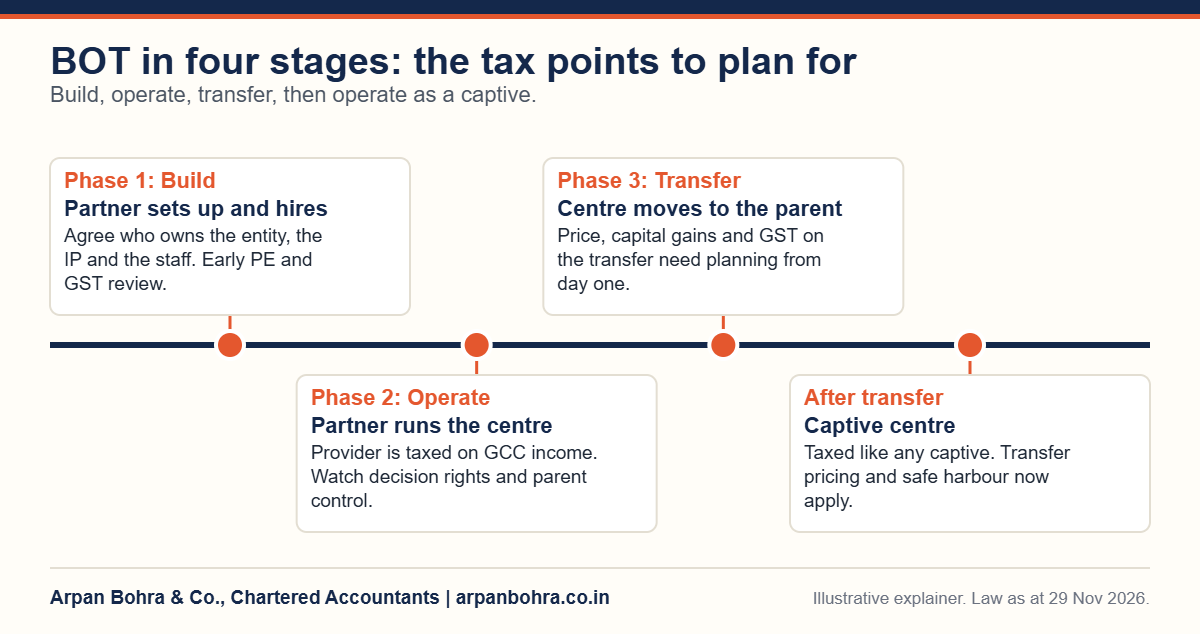
- Before transfer: the partner is taxed on its income from running the GCC. The parent’s Indian exposure is mainly PE risk, which rises if the partner exercises significant authority on the parent’s behalf. See PE risk for GCC parents.
- At transfer: the transfer of the entity or business can raise valuation, capital gains and GST questions. Agree the transfer terms at the outset.
- After transfer: the Indian entity is taxed like any captive centre.
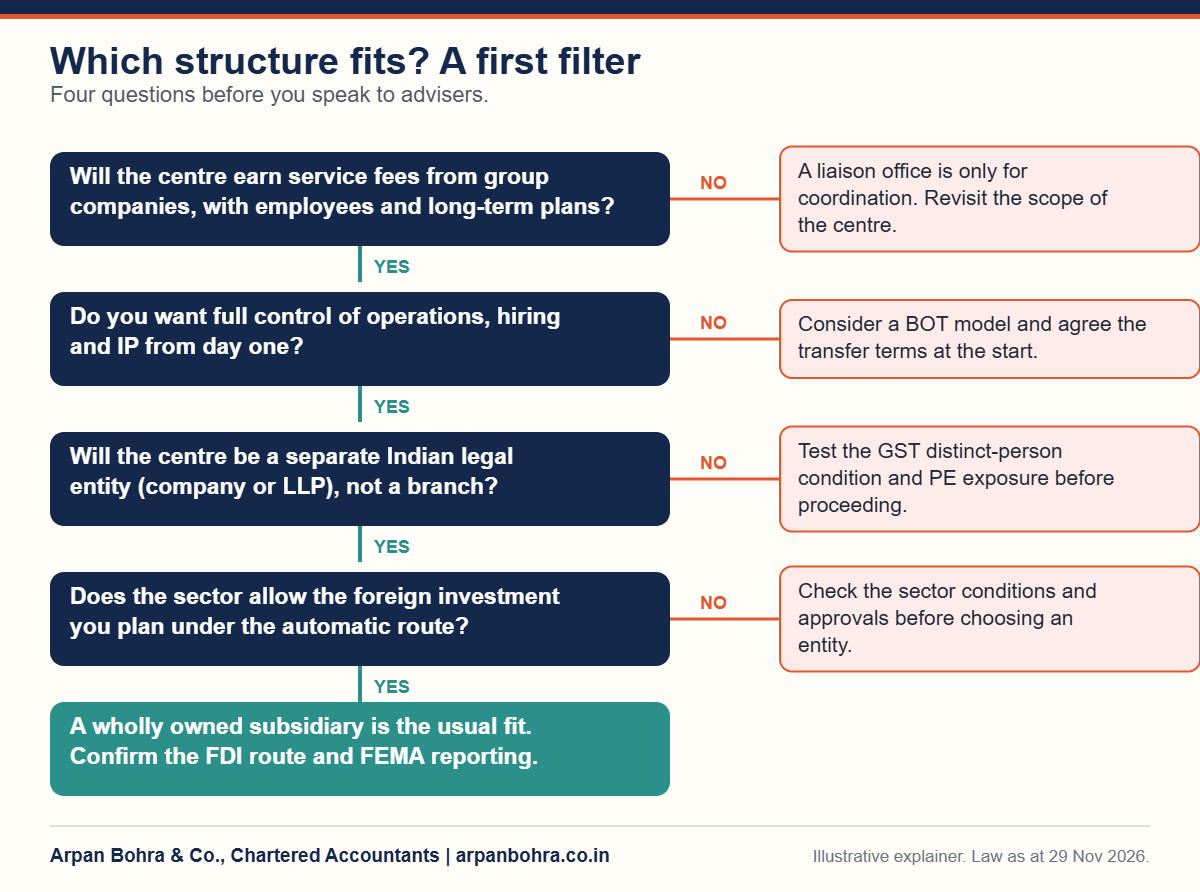
A first filter
- Choosing a branch because it looks simpler, then discovering the GST and PE consequences.
- Using BOT without agreeing the transfer price and tax cost at the start.
- Starting the sector and FDI check after the entity is incorporated.
- Forgetting the FEMA filings after the first capital infusion.
Frequently asked questions
Is a subsidiary or a branch better for a GCC?
For most GCCs, a subsidiary. A branch is treated as a PE of the foreign company and can fail the GST export test for services to its own head office.
Can a GCC be an LLP?
Yes, in sectors where foreign investment into LLPs is permitted. Check the sector and conditions first.
What is the tax risk in a BOT model?
Before transfer, the parent’s main exposure is PE risk. At transfer, valuation, capital gains and GST questions can arise.
Does the choice affect the 22% tax regime?
The 22% regime is available to domestic companies, so it is relevant to subsidiaries. A branch of a foreign company is taxed at foreign company rates.
Is a Hyderabad location relevant to the structure?
The structure rules are national. A Hyderabad centre registers its company and GST in Telangana and can sit in locations such as Kondapur, Gachibowli, HITEC City and Kokapet.
Takeaway. The structure sets the ceiling for everything that follows: how the GCC is taxed, whether its services are exports and whether the parent is exposed in India. Choosing it deliberately is cheaper than correcting it later.
Arpan Bohra & Co., Chartered Accountants, Hyderabad. Website: https://www.arpanbohra.co.in/ | Email: ab@arpanbohra.co.in. For general information only. Tax and exchange-control law changes frequently and outcomes depend on facts, so consult a qualified professional before acting.
This article is for general information and is not professional advice. Law and rates change; please consult us before you act.